Dora Bunner’s poisoning
A Murder Is AnnouncedDora Bunner’s poisoning is the murder concealed within a familiar domestic routine: after mislaying her aspirin, Dora takes tablets from a bottle beside Letitia Blacklock’s bed and dies in her sleep. The remaining tablet is identified as not aspirin, and the doctor suspects narcotic poisoning. Because the household had hosted a birthday party the previous day, the discovery raises the possibility that someone had substituted the tablets during an ordinary visit upstairs.
The Missing Aspirin
The sequence begins with Dora’s uncertainty about where she has put her medicine. She cannot find her own aspirin and says that she knows she has a new bottle somewhere. Phillipa Haymes offers tablets from the bottle on her dressing table, while Julia Simmons remarks that there is plenty of aspirin in the house. Dora retreats upstairs still vexed at having misplaced her own supply. These exchanges establish both her confusion over the bottle’s whereabouts and the ease with which aspirin could be obtained in the house.
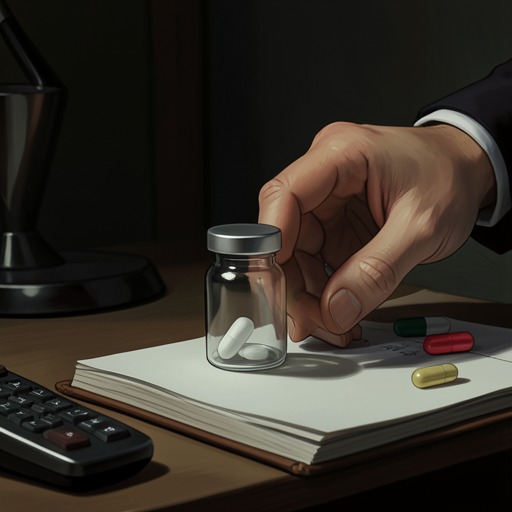
Later, Dora says she cannot find her aspirin and accepts the suggestion that she use some of Letitia’s, kept beside Letitia’s bed. She takes two tablets and leaves one in the bottle. The difference between the medicine she expects and what she takes is the fatal hinge of the episode: the bottle appears to offer a routine remedy, but its contents have been replaced.
Discovery and Medical Findings
Dora is found dead in her bed the next morning. The doctor says she died in her sleep; although her health had been poor, he does not consider the death natural and suspects narcotic poisoning. The surviving tablet is sent for analysis, and the doctor reports that it is definitely not aspirin. The evidence thus connects the mistaken-looking act of taking medicine with a deliberately altered bottle, while the analysis gives the police a material clue beyond the circumstances of Dora’s death.
The report does not immediately identify who prepared the tablets or when the substitution occurred. The bottle was beside Letitia’s bed, but the fact that Dora took from it does not itself establish that Letitia knew its contents had been changed. The investigation instead has to consider who could have reached the medicine and how recently the substitution might have been made.
Opportunity and Investigation
The police note that all the relevant people had been at the house the previous day for a birthday party for Dora. Any of them, the account observes, could have gone upstairs and substituted the tablets; someone who lived in the house could also have done so earlier. The party therefore supplies a recent shared opportunity, but does not by itself distinguish among the people present.
The broader investigation is already shaped by the difficulty of trusting confident recollection. During questioning about the earlier hold-up, Craddock remarks that witnesses will all have seen something different, and the inquiry recognizes that people may believe they saw details they could not actually have perceived. Dora’s increasing forgetfulness is also treated separately from the accuracy of particular observations: in another discussion, Miss Murgatroyd is described as flustered and contradictory, but those traits are not taken as automatic proof of guilt. Against that background, Dora’s poisoning is established through concrete particulars—the bottle, the two tablets, the tablet left behind, and the medical finding—rather than through an assumption that a witness’s general account must be reliable.
Consequences and Significance
Dora’s death changes the investigation from a case centered on the apparent shooting into one that includes a second, concealed killing. The ordinary aspirin bottle becomes a means of murder and a clue to access: several people had recently been in the house, and the medicine was kept in Letitia’s bedroom. At the moment of discovery, the evidence establishes poisoning and a field of opportunity, but not the identity of the person responsible.
The episode’s force lies in the contrast between Dora’s domestic, almost apologetic search for a misplaced remedy and the police’s later recognition that the tablets were not what she believed them to be. Her own absent bottle leads her to someone else’s supply; the remaining tablet, the small remnant of that exchange, gives the investigation a testable object. The poisoning makes clear that in this household the familiar and readily shared can conceal a deliberate substitution.