Inheritance and greed
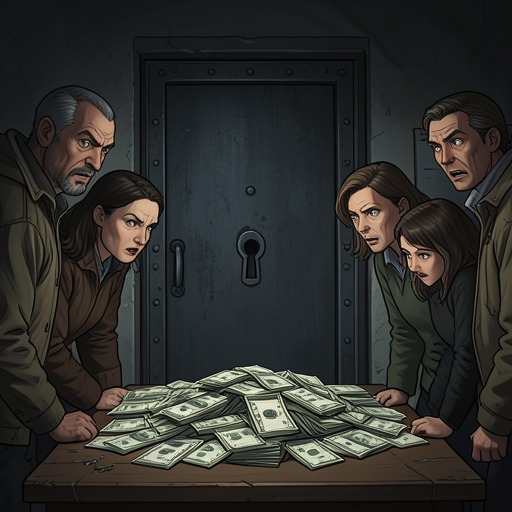
A Murder Is AnnouncedInheritance and greed are inseparable in the mystery because Randall Goedler’s will makes a large fortune depend on who outlives whom and on the identity of a little-known branch of his family. The arrangement appears straightforward while Letitia Blacklock is expected to inherit, but a contingency clause redirects the estate to Sonia Goedler’s children if Letitia dies first. That legal condition makes family history actionable: possible heirs become suspects, uncertain identities become consequential, and the prospect that Belle Goedler may die soon gives the financial question a deadline.
The Will and Its Contingency
Randall Goedler died wealthy after repeatedly risking much of what he earned on new ventures. He had no children, and his fortune was placed in trust for his wife, Belle Goedler, during her lifetime, with the estate passing to Letitia Blacklock after Belle’s death. Letitia had served as Randall’s secretary, and the will’s provision made her the principal expected beneficiary, but not the only person whose interests depended on the order of deaths.
Letitia explains that if she dies before Belle, the fortune would instead go to the legal offspring of Randall’s only sister, Sonia. Randall had quarrelled with Sonia after she married Dmitri Stamfordis, a man Randall regarded as disreputable. Letitia recalls that Belle was responsible for having Sonia’s children added as contingent beneficiaries. When Randall initially rejected the idea of allowing Sonia’s husband to inherit, Belle proposed that the money go to the children instead; Randall grumbled but agreed to include them. The condition therefore reflects both a family rupture and an attempt to keep the fortune from passing directly to Dmitri.
The possible heirs are known as Pip and Emma, but for years their whereabouts and even their survival are uncertain. Belle and Letitia have heard nothing from Sonia or her children; Belle says they could be dead or anywhere. The will’s language gives the children a clear legal claim if the required sequence of deaths occurs, yet the absence of reliable information about them makes that claim a mystery in its own right.
A Fortune with a Deadline
When Inspector Craddock asks what would happen if Letitia predeceased Belle, Letitia admits she has scarcely considered it and initially answers that Pip and Emma would probably inherit. She also argues that Patrick Simmons and Julia Simmons would have little reason to kill her for money if they could simply wait a few more weeks. Her reasoning depends on an assumption about timing: if Belle dies first, Letitia stands to receive the fortune, so a potential claimant would not need to risk murder before that event.
The police see the same inheritance condition as a source of urgency rather than reassurance. Rydesdale points out that Belle is dying and could die at any moment; whoever hoped to gain from Letitia’s death could not safely wait. At the same time, the original plan has failed, the people under suspicion are being watched, and the police are checking their histories. Those obstacles make a new attempt harder to carry out without suspicion, but the large sum at stake gives the investigation reason to treat the danger as real.
The will thus creates competing calculations around a single uncertain interval. Letitia reasons that waiting would be more sensible for anyone seeking her inheritance, while the investigators recognize that Belle’s declining health may make delay dangerous for anyone whose claim depends on Letitia dying first. The same clause that appears to make the motive legible also complicates it: the value of an action changes with the order in which two women might die.
Greed and Self-Justification
In conversation with Bunch Harmon, Jane Marple acknowledges that people may do terrible things to obtain a great deal of money. Bunch imagines how a person might tell herself that wealth would fund charitable projects, homes for unwanted children, help for tired mothers, or rest abroad for elderly women who had worked too hard. The imagined good works do not remove self-interest; they offer it a more flattering account of itself.
Bunch recognizes the danger in that reasoning. Someone who wants money for plainly selfish purposes may at least understand what she is doing, whereas a person who persuades herself that the money will serve others may come to treat murder as an acceptable cost. Her reflection gives the inheritance plot a moral dimension beyond the question of who qualifies under the will: the capacity to disguise private appetite as public benefit can make greed harder to recognize, even to the person acting on it.
The scene also sets that self-deception against a respect for life that Bunch articulates through a small, careful gesture: she rescues a fly from the dregs of her coffee and places it on the table to dry. She says that people want to live even when they are old, in pain, or able to do little more than reach the sun. Her words do not solve the financial mystery, but they establish the human value the inheritance contest puts at risk. Money may be imagined as a means of doing good; the desire to live cannot be reduced to its usefulness or convenience.
Heirs, Suspicion, and Exposure
As the investigation turns to the contingent beneficiaries, identity becomes inseparable from financial motive. Julia Simmons is revealed to be Emma, one of the heirs, while Edmund Swettenham is suspected of being Pip. Craddock argues that, if Letitia died before Belle, the two people known as Pip and Emma would inherit; he suggests that Edmund might want to marry a rich woman and therefore have a motive to ensure Letitia died first.
Edmund rejects the accusation and says he can establish his own identity through his birth certificate, schooling, and university records. Phillipa Haymes then identifies herself as Pip. She says that Letitia has treated her well, that she did not try to kill her, and that Edmund need no longer be suspected on the mistaken premise that he is the heir. The exchange separates the question of legal inheritance from the detective’s earlier assumptions about who might benefit: Emma’s identity is established, and Pip is not Edmund but Phillipa.
The inheritance scheme therefore generates suspicion without making every suspected person guilty. Its clauses explain why the police scrutinize possible heirs and why the approaching death of Belle matters, but family status and financial opportunity do not by themselves prove an attempt on Letitia’s life. The investigation has to distinguish the fortune’s actual beneficiaries from people merely thought to be beneficiaries, and then distinguish motive from responsibility.
The Theme’s Narrative Function
The estate’s conditional transfer turns inheritance into more than background information. It organizes the novel’s timetable, supplies a concrete reason to investigate the identities of Pip and Emma, and gives the police a basis for fearing that another attempt may follow after the first plan fails. The will’s details also produce a chain of reversals: Letitia’s apparent position as certain heir is qualified by the contingency; the unknown children become relevant because Belle may die; and the search for those heirs leads to mistaken suspicion of Edmund before Phillipa’s identity is disclosed.
At the same time, the novel places legal entitlement beside moral language. Randall’s hostility to Dmitri, Belle’s intervention for Sonia’s children, and Bunch’s imagined charities all show that the meaning of a fortune is argued over as well as allocated. A will can specify who receives wealth, but it cannot determine whether a claimant deserves it, what the money will be used for, or how far someone will go to obtain it. The danger grows precisely because the eventual inheritance is both immense and conditional, while the people who might benefit can tell themselves different stories about why it should be theirs.