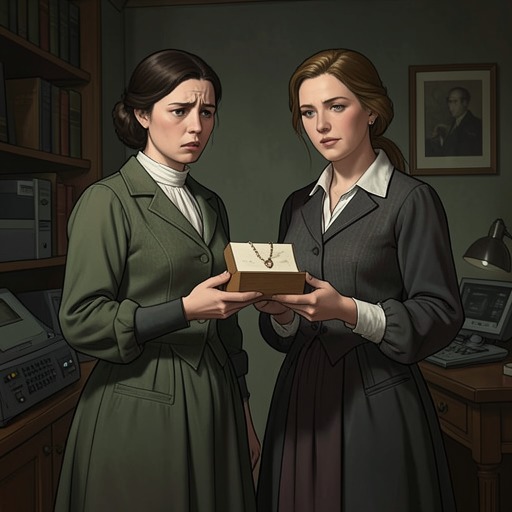
Letitia Blacklock · Charlotte Blacklock
A Murder Is AnnouncedLetitia Blacklock / Charlotte Blacklock names two sisters whose resemblance conceals a decisive moral difference: the real Letitia is remembered as a woman of exceptional integrity, while Charlotte takes her name after her death and uses that borrowed identity to claim the inheritance. The distinction between them turns the will’s conditional bequest into the motive and machinery of the mystery.
Identity and Background
Letitia trained as a chartered accountant after breaking away from a difficult childhood dominated by a narrow, tyrannical father. Her sister Charlotte was an invalid, disfigured, and withdrawn from social life. When their father died, Letitia abandoned her professional life to care for Charlotte, treating that obligation as a duty that could not be set aside.
Before returning to her sister, Letitia worked for Randall Goedler. He relied on her judgment, and she repeatedly kept him from trouble. His judgment of right and wrong could be unreliable: he did not always recognize the boundary between clever dealing and dishonesty. Letitia did, and her integrity made her an ethical counterweight to his carelessness. She also once rescued him financially, but her influence on him extended beyond money.
The sisters’ appearance and circumstances later made their identities unusually easy to confuse. They were elderly Englishwomen with a strong family resemblance, and few people had known Charlotte well. That resemblance supplies the practical opening for the impersonation; it does not erase the difference in character that the revelation exposes.
The Goedler Inheritance
Randall died wealthy and childless, leaving his fortune in trust for his wife, Belle, for her lifetime, with the estate passing absolutely to Letitia after Belle’s death. The arrangement made Letitia the expected beneficiary, but the order of deaths mattered. If Letitia died before Belle, the fortune would instead pass to the legal descendants of Randall’s sister, Sonia.
Belle had pressed Randall to provide for Sonia’s children in that contingency. Randall objected to the prospect of Sonia’s husband, Dmitri Stamfordis, receiving his money, but agreed that the children—Pip and Emma—could inherit. Belle later explained that the provision was her own suggestion: she had raised the possibility of Letitia dying first, and Randall reluctantly put the alternative heirs into the will. The family had then vanished from their knowledge; Belle did not know whether Sonia or her children were alive or where they might be.
This contingency made the inheritance more than a simple gift to a faithful employee. Letitia’s presumed survival would make her the beneficiary; her prior death would redirect the money to Sonia’s descendants. The legal sequence of deaths therefore created competing stakes around identity and kinship, even when the people named as possible heirs were absent from the sisters’ lives.
Charlotte’s Impersonation
After the operation that corrected Charlotte’s deformity, the scar could be hidden beneath a choker of pearls or beads. Letitia took Charlotte to Switzerland to seek medical advice, and the operation succeeded. During the war, returning to England was difficult, and the sisters remained in Switzerland, doing Red Cross and other work.
Charlotte’s substitution of identities began when Letitia died and was buried under Charlotte’s name. Charlotte returned to England as Letitia. In Miss Marple’s reconstruction, the change may have been an impulse rather than a fully formed plan: Charlotte had long lived in her sister’s shadow, then assumed the authority and initiative associated with Letitia’s life. She did not regard the inheritance as wholly separate from herself, reasoning as though she and Letitia were one and the money was meant to come to Letitia soon.
The impersonation depended on ordinary details as much as on resemblance. Charlotte bought a house in a part of England unknown to her, avoiding people in her native Cumberland who might recognize her and, especially, Belle, who had known Letitia well. Arthritis in her hands helped explain handwriting differences; the scar from the operation remained covered by the pearl choker. Because few people had known Charlotte, the outward signs that might have exposed the substitution were limited.
Character, Evidence, and Exposure
Belle’s recollections establish the contrast on which the deception depends. She considered Letitia a fine and completely honest person, someone who would never have contemplated fraud. Miss Marple likewise describes Letitia as devoted to Charlotte and recalls that she gave up her position with Randall to care for her sister. Charlotte, by contrast, could treat a sudden expedient as not really wrong and collapse the moral boundary between her own claim and Letitia’s.
The two identities are finally separated by the concealed physical evidence beneath the necklace. When Sergeant Fletcher moves to arrest the woman he calls Letitia, Miss Marple corrects him: she identifies her as Charlotte and points to the operation scar under the pearls, the mark left by the successful goitre operation. The choker that had helped maintain the appearance of continuity becomes the clue that reveals what it concealed.
The case also gives the inheritance mystery a precise human structure. Letitia’s reputation and the conditions of Randall’s will make the false identity plausible; Charlotte’s adoption of that identity turns resemblance into a means of control and concealment. By recovering the difference between the sisters, the investigation restores the distinction the impersonation tried to abolish: the real Letitia’s integrity cannot be inherited simply by taking her name.