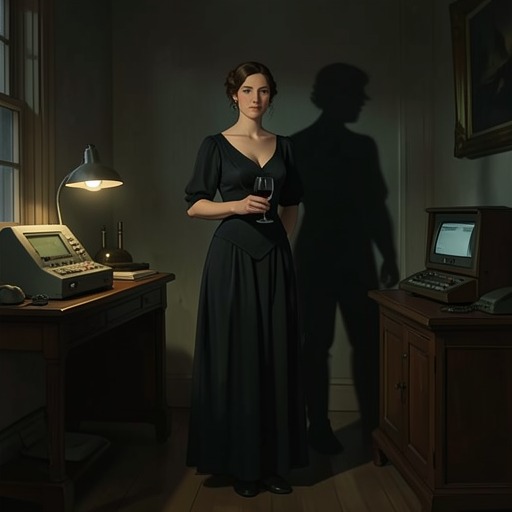
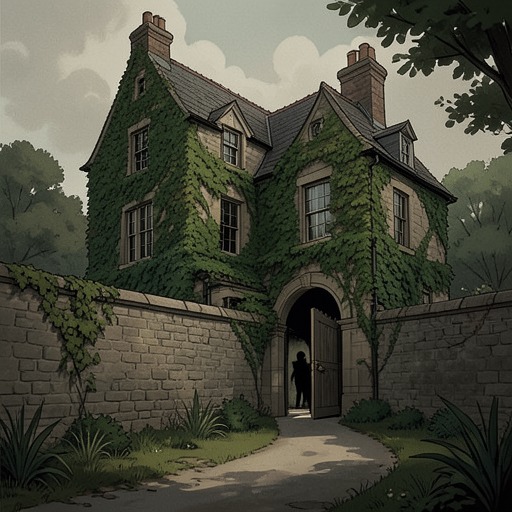
Little Paddocks drawing-room’s second door
A Murder Is AnnouncedThe Little Paddocks drawing-room’s second door is the quiet, concealed route that explains how the staged hold-up could disguise a real shooting. Its importance lies not simply in providing another way out: once oiled, it lets the attacker move between the drawing-room and the dark hall without being heard, while the guests watch the spectacle at the regular entrance. The door makes the room’s apparent sequence of events deceptive, and its preparation becomes evidence that the crime was planned from inside the household.
The Door and Its Preparation
The second door was not the drawing-room’s ordinary entrance. It was a door that was supposed to be nailed up, or otherwise kept closed, and it led into the hall. Someone had oiled it so that it could open without a sound. The preparation mattered because it gave the person responsible for the attack a way to leave the drawing-room unnoticed when the lights went out, rather than having to pass through the open, visible route used in the supposed hold-up.
Sergeant Fletcher recognized the door’s significance when he had Little Paddocks to himself. With Mitzi off duty and Miss Blacklock and Dora Bunner away in the village, he could search the house without interruption. He reasoned that whoever had oiled the door had done so to slip out of the drawing-room as soon as the lights failed. That inference narrowed the possibilities: Mitzi would have had no need to use the door, while Fletcher could see no practical opportunity for the neighbours to have prepared it. The search, however, yielded no supporting evidence in the wiring or electric fittings; the household bedrooms also seemed unremarkable. The door offered a strong explanation of the attacker’s route, but did not by itself identify who had prepared it.
How the Door Enables the Staged Hold-Up
The door’s function becomes clearer when the apparent robbery is tested against the physical difficulty of carrying it out. Miss Hinchcliffe points out that the regular drawing-room door swings shut. Letitia Blacklock had bought a heavy glass doorstop to hold it open, but an imagined robber entering with a revolver and torch could not easily manage the doorstop as well as the weapons and the business of ordering people to put their hands up. The supposed use of the doorstop therefore raises a practical objection to the straightforward version of events.
The second door supplies the answer. In the reconstruction Miss Hinchcliffe describes to Miss Murgatroyd, the apparent attacker opens the regular door dramatically and draws everyone’s attention to the torch and the hold-up. While the people in the room are watching that entrance, another person slips out through the oiled door into the dark hall. From there, the attacker comes up behind Rudi Scherz, fires at Letitia, and shoots Rudi. The revolver is left beside him, inviting the assumption that he was the gunman; the attacker then returns through the second door before anyone can properly see what happened. The quietly prepared door thus makes the visible performance possible by concealing the real movement behind it.
Clues, Misreadings, and the Investigation
The door is one part of a larger pattern of misleading appearances. Fletcher identifies the need for a silent exit but cannot find anything suspicious in the electrical installation that would explain how the lights were fused. The route and the blackout remain distinct problems: knowing that the door was prepared helps explain how someone could move unseen, but it does not reveal how the lights were made to go out or establish the culprit’s identity.
Dora Bunner’s confused recollection of a lamp gives Jane Marple another strand of the reconstruction. While waiting in the drawing-room, Marple recalls Dora’s belief that Patrick had tampered with a lamp to cause the blackout. She notices that the lamp in the room is a Dresden shepherd, adapted from a candlestick for electric light, and remembers that it belonged to a pair with a shepherdess. Dora had remembered the shepherdess as present on the night of the hold-up, whereas the shepherd stood there the next morning: the lamps had been switched overnight. This lamp clue concerns the blackout rather than the door itself, but, alongside the concealed route, it shows how small changes in the room’s familiar furnishings can expose the staged nature of the attack.
Narrative and Evidentiary Significance
The second door matters both as part of the crime’s mechanics and as a test of observation. At first, attention is drawn to the ordinary entrance, the torch, the revolver, and the apparent robber. The door that seems to have been closed off redirects the investigation from what the witnesses were made to watch toward the route they were not watching. Its silent operation explains how the attack could be staged, while its deliberate preparation establishes that the supposed hold-up depended on prior access to the house.
The clue does not solve the mystery alone. Fletcher’s search shows that a plausible route may be identified without yielding a decisive suspect, and the reconstruction to Miss Murgatroyd explains the method without naming the attacker. The door therefore functions as a physical explanation and a limit on inference: it makes the hidden movements intelligible, but has to be considered with the blackout, the switched lamps, and the misleading placement of the revolver to reconstruct the full deception.