Little Paddocks staged hold-up
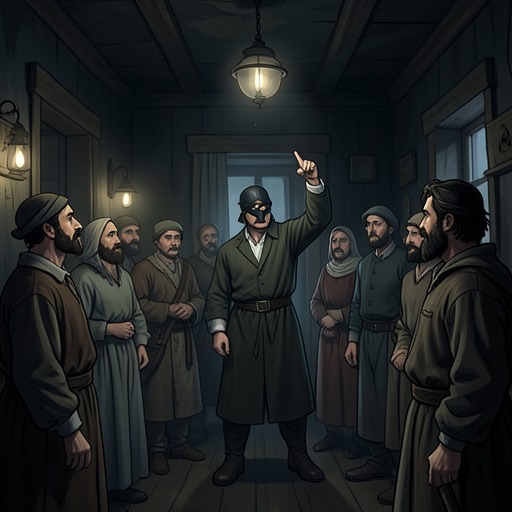
A Murder Is AnnouncedThe staged hold-up at Little Paddocks is the plan Charlotte Blacklock devised to kill Rudi Scherz while making his death appear part of an armed intrusion. She enlisted Rudi to act as the supposed gangster, advertised the event, and arranged his access to the house. During the staged confusion, Edmund Swettenham took Colonel Archie Easterbrook’s revolver and used the house’s carefully oiled second door to leave and return to the drawing-room. Yet the later reconstruction identifies Charlotte as the person who shot Rudi: the ostensible hold-up concealed a murder, and Rudi’s participation did not mean he understood the danger he faced.
Background and Motive
Charlotte had already established herself as Letitia Blacklock, including with the bank and Mrs Goedler. Maintaining that fraud made Rudi, a Swiss hotel clerk who had recognized her at the Royal Spa Hotel, a threat to her security. The recognition was the decisive change in her circumstances: before it, Charlotte could rely on her assumed identity; afterward, she feared that someone who knew her former identity might expose her.
The evidence does not present Rudi as knowingly attempting to blackmail Charlotte. He had no idea that he possessed information she feared, and Charlotte appears to have provided him money after he got into trouble at the hotel. His own expectation was simpler: he was a personable young man who had found that a convincing tale of hardship could persuade older women to part with money. The gap between his understanding of their dealings and Charlotte’s fear of exposure explains how she could recruit him without disclosing the real purpose of the plan.
The Plan and Its Participants
Charlotte told Rudi that she wanted a stranger to play the gangster in a sham hold-up at a party and offered him a generous payment to cooperate. She supplied the murder advertisement for him to place, asked him to visit Little Paddocks so that he could learn the house’s layout, and showed him where she would meet him and let him in on the night. Dora Bunner knew nothing of these arrangements, leaving Rudi’s role hidden from someone who was close to Charlotte and living in the house.
The staged nature of the episode therefore depended on dividing knowledge among its participants. Rudi accepted what he understood to be a paid performance, while Charlotte knew that the apparent game provided a way to remove him. In the later account, Edmund also emerges as a participant in the shooting episode: he took Colonel Archie Easterbrook’s revolver, followed Patrick Simmons into the far room, and used the blackout and the oiled door to get out of and back into the drawing-room. His actions formed part of the apparent confusion, but the account distinguishes them from Charlotte’s murder of Rudi.
The Shooting and Its Reconstruction
Mitzi’s later testimony undermines the story she had previously given about being in the pantry cleaning silver. She says she was already in the dining-room when she heard the gunshot, and that she looked through the keyhole. In the darkened hall, the gun sounded again; the falling torch swung around, and she saw Miss Blacklock near Rudi with a gun in her hand. That sighting supplies the crucial correction to the apparent account of the shooting: Charlotte was present with the weapon, despite her immediate denial that Mitzi could have seen her.
Inspector Craddock then turns the same evidence toward Edmund. He explains that Mitzi could not have seen Miss Blacklock in the position she described if Edmund had been standing there with the gun. Craddock accuses Edmund of taking Colonel Archie Easterbrook’s revolver, arranging the business with Rudi as a joke, following Patrick into the far room, slipping out through the oiled door when the lights went out, shooting at Miss Blacklock, killing Rudi, and returning to the drawing-room to click his lighter. The accusation and Mitzi’s testimony are parts of the reconstruction of the staged episode; they do not erase the later account’s identification of Charlotte as the killer who arranged the plan and shot Rudi.
Exposure and Significance
The plot’s central reversal lies in the difference between appearance and purpose. Rudi seems to be the intruder at the centre of a theatrical hold-up, but he has been paid to enter the house and does not know why Charlotte wants him there. The performance creates a public explanation for his presence while giving Charlotte an opportunity to kill him and make the shooting look like part of the staged crime.
The episode also links the apparent crime at Little Paddocks to Charlotte’s assumed identity. Rudi’s recognition of her at the hotel turns a vulnerable deception into a source of fear; her response is not to bargain openly with a blackmailer but to construct an elaborate scene in which the man who recognized her appears to be an armed criminal. Once Mitzi speaks and Craddock reconstructs the movements through the house, the staged event becomes evidence against those who relied on its confusion. The hold-up’s failure is thus also the exposure of its concealed purpose: Rudi was recruited as a performer, but the performance was designed to disguise his murder.