Miss Hinchcliffe
A Murder Is AnnouncedMiss Hinchcliffe is a practical, forthright resident of Boulders, where she shares a home with her friend Miss Murgatroyd. Initially skeptical of the murder announcement at Little Paddocks, she later helps reconstruct the staged hold-up by testing its physical details and urging her friend to recover her memory. Her forceful manner contrasts with Miss Murgatroyd’s uncertainty, but the two women’s shared investigation becomes pivotal: a remembered gap in the drawing room reveals that Letitia Blacklock was not where the witnesses assumed she had been.
Identity and Life at Boulders
Boulders is a group of three cottages knocked into one, inhabited by Miss Hinchcliffe and Miss Murgatroyd. Miss Hinchcliffe has a short, cropped hairstyle and a weather-beaten appearance; she wears corduroy slacks and a battledress tunic. The practical work of the household suits her matter-of-fact manner: when Miss Murgatroyd finds her tending the henhouse, she is mixing balancer meal into cooked potato peelings and cabbage stumps.
The women’s home and routine connect them to the village’s informal network. Miss Hinchcliffe keeps pigs and is well acquainted with local farmers, a connection that helps her collect butter through a quiet barter arrangement. A note from Miss Blacklock about Thursday and leaving something in the usual place is explained by this system: farms share goods such as butter, cucumbers, and meat, sometimes outside formal rules. Miss Hinchcliffe’s ordinary errands and local relationships thus form part of the same network through which people enter one another’s homes and exchange provisions.
The Murder Announcement and the Hold-Up
When Miss Murgatroyd reads the announcement that a murder will take place at Little Paddocks on Friday, October 29, at 6:30 p.m., Miss Hinchcliffe dismisses it as daft. Her response is characteristic: she does not leap to speculation, and she punctures the suspense with a practical suggestion that the visit should at least include a drink. She later accompanies Miss Murgatroyd to Little Paddocks, where she greets Miss Blacklock with a firm handshake and asks about the ducks.
During the staged hold-up, Miss Hinchcliffe is standing by the mantelpiece, hoping someone will offer her a drink. In the darkness, the intruder’s powerful torch dazzles the people in the room as it moves around; Miss Hinchcliffe recalls the light sweeping about and the shots following. She does not claim to know whether the shots were carefully aimed, and her account preserves the uncertainty of a witness under strain. She remembers thinking that Patrick Simmons might be playing a dangerous joke with a loaded revolver, but cannot say from her impressions alone what actually happened.
That uncertainty matters to the investigation. The witnesses broadly believe they saw a masked man holding them up, although the lack of light in the hall means they could not have seen him as clearly as they suppose. Miss Hinchcliffe’s recollection of the torch and her position in the room becomes part of the larger distinction between what people confidently concluded and what their actual viewpoint allowed them to observe.
Reconstructing the Scene
After thinking over the incident, Miss Hinchcliffe tells Miss Murgatroyd that the whole arrangement was fishy. Rather than leave the problem at suspicion, she conducts a simple rehearsal. She asks her friend to tuck up her hair and use a trowel as a revolver, then has her try to imitate the intruder. Miss Murgatroyd finds the task difficult because the door swings back while she has both hands occupied.
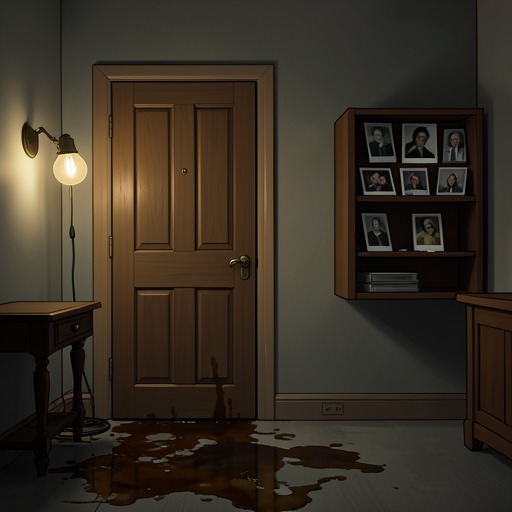
The rehearsal brings Miss Hinchcliffe to a concrete feature of the Little Paddocks drawing room: its door would not stay open. Miss Blacklock had bought a heavy glass doorstop to hold it, an object Miss Hinchcliffe remembers particularly well because she had been trying to buy it herself. Her recollection is not an abstract theory about the crime but a practical observation about how a person could enter and keep the door open while appearing to hold a weapon and a torch. The details of the room, the door, and the doorstop let her test the supposed sequence against the actual arrangement.
Miss Hinchcliffe’s own evidence also shows the limits of a witness’s first account. At the time of the shooting she was watching the darkness and the moving torch from the mantelpiece; later, she recognizes that the reconstruction needs more than the general impression of a masked figure. Her method is to examine what a person’s position and hands would permit, then use that constraint to question the accepted story.
Miss Murgatroyd’s Memory and the Discovery
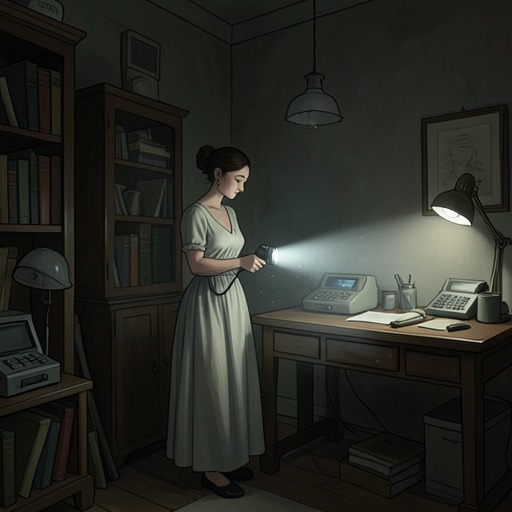
The central development in Miss Hinchcliffe’s part of the investigation comes at Boulders, in the dim living room where the two friends argue over Miss Murgatroyd’s inability to remember the shooting. Miss Hinchcliffe insists that her friend must try because otherwise no one can recover what she saw. She reasons that Miss Murgatroyd had been standing behind the door, with the door between her and the torch. Unlike the other people in the room, she was not looking into the glare; she faced the same way as the torch and might have seen what its beam briefly illuminated.
Miss Hinchcliffe’s prompting helps Miss Murgatroyd move from the belief that she saw nothing to the possibility that she registered details without understanding their importance. The light had passed across the room, illuminating faces, furniture, and the wall. In retrospect, Miss Murgatroyd’s memory includes the space where Letitia Blacklock was later understood to have been shot: at the decisive moment, that place was empty. The remembered absence, rather than a clearly recognized person, becomes the key observation.
Miss Marple later explains that Miss Hinchcliffe had been urging her friend to remember when Charlotte Blacklock overheard their conversation through an open window. Charlotte realized that someone else might have observed the scene and that Miss Murgatroyd was approaching the truth. The recollection Miss Hinchcliffe helps elicit therefore has consequences beyond solving the original deception: it makes her friend a danger to the murderer.
Loss and Narrative Significance
When Miss Hinchcliffe returns and finds Miss Murgatroyd dead, her response is controlled but fierce. She looks down at her friend and vows to kill whoever was responsible if she gets hold of her. Her immediate understanding that the killer was a woman comes from what Miss Murgatroyd had called after her as she left for the station. Miss Hinchcliffe explains that the clue was in the wording, and bitterly recognizes that if she had stayed to listen, the danger might have been understood sooner. Miss Marple tells her not to blame herself; the missed opportunity cannot be undone.
Miss Hinchcliffe’s forcefulness and practical intelligence make her more than a colorful witness. Her questions about the door and her insistence on testing the hold-up help turn an unreliable general impression into a problem of sightlines, objects, and bodily position. Her friendship with Miss Murgatroyd also gives the reconstruction its emotional stakes: the effort to remember is at once an act of loyalty and the means by which the hidden crime is exposed. The murder of Miss Murgatroyd shows how dangerous that recovered knowledge becomes, while Miss Hinchcliffe’s response registers the personal cost of the investigation.