Miss Marple deduces Rudi was a fall guy
A Murder Is AnnouncedJane Marple deduces that Rudi Scherz was a paid fall guy by separating what the witnesses actually perceived in the darkness from what they later believed they had seen. Her reconstruction turns the apparent armed hold-up into a staged performance: Rudi was sent to frighten the household, but another person fired the fatal shots and left the revolver beside him, making the hired intruder appear to be the assailant. Marple identifies the deception’s logic without naming its organizer, directing the police to ask Miss Blacklock who wanted her dead.
The Witnesses’ Certainty and Its Limits
The inquiry begins with conflicting accounts of a brief, highly charged scene. Craddock observes that each witness will have seen something different, while the preliminary medical report cannot establish whether the revolver discharged accidentally or deliberately. This uncertainty makes the witnesses’ descriptions important, but not automatically dependable: their agreement that a masked man entered with a revolver and torch may reflect a shared interpretation rather than a shared, clear view.
Marple’s key step is to challenge the apparent certainty of those accounts. Craddock states the accepted version—that the witnesses saw a masked man hold them up—and Marple answers that they might not have seen anything of the kind. With no light in the hall or on the landing, a person standing in the doorway and shining a powerful torch into the room would leave the occupants able to see little beyond its beam. Craddock confirms that he has tested this effect. The dazzling light supplies a concrete reason why the witnesses could not reliably distinguish the entrant’s features or what he held.
Their later accounts are therefore not a simple record of immediate perception. Marple proposes that witnesses who described the masked man were reconstructing the scene after the lights came on, incorporating what they then saw into their recollections of the moment itself. The torch had shaped their attention; subsequent observation and retelling supplied a more definite picture than the darkened room had allowed. The apparent consensus was thus compatible with a crucial absence of direct visual evidence.
Reconstructing the Staged Hold-Up
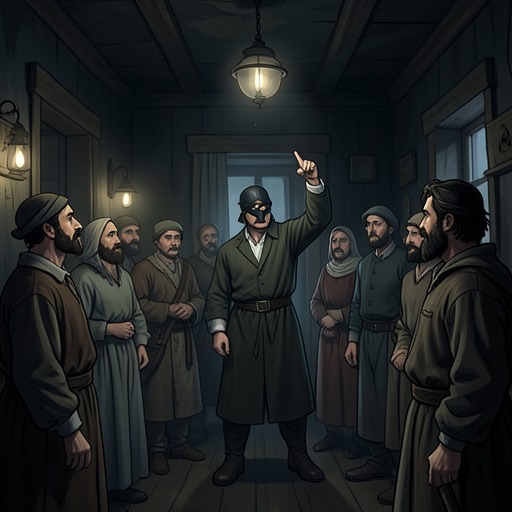
Marple interprets the incident as an arrangement for which Rudi was recruited and paid. In her account, he placed a newspaper advertisement, inspected the household premises, and then came on the appointed night wearing a mask and black cloak. He was to throw open a door, brandish a torch, and call out a demand. The performance was intended to resemble a conventional hold-up, making its visible elements easy for witnesses to describe afterward even though the glare prevented them from seeing the scene clearly as it happened.
The crucial distinction is that Rudi, in Marple’s theory, did not have a revolver. The witnesses’ claims that they saw one cannot establish that he carried it, because they could not see past the torch well enough to verify what was in his hand. Instead, Marple proposes that someone approached him quietly in the darkness and fired two shots over his shoulder. Frightened, Rudi turned; that second person then shot him and let the revolver fall beside him. The weapon’s position could consequently make Rudi seem responsible for the shooting, while the order of events points to another shooter.
This reconstruction turns the hold-up from an isolated act of violence into a means of concealment. The mask, cloak, torch, shouted demand, and apparent weapon made Rudi’s role legible to the witnesses as that of an armed attacker. Yet the very torch that made the scene look like a familiar robbery also prevented them from seeing it accurately. Marple’s solution rests not on dismissing the testimony wholesale, but on distinguishing what witnesses could observe from what they inferred afterward.
Naming the Fall Guy, Not the Killer
Marple calls Rudi a fall guy: someone paid to take the blame for a crime committed by another. She regards him as credulous enough to believe that the planned intrusion was a joke, while still understanding that he was paid to advertise the event and reconnoitre the house. The distinction matters: in her account, his participation explains why he entered in disguise and staged a threat, but does not make him the person who fired the fatal shots.
The theory also explains how a planted appearance could survive the witnesses’ uncertainty. Once the lights returned, the household could connect the masked entrant, the revolver lying beside him, and the shooting into a single apparent sequence. Marple instead separates those details and places a second, unseen person between them. What looked like proof that Rudi had attacked the household becomes the cover under which he himself was killed.
Marple does not identify the person who came up behind Rudi. When asked who this Mr X might be, she says the police will have to find out from Miss Blacklock who wanted to kill her. The deduction therefore resolves Rudi’s apparent role while leaving the central question of responsibility open: the staged attack was, in Marple’s view, a deliberate attempt on Miss Blacklock’s life, and the person who arranged it remains to be exposed.
Observation, Memory, and the Missing Person
The deduction belongs to a wider pattern in which precise observation depends on circumstances, not merely on confidence. The participants’ testimony diverges under the strain of the incident; one witness is described as flustered and contradictory, while Marple insists that a dazzling torch made clear vision impossible for those facing it. She also points out that a person standing behind the door would have a different view: the door blocked the torch, leaving that observer less dazzled than the others. Position and obstruction could therefore determine what each person was capable of noticing.
Marple’s later explanation of Miss Murgatroyd’s recollection makes the same distinction between seeing and understanding. Recalling how a shock can leave someone with a sharp memory of an incidental detail, she reasons that Miss Murgatroyd mentally followed the torch across the room, past its occupants and furnishings. In that reconstruction, the significant memory was not simply the sight of the shooter. It was the vacant place where Letitia Blacklock had later been assumed to stand when she was shot: at the moment of the shots, Letitia was not there. That separate deduction deepens the importance of Marple’s method. A witness may retain an accurate fragment without grasping its meaning at once; the investigator must recover both the fragment and the conditions under which it was seen.
Marple’s account thus gives the reader a method for revising apparently settled evidence. The witnesses’ confidence is not treated as proof of deception or as proof that they saw nothing whatever. Instead, their limited sight, later reconstruction, and differing positions explain how they could report a masked gunman while failing to see the person who actually controlled the shooting. The fall-guy theory transforms that gap in perception into the central clue: Rudi’s visible role was arranged to attract blame, while the unseen second person remains the real target of the investigation.