Murder Game
A Murder Is AnnouncedThe Murder Game is a parlour role-playing game in which participants draw secret parts, an apparent murder takes place in darkness, and a designated detective questions the players. At Little Paddocks, its conventions supply a ready-made explanation for an alarming interruption: the guests expect a game, so a staged hold-up can initially pass as part of the entertainment. The same darkness, torchlight, and divided attention that make the scene seem theatrical later expose how little the witnesses could reliably have seen.
The Game as the Guests Understand It
Before the gathering, Edmund Swettenham offers a hazy account of the game: players draw roles, one becomes the victim and another a detective, and the lights go out while the victim pretends to be dead. Mrs Swettenham finds the idea odd when she sees the newspaper announcement, and Edmund is unsure how the game is organized. His description nonetheless establishes the essential expectation: a simulated crime is to happen in a domestic setting, under the cover of play.
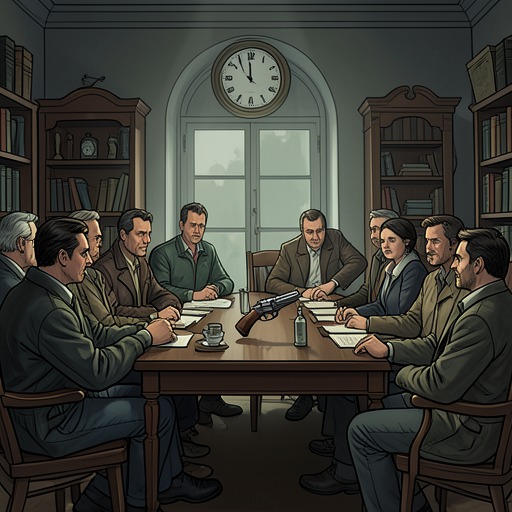
Colonel Archie Easterbrook gives a more confident version. Participants draw lots; one is secretly assigned as murderer, the murderer chooses a victim after the lights go out, and the victim waits before crying out. The chosen detective then takes charge, asking everyone where they were and what they were doing in an effort to identify the real culprit. Archie presents police experience as an advantage in playing the detective, making the game resemble a small rehearsal of investigative procedure. The contrast between Edmund’s uncertainty and Archie’s orderly account shows that the name covers a recognizable format, but that its success depends on organization and the players’ willingness to perform their parts.
The Announcement and the Blackout
The newspaper advertisement makes the game’s premise unusually stark. It announces that a murder will take place at Little Paddocks on Friday, October 29, at 6:30 p.m., and tells friends that the notice is their only intimation. When Dora Bunner points it out, Letitia Blacklock reads it aloud and immediately asks Patrick Simmons whether it is his idea. The announcement thus arrives not as a neutral invitation but as a puzzle about who has arranged the entertainment and what the wording means.
At the appointed gathering, the mantel clock chimes the quarter and then the half; as its final note fades, the lights go out. The guests respond as if the expected performance has begun. Mrs Harmon expresses delight, while Dora says she does not like it; other voices register unease, ask what to do, or call for Archie. The change from a public announcement to a sudden blackout turns the game from an abstract proposal into a shared scene, in which no one has a clear view and each person reacts from a different position.
A Play-Acted Hold-Up and Its Evidence
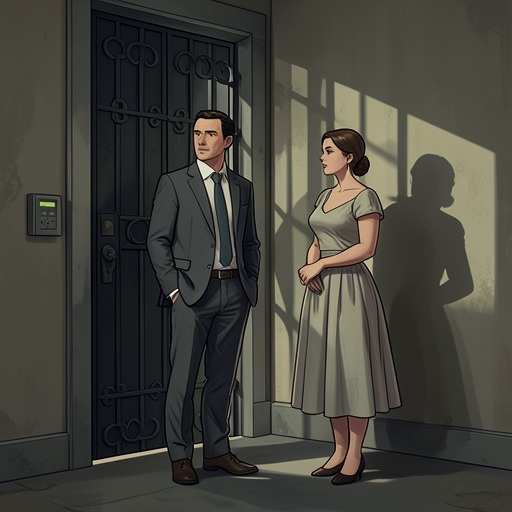
The apparent entertainment becomes cover for a real hold-up at Little Paddocks. When the police review what the guests say they witnessed, their accounts differ in detail, but the assumed outline is remarkably firm: they believe a masked man carrying a revolver and torch opened the door and held them up. Craddock points out the difficulty of reconciling what people report seeing during intense excitement. Jane Marple challenges the assumption beneath the accounts: if the hall and landing were unlit, the witnesses may not actually have seen the supposed intruder at all.
The torch helps explain the contradiction. Miss Simmons is asked whether the man held it steadily or moved it; the beam, described as dazzling, made people blink. Jane Marple later explains that the other guests were looking toward the light and were dazzled, while someone standing behind the door would have been shielded from it and facing in the direction it illuminated. The same source of light that seems to confirm the witnesses’ story could therefore have prevented them from observing its subject clearly. Their confidence in a familiar hold-up scene is not the same as accurate perception.
The house’s ordinary layout adds another layer of uncertainty. Dora lists a dummy door and the proper drawing-room door close together, among several other doors in the narrow hall; she says she has often tried the wrong one. A table had once stood against the dummy door before being moved along the wall. In a darkened, confusing interior, familiar objects and routes could mislead as readily as the theatrical premise. The game’s success as a deception rests not on clear observation but on the witnesses’ readiness to fit fragments of experience into the expected pattern.
Memory, Recollection, and the Game’s Reversal
The case distinguishes immediate perception from later recollection. Miss Murgatroyd is described as flustered and inconsistent in her account, and her manner is not treated as proof of guilt. Jane Marple instead reasons that a person may register details without consciously attending to them, then recover them when prompted to remember the scene differently. She recalls examples of noticing a specific visual detail during moments of shock, to explain why Miss Murgatroyd might remember what she had not understood at the time.
Following the torch’s path in memory—from the mantelpiece across the windows and the people between them—Miss Murgatroyd recalls the wall where Letitia was supposed to have been standing when the shots were fired. The crucial recollection is that Letitia was not there at that moment. The phrase “She wasn’t there” first sounds as though it might identify one of the people being considered; Jane recognizes that it refers instead to an unoccupied place where someone was expected to be. The detective work thus turns on recovering a spatial detail that escaped conscious notice, rather than trusting a witness’s confident interpretation of the scene.
The Murder Game’s significance lies in this reversal. Its conventions teach the guests to expect an invented crime and provide the apparent intruder with a ready theatrical role, but the investigation must separate the game’s story from what occurred. Darkness, a moving torch, a confusing doorway, and later acts of remembering show how an event can be misperceived and then narrated as though it had been clearly observed. The game is therefore both the cover for the staged scene and the model through which the novel examines the distance between seeing, remembering, and understanding.