Post-war austerity and shortages in Britain
A Murder Is AnnouncedPost-war austerity and shortages in Britain are rendered through the small economies of household life: fuel must be accounted for, domestic help is difficult to secure, and neighbors rely on informal exchanges to obtain food and other goods. In Chipping Cleghorn, these conditions are more than historical backdrop. They shape domestic routines and the practical circumstances in which people enter one another’s homes, leave provisions, and explain their movements.
Fuel and the memory of plenty
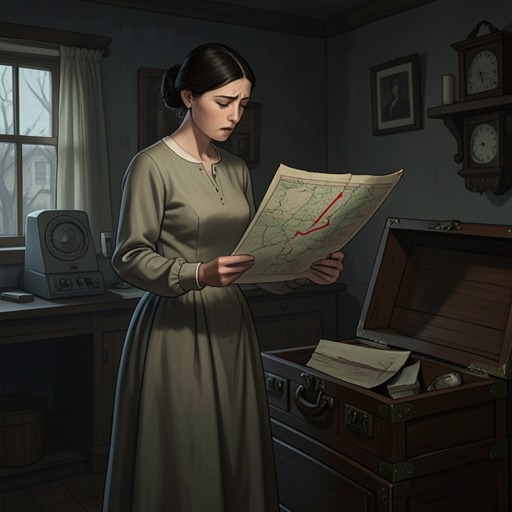
The limits of the post-war fuel supply become explicit when Miss Blacklock explains why she has had the central heating lit. The damp, misty weather has left the house feeling clammy, and she has asked Evans to light the heating before he goes. Patrick responds by teasing her about the precious coke, but the joke points to a real constraint: using coke matters because the alternative is even more precious coal.
The household cannot simply buy fuel as needed. Miss Blacklock says that the Fuel Office will not even allow them the small amount due each week unless they can state that they have no other means of cooking. Fuel supply is thus connected to official allocation and to the household’s other resources; the decision to heat the house is made within a system of limits rather than abundance.
Julia listens as though the earlier world of plentiful fuel were unfamiliar. Miss Blacklock recalls that people once could buy as much coal and coke as they wanted without filling in forms, and without a shortage. There had been different kinds and qualities of fuel, rather than the stones and slates she associates with what is available now. Her recollection does not establish that the past was better in every respect: she acknowledges that an older person naturally prefers her own times, while cautioning the younger people against doing the same. The exchange nevertheless sets remembered abundance against present rationing, making the distance between generations tangible through the fuel used to warm a house.
Domestic work under changed conditions
A conversation between Mrs Swettenham and Edmund shows that scarcity extends beyond goods to household labor. Mrs Swettenham worries that if Mrs Finch takes a dislike to the family and will not come, they may have no one else to hire. Edmund suggests advertising in the Gazette, but his mother dismisses the idea as useless. In her view, without an old nurse in the family who will go into the kitchen and do everything, a household is simply sunk.
The exchange also exposes a disagreement over what counts as work. Edmund protests that he is writing a book, while Mrs Swettenham means work in the practical, household sense. Her complaint is not merely that a particular worker might leave; it is that replacing domestic labor has become difficult. Edmund’s joking suggestion that his mother ought to have provided him with an old nurse, and her reminder that he had an ayah, turn that difficulty into a contrast between his childhood arrangements and the current household’s dependence on available help.
Village access and informal provision
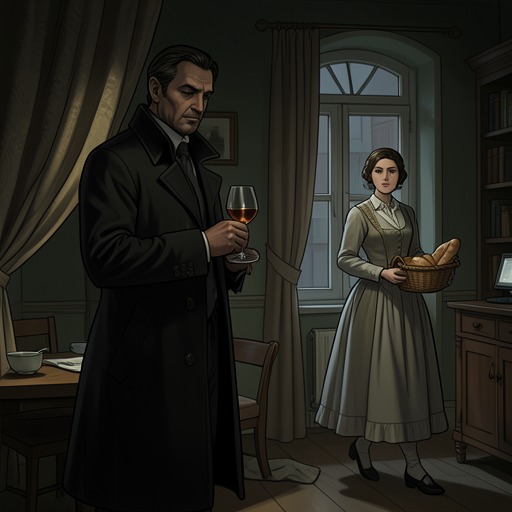
Mrs Swettenham describes a village in which neighbors ordinarily walk into one another’s houses during the day without locking doors. When Sergeant Fletcher asks how she entered, she explains that she came through the side door to bring quinces for Miss Blacklock, who wants to make quince jelly but has no quince tree of her own. The fruit is left in the dining room. This practical act of sharing is also an example of how familiar, informal access works in the village: bringing something useful does not necessarily involve a formal visit or a locked entrance.
Mrs Swettenham contrasts this habit with an earlier domestic order in which someone would answer a bell. She remembers eighteen servants in India, not counting the ayah, and three at home when she was a girl; her mother had considered it a mark of poverty not to afford a kitchen maid. These recollections make clear that her present experience of household life is shaped by a remembered abundance of paid service, even as the household now depends on the less formal circulation of goods among neighbors.
The difference matters to the investigation because everyday hospitality and exchange complicate assumptions about who could enter a house. Mrs Swettenham’s explanation makes unannounced access seem ordinary rather than suspicious. The same openness that permits a neighbor to leave quinces also means that movement between homes cannot be assessed as though every entry required an invitation or a servant to answer the door.
Barter and the investigation
A note from Miss Blacklock mentions that Thursday is the day and that anything for her should be left in the usual place. Miss Marple recognizes the note and passes it to the Inspector. Bunch then explains the local arrangement behind its wording: a nearby farm makes butter on Thursdays and lets selected people have some, while Miss Hinchcliffe often collects it because she is well connected with the farmers through her pigs.
The exchange is not a simple purchase. One person may receive butter and send cucumbers in return; when a pig is killed, someone may receive a little of the meat. Bunch also describes occasions when an animal has an accident and must be destroyed. She calls the whole arrangement a hush-hush local barter scheme and says it would be difficult to explain plainly to the police because some of the exchange may be illegal and the details are complicated. In this instance, she thinks Miss Hinchcliffe may have entered Little Paddocks with a pound of butter and left it in the usual place: a flour bin under the dresser, which does not actually contain flour.
The flour bin gives the exchange a precise household address. What might otherwise look like an unexplained delivery is intelligible within the village’s informal network of food and favors. Miss Marple’s recognition of the note, followed by Bunch’s account of Thursday butter and the concealed purpose of the bin, helps the Inspector understand a local practice that its participants do not readily describe to the police. Scarcity has produced not only inconvenience but also an alternative system of distribution, one whose ordinary routines become relevant evidence during the inquiry.
Work, service, and local knowledge
The pressures of work and service also surface in a complaint about the working habits of people employed outside the household. Someone says that there is no consideration nowadays: work is delayed by breaks, rain, faulty equipment, and leaving before the proper time. The complaint is followed by the specific observation that Mrs Haymes left at twenty minutes past five the previous day instead of five. The evidence does not establish this as a direct result of shortages, but it places the question of labor and time alongside the other accounts of changed domestic arrangements.
Taken together, these details show austerity through its effects on ordinary decisions: whether to burn coke or coal, whether a household can replace domestic help, how neighbors share fruit or butter, and how an investigator makes sense of an open door or a delivery left under a dresser. The novel’s village is not isolated from post-war restrictions; its routines adapt around them. At the same time, remembered servants and unrestricted fuel offer a contrasting measure of how sharply the conditions of domestic life have changed.