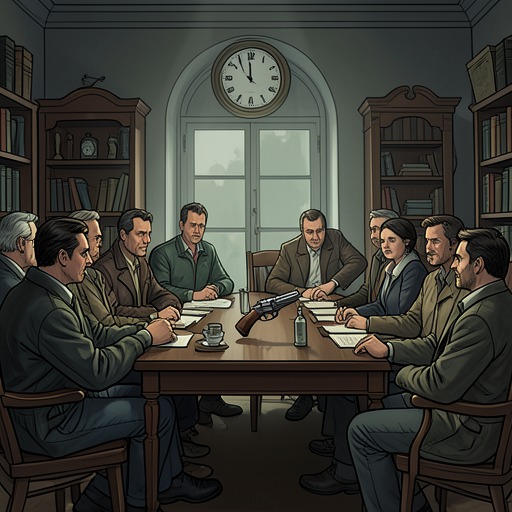
Rules of the Murder Game
A Murder Is AnnouncedThe Rules of the Murder Game establish the party’s expected sequence of roles and actions, then provide the framework against which the staged hold-up is mistaken for a real crime. A game built around darkness, restricted observation, and later questioning becomes central to the mystery because the witnesses’ accounts describe more than they could actually see.
Roles and Basic Procedure
Players draw lots or take slips of paper to determine their parts. One becomes the murderer, another the victim, and a third is selected as detective; the murderer’s identity is meant to remain unknown to the others. The lights are turned out, the murderer chooses a victim, and the victim counts to twenty before signaling that they have been killed. The detective then takes charge and questions the players about where they were and what they were doing, looking for inconsistencies that might identify the murderer.
The game depends on orderly organization as much as surprise. Colonel Archie Easterbrook calls it enjoyable when handled well, but stresses that it needs someone who understands the procedure; he also suggests that a detective with some knowledge of police work would make the game more effective. The contrast between playful role-playing and an investigation conducted through questions anticipates how closely the party’s activity will resemble the real inquiry.
From Game Script to Staged Hold-Up
The rules help make a mock crime legible to the assembled guests: darkness interrupts ordinary observation, a sudden action supplies the apparent threat, and the detective’s questions follow afterward. During the hold-up, the intruder’s powerful torch is directed at the people in the room. One witness describes it as dazzling and says it made the guests blink. The light does not simply reveal a scene; its glare limits what most people can observe.
The witnesses nonetheless converge on the familiar image of a masked man with a revolver and a torch. Miss Marple points out that they could not actually have seen him as they claimed. The distinction is crucial: they experienced the interruption and the glare, but their accounts of the armed intruder are shaped by what the event seemed to be. The game’s conventions supply a ready-made pattern for interpreting a confusing episode as a hold-up.
Questioning, Sightlines, and Memory
The subsequent inquiry echoes the game’s detective role, but its questions test not only where witnesses were, but what their positions allowed them to perceive. Miss Marple explains that a person standing behind the door was shielded from the torch and faced in the direction it illuminated. While the others were dazzled, that witness had a different view. The same burst of light therefore did not create one shared experience: position and exposure divided the room into sharply different fields of observation.
Miss Marple also distinguishes immediate perception from later recollection. Drawing on her own memories of railway and wartime incidents, she observes that people under shock may retain seemingly incidental visual details without understanding their importance at the time. Miss Murgatroyd’s recollection follows the torch’s path across the room, past people and objects, and eventually to the wall where the bullet holes were found. What matters is not simply that she remembers details, but that a place in her mental sequence seems unoccupied when someone should have been there. Her belated recognition turns a fragment of remembered space into evidence about the shooting.
Function in the Mystery
The Murder Game’s procedure acts as both cover and interpretive trap. Its familiar roles encourage the group to treat the scene as a performance, while its sequence of darkness, action, and questioning resembles the structure of the investigation that follows. Yet the later inquiry exposes a weakness in the game’s apparent logic: questioning witnesses cannot make them reliable observers if the lighting and their positions prevented them from seeing what they believe they saw.
The rules therefore matter beyond the entertainment planned for the gathering. They establish the expectations through which the hold-up is staged and then help reveal why confident testimony can be misleading. The decisive clue comes not from a witness who gives a complete account at once, but from Miss Marple’s attention to the difference between what a person consciously reports and what memory has quietly retained.