The lamp
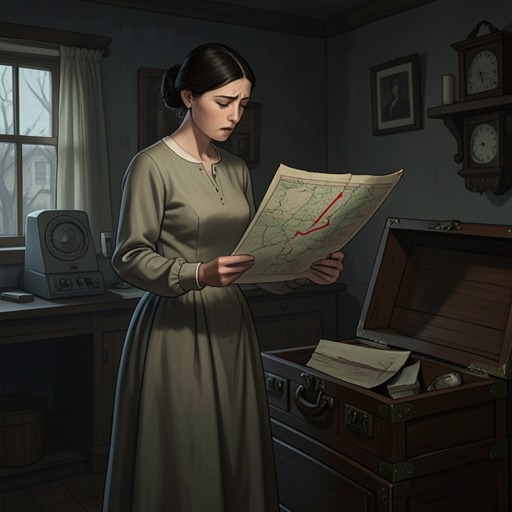
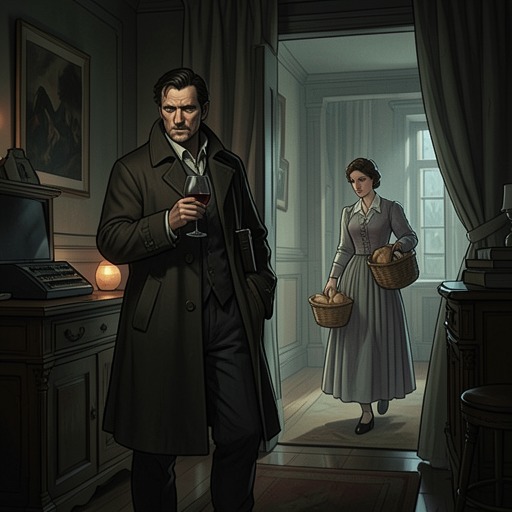
A Murder Is AnnouncedThe lamp is the switched shepherdess lamp whose deliberately frayed cord Letitia Blacklock short-circuits with water from a vase of violets. The resulting failure of the lights provides cover for the staged hold-up and Rudi Scherz’s shooting, but the device’s physical details also expose how the apparent accident was engineered. Its importance lies in the gap between what the room’s occupants believe they have witnessed and what the lamp’s wires, water, and placement reveal afterward.
Design and Preparation
Letitia prepares the lamp as part of a plan that makes an electrical failure seem spontaneous. Before the shooting, she frays its cord until the wires are nearly bare. The cigarette-box, vase, and lamp switch are close together on the table, allowing her to handle the flowers and cause the short circuit in a single, ordinary-looking movement.
The lamp is also one of a pair. Jane Marple had noticed that one lamp had been exchanged for the other, probably during the night. That substitution matters because the lamp that appears to be part of the room’s familiar furnishings is not simply an incidental prop: its position and condition have been incorporated into Letitia’s preparations. The plan’s small domestic adjustments—including oiling the second drawing-room door and moving the table—help make the larger deception possible, while the lamp supplies the immediate interruption.
The Failure During the Shooting
At 6:30, as the clock begins to chime, Letitia stands by the table with her hand near the cigarette-box. The room’s attention turns toward the clock. In the role of hostess, she can plausibly reach for cigarettes; instead, she picks up the vase of violets. She spills water onto the already damaged wire and switches on the lamp. Because water conducts electricity, the exposed wires fuse and the lights fail.
The malfunction is brief but consequential. The darkness allows the staged hold-up to unfold and disguises the mechanics of the shooting as confusion during an intrusion. The lamp’s failure therefore changes the meaning of an apparently commonplace action: lifting flowers becomes the means of controlling what the witnesses can see at the decisive moment.
Evidence in the Apparent Accident
Dora Bunner’s first statement contains the observation that unlocks the lamp’s role: she saw Letitia pick up the violets. Dora often distorted things she had heard, but Jane Marple recognizes that she could accurately report what she had seen. Dora also recalled a flash and a crackle. Those details fit the short circuit, even though her broader understanding of events was unreliable.
Other traces complicate the appearance of a simple accident. Dora mentioned a burn on the table where someone had supposedly put down a cigarette, although nobody had lit one. The violets were dead, and the vase contained no water. That absence was a mistake in Letitia’s staging: she should have refilled it, but Dora was willing to believe that she herself had failed to put water in the vase. Her forgetfulness thus helps the false explanation survive, while her precise visual memory preserves the crucial movement.
Replacement and Recognition
The lamp examined the following morning was in good order, like the others: its cord was not frayed and its wires were not fused. This later condition does not match the damage required to produce the failure in the drawing room. It supports Marple’s earlier suspicion that the pair of lamps had been switched, and that the compromised lamp had been removed or replaced after serving its purpose.
A second accidental spill helps Marple join the clues. When Bunch Harmon spills water from the Christmas roses onto the lamp wire, Marple immediately sees that only Letitia could have fused the lights at the earlier gathering, because only Letitia had been near the table. The new spill recalls the old mechanism in a different setting: water on a wire is no longer an unexplained mishap but the key to reconstructing a deliberate act. Craddock and Marple connect Dora’s account, the exchanged lamps, and the damaged cord into a coherent explanation of the blackout.
Narrative Significance
The lamp moves from background furnishing to conspicuous evidence. During the shooting, its failure seems to be a technical accident that interrupts ordinary domestic life. In retrospect, the water and exposed wire reveal how thoroughly the room’s familiar objects have been recruited into Letitia’s deception. The lamp’s ordinary usefulness becomes the cover for an extraordinary act, and its failure marks the point at which apparently separate observations begin to form a pattern.
Its evidentiary force depends on distinguishing kinds of knowledge. Dora cannot reliably interpret what she hears, and she is ready to misremember the vase’s water, yet she has seen Letitia lift it. Marple’s solution gives that modest visual fact its proper weight. The lamp does not itself explain the entire crime, but its prepared cord, timed placement, short circuit, and subsequent replacement expose the deliberate construction behind the darkness.