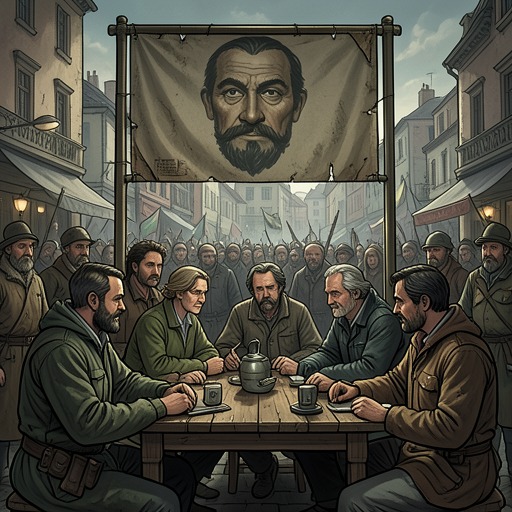
The murder announcement at Little Paddocks
A Murder Is AnnouncedThe murder announcement at Little Paddocks is both a literal invitation and the narrative trigger for a mystery: it promises a staged parlour-game killing at a precise time and place, only for the game’s premise to give way to a real corpse. Its sharp contrast between entertainment and death establishes the central puzzle and calls for Jane Marple, the story’s decisive detective.
The Invitation
The invitation states that “A murder is announced and will take place on Friday, October 29th, at Little Paddocks, at 6:30 p.m.” The specificity makes the announcement sound like a carefully arranged social event: it gives the guests a date, an address, and an hour, presenting the promised murder as something they are expected to attend.
Its wording also sets the mystery in motion before the gathering begins. The announcement is not merely an ominous prediction; it frames the evening as a game whose rules appear familiar to the townspeople, leaving open the crucial question of whether the announced crime is only a performance.
Game and Reality
Those who receive the invitation expect a party game. A secret murderer is to be chosen, the lights will go out, a victim will fall, and the players will try to identify “whodunit.” In that expected version of events, danger is a temporary fiction governed by play and solved through guessing.
The discovery of a real corpse breaks that understanding. What seemed an amusing game becomes inseparable from an actual death, and the announcement’s precise promise acquires a second, more threatening meaning. The reversal turns the guests’ shared expectations into part of the mystery: the familiar performance offers cover for a crime that is not pretend.
Narrative Significance
The announcement supplies the story with a compact dramatic structure: a declared murder, an anticipated game, and a corpse that makes the distinction between them urgent. Its central irony lies in the guests’ confidence that they know what sort of event they are attending. The invitation appears to make murder safe by naming it as entertainment, but reality defeats that assumption.
The story therefore requires more than the players’ ordinary guesses. The setup identifies Jane Marple as the brilliant detective needed to resolve a game that has become genuinely murderous. The announcement is significant not because it explains who committed the crime, but because it establishes the terms of the puzzle and the gap between what the guests expect and what actually happens.