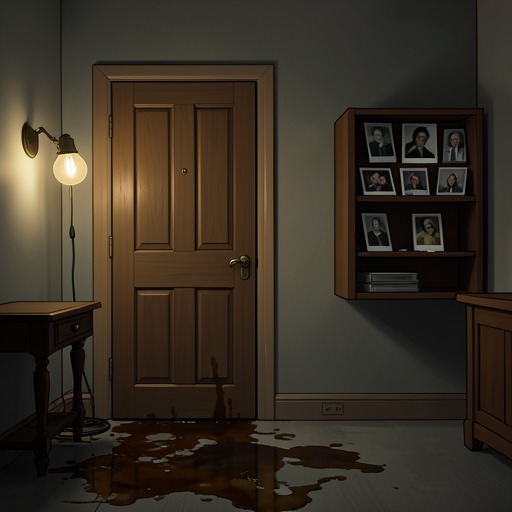
the sealed door in the Little Paddocks sitting room
A Murder Is AnnouncedThe sealed door in the Little Paddocks sitting room is the concealed threshold between the house’s long drawing-room and the smaller room with a bay window. Though the rooms had been joined and the doorway was said to be permanently closed, Inspector Craddock’s inspection reveals that the door has recently been opened. Its quiet, ordinary fittings turn the room’s familiar layout into evidence: the supposed dummy door was real, accessible, and connected to the movements of someone inside the house on the night of the shooting.
Architecture and concealment
Little Paddocks is a medium-sized house built in the early Victorian style, with a long, shallow veranda and green-shuttered windows. The drawing-room is long and narrow, and the veranda roof deprives it of much of its light. At one end, double doors originally led into a small room with a bay window. A former generation removed the doors and replaced them with velvet portieres; Miss Blacklock later dispensed with the curtains, making the two rooms function as one double drawing-room. The room has a fireplace at each end, though neither is lit when the house is shown, and central heating supplies a gentle warmth.
The alteration makes the door’s status easy to misunderstand. With the two rooms in everyday use as a single space, the second entrance seems unnecessary; the former opening is described as fastened up and treated as a dummy. Yet the architectural change never erased the door itself. It only obscured its practical significance, leaving behind a real opening that could still be used.
The door during the shooting account
When Miss Blacklock recounts the appearance of the masked gunman, she identifies the entrance he used as the door into the drawing-room. Asked which door she means, she distinguishes it from the other one, which she describes as a dummy. The distinction supports the account’s apparent simplicity: one door is the ordinary entrance, while the other is supposedly not an entrance at all.
That description becomes less secure when the house’s layout is examined. The alleged dummy is, in fact, the former door of the small drawing-room. Its existence matters because the attack took place in a room with two possible doorways, even though the second had been represented as sealed. What initially sounds like a minor architectural clarification therefore bears directly on whether the room’s occupants and movements have been fully accounted for.
Craddock’s inspection
Inspector Craddock tests the door and finds a bolt at the top. It slides back with striking ease. Miss Bunner says that the door has not been opened for years, certainly not since she has been in the house, and suggests that its key may be among the many old keys kept in the hall drawer. Craddock searches the rusty assortment, chooses a key that looks different from the others, and finds that it fits and turns readily.
When he pushes, the door opens noiselessly. Miss Bunner immediately warns him to be careful in case something has been placed against it on the other side, a concern that emphasizes how completely the household has treated the entrance as closed. Craddock instead notices the condition of its fittings: the lock and hinges have been oiled. He concludes that the door has been opened recently, contradicting the assurance that it has remained shut for years.
Investigative significance
The discovery changes the door from background architecture into a test of the household’s account. The key, bolt, lock, and hinges are not merely signs of an old, neglected entrance: the bolt moves easily, the key works, the door opens silently, and the mechanism has been maintained with oil. Together, these details point to deliberate recent access rather than a permanently sealed doorway.
Craddock’s immediate question is who opened it. He considers whether the person he calls X came from outside, then rejects that possibility: X was in the house and in the drawing-room that night. The door thus narrows the mystery toward someone with access to the interior and gives the police a material clue against the reassuring story that the entrance was unusable. Its importance lies in the contrast between what the room’s occupants say they know—that the door is closed and has long been untouched—and what its freshly oiled fittings disclose.