Atmosphere Plant
A Princess of MarsThe Atmosphere Plant is the fortified source of Barsoom’s artificial atmosphere, transforming stored solar energy into air and sending it to the planet’s five principal air centers. Its walls protect a system on which every living community depends; when the pumps stop, that dependence becomes an immediate planetary crisis. The plant’s hidden entrance and Carter’s recovery of its nine-sound key turn an isolated industrial installation into the decisive setting of the novel’s final struggle for survival.
Purpose and operation
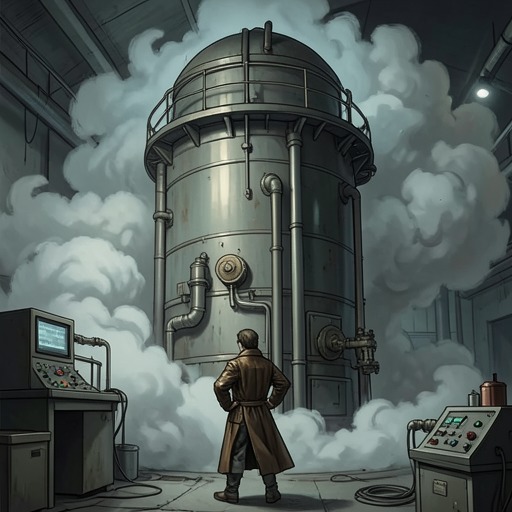
The plant stands within a huge building that Carter finds after escaping the Warhoons. The structure covers about four square miles, rises two hundred feet, and appears sealed except for a small door in its massive outer wall. Inside, Carter learns that the machinery maintains the atmosphere on Mars, and that its process depends on the ninth ray, one of the radiations he had seen shining from his host’s diadem.
Finely adjusted instruments on the roof separate the ninth ray from the Sun’s other rays. Three-quarters of the building is devoted to reservoirs that store it. The stored product is treated with selected electric vibrations; the resulting compound is then pumped to the five principal air centers. When released there, it meets the ether of space and becomes atmosphere. The sequence joins solar energy, electrical treatment, storage, and distribution in a single engineered system rather than relying on a naturally replenished supply.
The plant’s reserves are large enough to sustain the existing atmosphere for a thousand years. The keeper therefore identifies no immediate threat in the stored supply itself; the danger lies in a possible accident to the pumping apparatus. That distinction governs the later crisis: the atmosphere does not fail because the ninth ray has run out, but because the machinery that circulates its compound ceases to work.
Fortification and custody
The building’s scale is matched by its defenses. Its walls are described as a hundred and fifty feet thick, and even its roof is protected against aerial attack by a five-foot glass covering. The small door is not merely an entrance to a secure building: the secret of gaining ingress is held by only two people at a time, the two keepers responsible for the plant.
Carter’s host has watched the pumps for eight hundred years. Twenty radium pumps stand in the inner chamber, and any one of them could supply the atmosphere compound for all Mars. They are used in rotation, one at a time for a day-long stretch of a little over twenty-four and a half Earth hours. The keeper shares the watch with one assistant. Each spends half a Martian year—about 344 Earth days—alone in the isolated plant, making the continuity of the system dependent on a small and unusually secluded staff.
The knowledge is distributed more widely than access: every Red Martian learns the principles of atmospheric manufacture from childhood, yet only the keepers know how to enter the plant. This arrangement reflects the scale of the stakes. The Red Martians fear an attack by Green Martians or by a deranged Red Martian, but all Barsoomians understand that the survival of every form of life depends on uninterrupted operation. The walls can resist assault; the concealed entry and limited custody of its secret are meant to protect the means of keeping the pumps running.
Failure and planetary crisis
The plant becomes the center of a crisis when its keeper fails to send a wireless report for two days. Calls from a score of capitals receive no response, and the governments of Barsoom ask that the assistant keeper be sent to investigate. A thousand cruisers search for him. One returns with news that he has been found dead beneath his house, while the authorities’ instruments register rapidly declining air pressure across the planet. The pumping engine has stopped.
The reported reserves cannot avert this danger: they are sufficient only if the apparatus can continue to distribute the atmosphere compound. At the council, Tardos Mors estimates that Barsoom has at most three days to live. The urgency is sharpened by the plant’s defenses. Men have already begun trying to break through its walls, but after laboring against the hard surface they have made scarcely any progress. By the time Carter reaches the building, many of those workers are no longer conscious, and the remaining men have little time or strength left.
The crisis reveals the vulnerability concealed by the plant’s apparent permanence. It can store a thousand years’ worth of the essential ray and withstand prolonged attack, yet a failure in the pumps—and the loss of the people who know the entrance—can threaten the entire planet within days. Its immense reserves and formidable walls do not make it self-sufficient: continued life depends on working machinery and access to the rooms where it can be operated.
Carter opens the plant
Carter reaches the plant after a desperate flight from Helium, where he had seen Dejah Thoris collapse beside the incubator as the air supply failed. At the building, he finds a few men still conscious. One explains that the two people who knew the secret of the locks are dead and that, for three days, frightened crowds have been unable to solve the entrance’s mystery.
Carter recognizes what the others cannot. A series of nine long-forgotten sounds returns to his conscious mind, and he realizes that they form the key to the plant’s three great doors. As his strength fails, he sends the nine thought waves toward the first door. It slowly recedes. He cannot make his way through, so he directs his companion to go on to the pump room and release all the pumps—the only remaining chance for Barsoom to exist the following day.
From where he lies, Carter opens the second and then the third door. The companion crawls through the final doorway while Carter loses consciousness. The scene reverses the plant’s customary secrecy: the entrance’s hidden safeguard, which has rendered the building inaccessible even to the gathered rescuers, becomes passable through Carter’s recovered key. The novel establishes the opening of the doors and the order to restart every pump as the last effort to save Barsoom; it does not show the machinery’s subsequent operation in this scene.
Significance
The Atmosphere Plant gives material form to Barsoom’s dependence on engineered systems. The planet’s air is not an incidental background condition but the product of a chain of extraction, storage, treatment, and pumping, maintained by two isolated keepers and protected by barriers that ordinary force cannot quickly breach. The system’s complexity supports life across the planet while concentrating the risk of failure at a single installation.
That concentration also links the plant to Barsoom’s wider resource pressures. The society described in the novel lives amid dwindling natural resources, while the plant’s artificial atmosphere makes continued habitation dependent on sustained technical care. Its crisis transforms that long-term condition into an immediate countdown: when the pressure falls, political authority, military search, and collective effort all converge on the same locked door. Carter’s role is not to replace the machinery but to restore access to it. The plant’s survival, and Barsoom’s with it, depends on the moment when hidden knowledge becomes usable again.