Barsoom Atmospheric Supply Crisis
A Princess of MarsThe Barsoom atmospheric-supply crisis is the near-fatal interruption of the artificial system that sustains life across the planet. When the Atmosphere Plant’s engine stops, air pressure falls throughout Barsoom; John Carter’s recovery of the secret for opening the plant’s doors allows a surviving worker to reach the pumps, offering the planet its only remaining chance. The emergency makes the consequences of dependence on centralized life-support infrastructure immediate: a hidden failure at one facility threatens every community at once.
A planet sustained by engineered systems
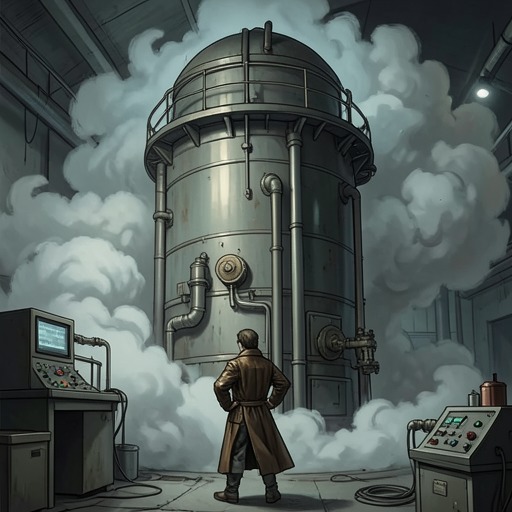
Barsoom’s atmosphere is not self-sustaining. The Atmosphere Plant separates the ninth ray from sunlight using instruments on the roof, stores it in vast reservoirs, and combines it with refined electrical vibrations. The treated substance is pumped to five principal air centers, where contact with the ether of space transforms it into atmosphere. The building is mostly reservoirs, and its reserves are described as sufficient to maintain the existing atmosphere for a thousand years. Yet that immense store cannot protect the planet if the pumping apparatus fails. The system’s reassuring scale and its single point of operational vulnerability coexist from the start.
The dependence belongs to a broader pattern of engineered provision. Water for farms is collected in immense underground reservoirs at the poles, where ice caps melt, then pumped through conduits beside cultivated districts. Small pipes carry it directly to plant roots, limiting evaporation. The farms’ regular yields and carefully cultivated produce suggest how extensively Barsoom’s settled life relies on managed flows of essential resources. Against that background, the Atmosphere Plant is not an isolated marvel but the most consequential instance of a civilization organized around infrastructure that must keep working.
The failure and the three-day warning
The crisis becomes public when the keeper fails to send a wireless report for two days. Repeated calls from a score of capitals receive no answer, and the other governments ask the rulers of Helium to intervene by sending the assistant keeper to the plant. A thousand cruisers search for the missing man. One returns with his body, found in the pits beneath his house, and the news turns an unexplained silence into evidence of murder and a potential planetary catastrophe.
The plant’s immense walls make the emergency harder to meet. The account stresses that breaching them by force would take months, even though the work of trying has already begun. That delay would matter less if the engine continued to operate; the instruments instead show air pressure falling across Barsoom, confirming that the pumps have stopped. Tardos Mors gives the council the measure of the danger: at best, the inhabitants have three days to live. The crisis is therefore not simply a shortage to be managed over time, but a race against the exhaustion of breathable air while the machinery remains inaccessible.
A planetary emergency becomes personal
For two days after the warning, the air supply shows no noticeable change. On the third morning, however, breathing becomes difficult at the higher rooftops of Helium. Business stops, and the avenues and plazas fill with people facing the approaching danger. Many remain composed, while some quietly grieve; by the middle of the day, people begin to lose consciousness by the thousands as asphyxiation advances.
John Carter and Dejah Thoris gather with the royal family in an inner courtyard’s sunken garden. Woola presses close to them, and Dejah Thoris watches the small incubator brought down from the palace roof, grieving the unknown life it contains and expects never to know. The failing atmosphere thus bears on more than the survival of a population in the abstract: it threatens a family’s future at the same time as it empties the public spaces of Helium. When Dejah Thoris sinks beside the incubator, Carter knows that she will die if the air is not restored.
The remembered key and the attempt to restart the pumps
Carter’s earlier knowledge of the plant becomes decisive. Before the catastrophe, he had found himself inside the building and learned from its keeper how the ninth ray was processed and distributed. He had also listened to the old man without revealing his ability to sense mental operations, an ability that let him learn information the keeper might otherwise have withheld. The account of the emergency connects that earlier encounter to Carter’s present chance: as he tries to resist the prospect of Dejah Thoris’s death, nine long-forgotten sounds return to his conscious mind, and he recognizes them as the key to the plant’s three great doors.
Carter takes a flier and races to the plant. He travels low to breathe the denser air and throws overboard everything but the engine and compass to increase speed. By the time he arrives, men have been trying to break through the wall, but have made little progress; most lie unconscious, and only a few remain alert. One man tells Carter that he can operate the pumps if the doors are opened, although he doubts that he or anyone else can last much longer. Carter has no time to explain. Kneeling weakly, he sends the nine thought waves at the first door, which slowly recedes.
The first opening does not finish the task. Carter tells the man to proceed to the pump room and release all the pumps, then opens the second and third doors from where he lies. He sees his companion crawl through the final doorway and collapses unconscious. The ending leaves the effort at its point of greatest uncertainty: the doors are open and someone is on the way to the controls, but no restored air supply or subsequent recovery is yet confirmed in the account of these events.
Significance
The crisis exposes the gap between stored resources and usable resources. The plant holds enough of the ninth ray to sustain the atmosphere for a millennium, but stored reserves are no safeguard once the mechanism that distributes them stops. The contrast makes technical abundance conditional: Barsoom’s survival depends not only on accumulated capacity, but also on functioning machinery, secure access, and people capable of operating it.
The emergency also brings a slow planetary vulnerability into a sudden, shared reckoning. Barsoom’s dwindling resources are described elsewhere as pressures shaping population controls and a harsh struggle for survival; here, the threat is concentrated into three days and measured through falling air pressure, interrupted daily life, and mass unconsciousness. By linking a system failure to the intimate scene in the garden and then to Carter’s remembered knowledge of the locks, the narrative moves from planetary dependence to personal action without yet guaranteeing the outcome. The crisis ends not with recovery, but with a narrow possibility: the pumps may be reached before the last breathable air is gone.