Barsoom's artificial atmosphere system
A Princess of MarsBarsoom's artificial atmosphere system sustains life across the planet, converting the ninth ray into atmosphere and pumping it to five principal centers. The system’s vast stored reserves make the air supply appear secure for centuries, but its dependence on a vulnerable pumping apparatus turns a hidden technical failure into a planetary emergency. In the climax, the engine stops, the keepers are found dead, and John Carter uses a secret thought-wave key to open the plant so its pumps can be set running again.
Design and Operation
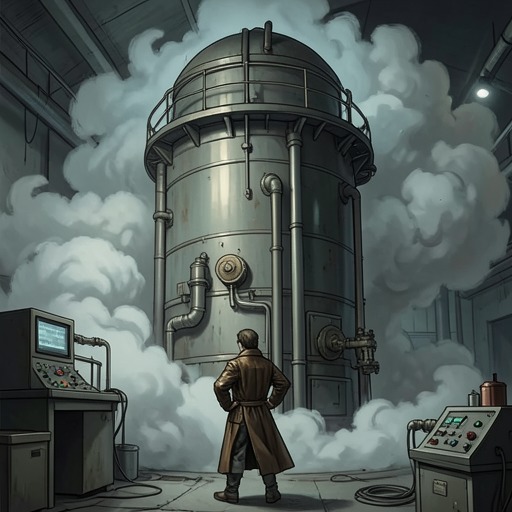
At the heart of the system is the ninth ray, a component of sunlight that the Martians separate and store. Instruments finely adjusted on the roof of the great building collect it; three-quarters of the structure is devoted to reservoirs holding the supply. The stored ray is treated electrically, with refined electric vibrations incorporated into it, and then pumped toward the planet’s five principal air centers. Once released there, contact with the ether of space transforms it into atmosphere.
The plant is described as holding enough reserve ninth ray to maintain the existing atmosphere for a thousand years. That reserve, however, is not the same as an independent supply of breathable air: it must still be processed and moved by the machinery. The narrator’s account makes the distinction decisive. The system can store centuries of potential production, yet the planet remains dependent on the continuing operation of its pumps.
The central machinery includes twenty radium pumps, any one of which could supply all of Mars with the atmosphere compound. The pumps are used in rotation, one at a time for a day, a period described as a little over twenty-four and a half Earth hours. The keeper has watched them for eight hundred years, sharing the duty with a single assistant. Each man spends half a Martian year—about 344 Earth days—alone in the isolated plant. The arrangement combines extraordinary redundancy in the machinery with an exceptionally narrow human watch.
Secrecy and Protection
The building’s security reflects the planet-wide consequences of its operation. Its walls are 150 feet thick, and a five-foot glass covering protects the roof against attack from aircraft. The narrator is told that an assault by force would take months to penetrate the walls. Yet physical defenses are only one part of the system’s protection: while every Red Martian is taught the principles of atmosphere manufacture from childhood, only two people at a time know how to enter the building.
Entry depends on telepathy rather than an ordinary key. The outer doors’ locks respond to a precise combination of thought waves. When the keeper opens the doors for John Carter, Carter senses the nine Martian sounds in the keeper’s thoughts, though the keeper immediately refuses to disclose the secret. The scene establishes the access code as both knowledge and a safeguard: the plant’s workings are broadly understood, but control of the entrance is deliberately restricted.
The keeper’s explanation also places the system within a larger network of essential infrastructure. The farm settlements, for example, receive water from underground reservoirs at the poles through long conduits; the air plant performs a comparably indispensable service on a planetary scale. The atmosphere system is therefore not a decorative marvel but the condition on which every other community, journey, and undertaking depends. Its importance is recognized across nations: when the keeper fails to report, governments send repeated calls, and a thousand cruisers search for the missing assistant.
The Three-Day Crisis
The system’s hidden fragility becomes explicit when the assistant keeper’s body is brought to a council meeting. Tardos Mors reports that the keeper has sent no wireless message for two days and that calls from many capitals have received no answer. The assistant has been found dead in the pits beneath his house. The plant is too strongly built for anyone to expect a rapid breach, but the instruments now show that air pressure is falling across Barsoom: the engine has stopped.
The reserve supply cannot avert the immediate danger if the pumps cease to operate. Tardos Mors tells the council that, at best, the people of Barsoom have three days to live. The crisis turns a remote technical failure into a shared deadline. The air plant’s normal invisibility is replaced by the recognition that every community’s survival rests on a mechanism that few can reach and fewer can unlock.
Recovery and Narrative Significance
John Carter recognizes the key when nine long-forgotten sounds return to his conscious mind. He had earlier encountered the sequence while reading the keeper’s thoughts, but its full meaning becomes clear only as the atmosphere crisis unfolds. Recalling it gives him a way through the plant’s otherwise impenetrable doors, not an independent means of restoring the system; the pumps must still be reached and released by someone who can enter.
At the entrance, Carter uses the nine thought waves to open the first door, then the second and third. Weak from the effort, he tells his companion to continue to the pump room and set all the pumps running, calling it Barsoom’s only chance of existing the next day. Carter collapses before learning the result in that moment. The ending thus depends on both parts of the system’s design: secret access must be recovered, and the machinery must be restarted.
The system binds scientific explanation to the novel’s final stakes. Earlier, its rays, reservoirs, electric treatment, and rotating pumps are presented through detailed technical description; later, the same apparatus determines whether the planet has days left to live. Its enormous reserve and durable walls promise stability, while the dead keepers and stopped engine reveal how much that stability relies on maintenance and tightly controlled knowledge. The atmosphere plant makes the novel’s planetary scale concrete: a single interruption at a guarded facility can threaten life everywhere on Barsoom.