Barsoomian egg incubation
A Princess of MarsBarsoomian egg incubation is both a reproductive process and a system of communal governance. Among the green Martians, eggs are tested, culled, stored, and hatched on a schedule controlled by the chieftains; the resulting children are raised by whoever captures them, not by their biological parents. The process preserves the community’s numbers in a harsh environment, while making kinship and care profoundly different from human family life.
Selection and Hatching
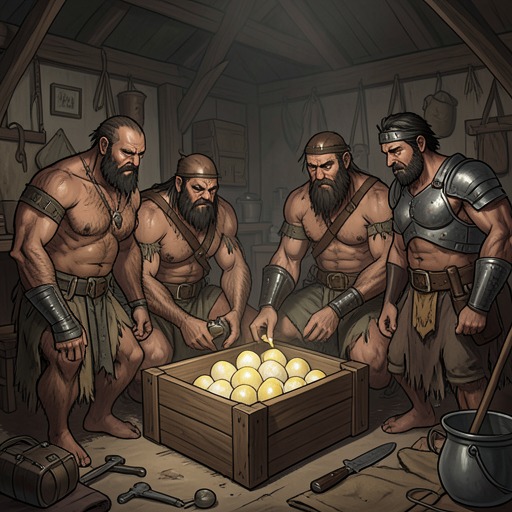
Each adult female produces about thirteen eggs a year. Eggs are assessed for size, weight, and specific gravity, then hidden in underground vaults whose low temperatures prevent incubation. A council of twenty chieftains examines the annual supply and retains only about one hundred of the most promising eggs, destroying the rest. After five years of selection, roughly five hundred eggs have been chosen from the thousands originally laid.
Those selected eggs spend a further five years in nearly airtight incubators, where the sun’s rays bring them to hatching. In the representative hatching witnessed by John Carter, almost all the eggs hatched within two days; approximately one per cent did not. The account offers no certainty about the fate of any eggs that hatch later, but says they are unwanted because prolonged incubation might be inherited and disrupt the established timetable. That timetable is precise enough for adults to calculate the proper return to the incubators almost to the hour.
The incubators are placed in remote strongholds, concealed from other tribes. Their secrecy is a practical safeguard: losing an incubator would leave a community without children for another five years. The arrangement makes the hatchery more than a nursery; it is a protected store of the community’s future.
Communal Upbringing and Kinship
After five years inside the egg, a young green Martian emerges fully developed apart from its size. The hatching is followed by an organized distribution: children run through an aisle formed by women and young people, who catch them in turn. The women return with their captives to their chariots, while children caught by young men are later handed to women for care.
Raising a child chiefly means teaching speech and the use of weapons, which are given to the young from their first year. Biological parentage does not determine upbringing. The mothers may not know their children, and the fathers may be difficult to identify; the hatchlings are treated as children of the community. A female who has never laid an egg can become a foster mother, as Sola did after beginning to lay eggs less than a year before she took in another woman’s child.
The system’s efficiency has an emotional cost. The narrative describes parental and filial love, and the idea of home, as absent from green Martian life. It connects that absence to a childhood in which survival and martial fitness take precedence, and in which defective children are killed rather than supported. Yet the account distinguishes this harsh custom from deliberate cruelty toward children: it presents a society struggling to sustain every life on a dying planet whose resources have dwindled, and explains that selective breeding is intended to keep births in balance with deaths.
Secrecy, Loss, and the Hidden Family
The incubators’ isolation also makes them strategic targets. Zodanga has waged a campaign against the green Martians that includes attacks on their incubators. When the destruction of an incubator prompts a Warhoon expedition against a small Thark community, the raid is postponed until after the great games; the incident shows how damage to a hatchery can turn a concealed reproductive system into the cause of military retaliation.
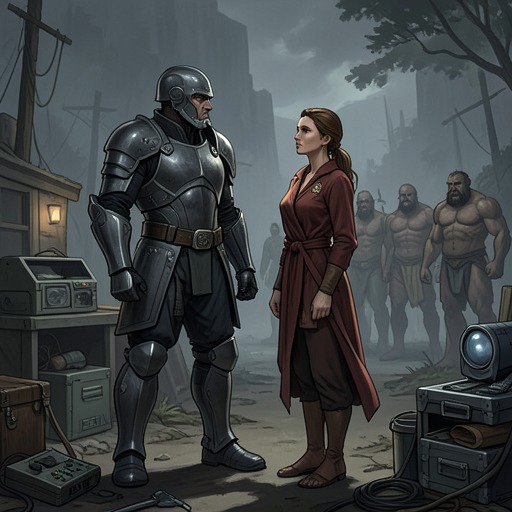
The communal arrangement does not eliminate biological attachment; it makes attachment dangerous and difficult to acknowledge. Sola’s history exposes a private family concealed inside the public system. Her mother, an unusually small woman who rejected the cruelty of green Martian society, fell in love with a young warrior. They kept their relationship secret for six years. When her mother learned that the returning caravan carried the young Tharks, she slipped onto a chariot with Sola and later placed her among the other children, knowing they might never meet again.
After the children were distributed among the chieftains’ retinues, Sola’s mother was imprisoned by Tal Hajus and died following efforts to force her to reveal the father’s identity. To protect Sola, she claimed she had killed her child and thrown the body to the white apes. Sola survived as an unrecognized child of the community, while Sarkoja suspected her true origin and knew who had betrayed her mother. Sola eventually told John Carter that her father was Tars Tarkas, trusting him to use the knowledge if it might help him, Tars Tarkas, Dejah Thoris, or herself. The revelation makes the system’s severing of parent and child concrete: biological kinship persists beneath communal upbringing, carrying both grief and political consequence.
Later Echoes and Significance
The image of an egg in an incubator returns in a very different setting at the palace in Helium. After Dejah Thoris and John Carter marry, a snow-white egg lies in a golden incubator on their palace roof. Ten soldiers of the jeddak’s Guard watch over it for nearly five years, and the couple regularly stand together before it, imagining the future that will begin when its shell breaks. Their shared attention gives the incubator the quality of a family shrine, in sharp contrast to the green Martian system’s deliberate separation of parenthood from child-rearing.
Together, these instances present incubation as a biological process shaped by social choices. For the green Martians, selection and secrecy protect communal continuity, but the separation of parent and child enforces a world without recognized home or inherited affection. Sola’s concealed parentage reveals what that order suppresses, while the Helium egg shows that the same image can also gather hope around a specific couple and an anticipated child.