Barsoomian marriage customs
A Princess of MarsBarsoomian marriage customs make a spoken promise decisive: once Dejah Thoris pledges herself to another man, later ceremonies are formalities rather than the act that creates the bond. The custom turns John Carter’s earlier failure to ask for her hand into a consequential misunderstanding, and makes their reunion a conflict between mutual feeling and obligations that neither can simply set aside.
The Promise and Its Force
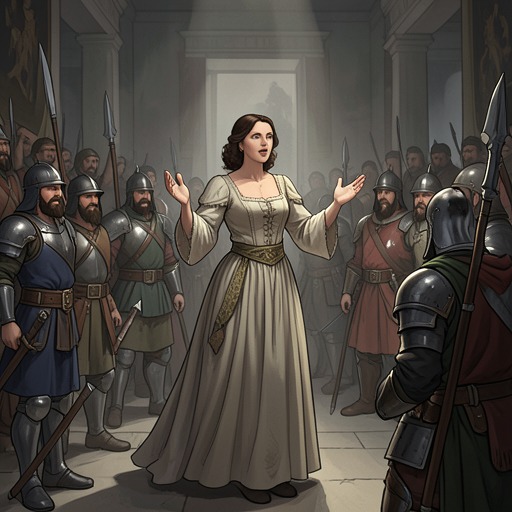
Dejah Thoris explains that she believed John Carter dead after the fighting at Warhoon. To protect her people from a victorious Zodangan army, she promised herself to Sab Than. Under Barsoomian custom, that promise already makes her as good as married; the ceremonies still to come cannot make the marriage more certain. She accordingly tells Carter that he may no longer call her his princess or himself her chieftain.
The rule gives speech immediate social force. It is not the public ceremony, but the commitment already made, that determines what Dejah Thoris may do. Her pledge was made in circumstances shaped by the threat to her people, yet the custom leaves no interval in which she can withdraw it once Carter returns. The personal and political stakes therefore meet in the same binding act.
Courtship and Carter’s Misunderstanding
Dejah Thoris recalls that Carter once called her his princess after fighting for her, without first asking for her hand. He understood his actions as grounds to claim her; she understood that he had not made the request that would have established the relationship. Her account distinguishes between women whom men fight for in order to ask them in marriage and women whom men fight for without seeking their hands. Winning a woman and asking her to marry are not interchangeable acts.
Carter’s mistake was not a lack of feeling but ignorance of the local convention. He says that he had believed a petition would be presumptuous and unwelcome, and now asks Dejah Thoris to be his wife. Her reply is that the request comes too late while Sab Than lives. The scene exposes how his assumptions about what counts as respectful courtship have left a mutual attachment without the promise that, under this society’s rules, could have secured it.
Competing Obligations
Dejah Thoris confirms that she had loved Carter and that she had meant her earlier words to him. She says she had promised herself to Sab Than because she thought Carter’s ashes lay in the pits of Warhoon, and because she sought to spare her people the consequences of Zodangan victory. Her declaration does not undo that pledge: personal feeling and public responsibility pull in different directions, but the custom recognizes the promise already given.
A further restriction closes off Carter’s proposed solution. Dejah Thoris says she may not marry the man who kills her husband, even in self-defense. She describes Barsoom as ruled by custom and tells Carter that they must share their sorrow and the memory of their days among the Tharks, then part. The rule thus prevents him from treating Sab Than’s death as a simple release from the existing bond.
Ceremony and Political Stakes
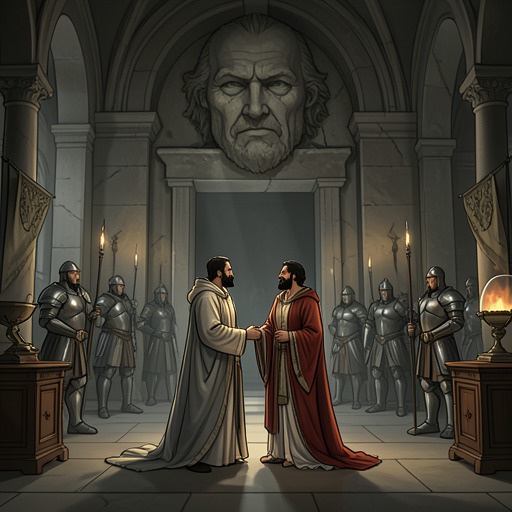
The later public ceremony makes the customs visible in material form. Officers carry a great golden chain, with a collar and padlock at each end, followed by the ornaments of a Zodangan prince and princess. Carter understands that Dejah Thoris is about to be joined to the Prince of Zodanga. When Than Kosis raises the collar, Carter breaks the window’s glass and enters the assembly, then strikes the chain that would bind her to another.
The contrast between promise and ceremony is central: the ceremony does not create the commitment, but stages its political consequences before the assembled court. Carter’s intervention interrupts that public enactment; it does not erase the earlier promise or the rule Dejah Thoris has explained. Marriage custom in this episode is therefore both intimate and political, joining personal choice, public alliance, and the costs of a word given under pressure.