Calot
A Princess of MarsThe Calot is a Barsoomian dog-like creature whose role in the novel ranges from feared predator and arena combatant to faithful guardian and companion. Its most sustained characterization comes through Woola: although the species can be used as a weapon or spectacle, Woola repeatedly acts with loyalty and independent purpose, complicating the harsher treatment of animals common among the green Martians.
Nature and Uses
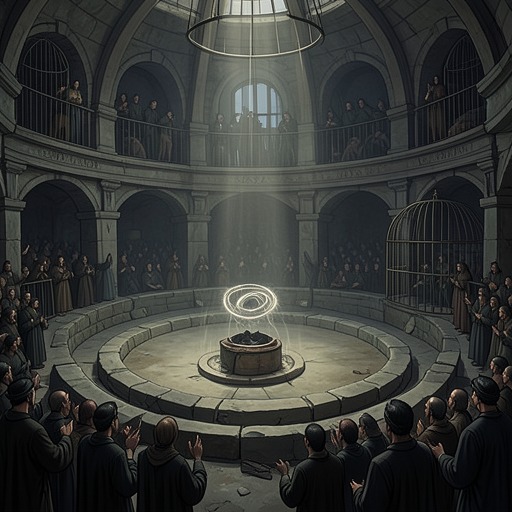
Calots appear among the wild animals used in the Warhoon games, where they are released against human prisoners. Sola warns John Carter and Dejah Thoris that they are to be thrown to the wild Calots in the great arena. At the games, packs of twelve are set against green Martian women armed only with daggers. The contest treats both people and animals as instruments of public spectacle: prisoners fight for survival, while the animals are made part of a sequence of lethal matches.
The Calot also figures in the Thark custom of punishing disobedient thoats. Carter’s account explains that a man who is thrown by his mount may face a struggle with the animal and that the consequences can be fatal. These episodes establish a world in which powerful animals are not merely companions or property but participants in a dangerous order of labor, punishment, and entertainment.
Woola as Guardian
Carter’s first experience with a Martian watchdog is with the creature assigned to guard him while he is captive among the green Martians. Left alone with Carter, the animal watches him and lies across the only exit. It remains his careful guard throughout his captivity, twice saving his life and never voluntarily leaving him. The account thus gives the Calot a continuing role rather than limiting it to a frightening appearance or a single rescue.
That protective role becomes unmistakable when a great ape is about to attack Carter. Woola bursts into the room and confronts the attacker, giving Carter the chance to get to his feet. The episode presents Woola’s intervention as an act with immediate stakes: the animal does not simply obey a command but responds to danger and protects the person to whom he has become attached.
Kindness and Reciprocity
Woola’s relationship with Carter shapes how Carter treats his own thoats. Rather than relying on the customary blows used to force the animals into obedience, Carter first establishes his authority and then gradually wins their confidence. Within days they follow him closely, nuzzle him, and respond readily to his commands. The contrast is practical as well as ethical: Carter argues that a trusted mount is more dependable on the march and in battle, where an animal’s unpredictable resistance can turn victory into defeat.
Carter’s example makes kindness a form of effective care rather than a rejection of strength or discipline. The animals’ responsiveness is visible in their conduct, and the green Martians interpret it as an extraordinary power. Woola’s bond with Carter therefore extends beyond personal affection: it provides the model for a different relationship between a warrior and the animals on whom he depends.
Persistence and Significance
After Carter, Dejah Thoris, and Sola escape, they become lost in the wasteland. Woola has followed them across the trackless country and comes to rest beside Carter, sharing the group’s danger. Carter embraces him, moved by the animal’s evident devotion. The party must press on, however, and one thoat collapses from exhaustion; Carter leaves it with its trappings after deciding against killing it, then continues with the remaining mount. The scene places animal fidelity and human survival side by side without making the journey easy for either.
Later, when Carter is separated from Dejah Thoris and wanders alone, Woola appears again and saves him from an attacking beast. Carter recognizes his companion by the light of the moon and is relieved to see him, while also fearing that Woola’s absence from Dejah Thoris means she has died. Woola is visibly weakened by hunger, and after eating the dead animal he resumes the search with Carter. The reunion therefore carries both comfort and uncertainty: Woola’s loyalty is clear, but his arrival cannot tell Carter what has happened to Dejah Thoris.
Across these episodes, the Calot’s significance lies in the contrast between its use as a weapon or spectacle and its capacity for sustained attachment. Woola’s actions repeatedly affect the course of Carter’s survival, while Carter’s treatment of animals turns companionship into a practical source of trust. The novel presents that bond through concrete acts of guarding, following, and rescue rather than through speech or explanation.