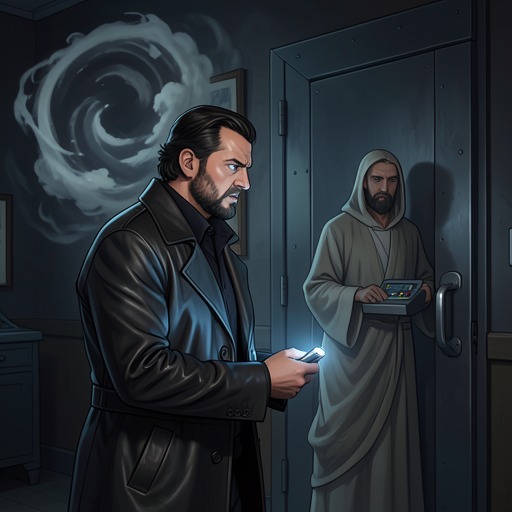
Captain Carter’s manuscript
A Princess of MarsCaptain Carter’s manuscript is John Carter’s account of his life, death, and experiences on Mars, presented within a frame that treats it as both a private testament and a document withheld from the world. Its preservation instructions govern when the story may be read, while its ending leaves Carter’s central question unanswered: whether the atmosphere on Mars was restored in time and whether Dejah Thoris survived.
Origin and Custody
The manuscript enters the book through a foreword by Edgar Rice Burroughs, who recalls Captain Carter as a tall, athletic, sociable man known to the children as Uncle Jack. Carter spent several months at Burroughs’s father’s home in Virginia before the Civil War and later returned for about a year. Though he said he had prospected and mined in Arizona after the war, he refused to discuss the details of those years. His reticence gives the manuscript the character of a delayed explanation for a life that had long seemed mysterious to those who knew him.
During a visit to Carter’s cottage on a bluff above the Hudson in the winter of 1885, Burroughs found him occupied with writing. Carter gave him a key to a compartment in the study safe and instructed him to take charge of the estate if anything happened. Burroughs later saw him at night on the bluff with his arms raised toward the sky, a posture that acquired a grim echo when Carter’s body was found in the snow at the same place. A coroner’s jury, finding no marks of violence, concluded that he had died of heart failure.
The safe contained instructions that made Burroughs both executor and custodian. Carter ordered that his body be taken to Virginia without embalming and placed in an open coffin inside a tomb he had already arranged to have built. He insisted that Burroughs personally ensure the plan was followed, secretly if needed. His estate was arranged so that Burroughs would receive its income for twenty-five years before inheriting the principal. Separately, the manuscript was to remain sealed and unread for eleven years, and its contents were not to be divulged until twenty-one years after Carter’s death. The account therefore reaches its audience under a timetable stipulated by its narrator before death.
The Testament and Its Narrative Frame
Carter begins by describing himself as apparently ageless: he says he has never aged as other men do, does not remember childhood, and still appears as he did decades earlier. Although he believes he has died twice and remains alive, he fears that a final death will eventually come. That conviction prompts him to write down the significant periods of his life and death, including the ten years his dead body lay undiscovered in an Arizona cave. The manuscript is not presented as an explanation of the phenomenon; Carter says he cannot explain it, and instead offers what he calls a chronicle of events.
His stated reason for keeping the account from readers is a fear of public disbelief and ridicule. He expects that people will reject what they cannot comprehend, yet hopes that his observations and knowledge of Mars may eventually help science understand the planet. This tension—between the anticipated refusal to believe and the hope of future confirmation—casts the narrative as testimony addressed to a later, more receptive audience. Its technical detail reinforces that posture: Carter reports, among other things, the construction and capabilities of Martian rifles, the scientific purpose of Dejah Thoris’s expedition, and the workings of the machinery that produces the planet’s artificial atmosphere.
The chronicle shifts between extraordinary adventure and procedural explanation. Carter describes his arrival near the edge of a long-dead Martian sea and the approach to a deserted city occupied by his captors; elsewhere, he records the use of radium projectiles and explains how the ninth ray is separated, stored, treated, and pumped to the planet’s air centers. He also describes the one-person aircraft he learns to fly, including its dimensions and its use of the eighth ray for propulsion. These accounts make the manuscript more than a record of personal encounters: it is also Carter’s proposed store of knowledge about a world whose survival depends on technical systems.
Mars as Recorded Knowledge and Peril
The manuscript’s scientific disclosures acquire their greatest narrative weight when the atmospheric system fails. Carter records the explanation that the ninth ray is gathered by instruments on the roof of a vast building, stored in reservoirs, and combined with refined electric vibrations before being pumped to five principal air centers. A reserve is said to be sufficient for a thousand years, but the system depends on functioning pumps. Carter learns that twenty radium pumps are installed, each capable of supplying the planet, and that two keepers divide the isolated watch, each spending half a Martian year alone at the plant.
That technical account becomes the basis of a planetary emergency. Tardos Mors reports that the keeper has failed to send a wireless message for two days, that the assistant keeper’s body has been found, and that instruments show air pressure rapidly decreasing across Mars. The earlier description of dependable machinery thus becomes a measure of the danger: a system built to sustain life for ages has stopped, and access to its interior is difficult. The manuscript preserves both the mechanism and the moment its failure threatens everyone who depends on it.
Carter also records Dejah Thoris’s account of the expedition that brought her into captivity. She identifies it as a scientific research party sent by her father’s father, the Jeddak of Helium, to rechart air currents and take atmospheric-density measurements. The party was unprepared for battle because it came on a peaceful mission, marked by its banners and craft colors. In her explanation, the research serves the wider population of Mars: the work helps maintain the planet’s air and water supply. The manuscript consequently links scientific observation, political conflict, and the material conditions of life on the planet.
The Ending and Its Unanswered Question
The manuscript’s final crisis is not resolved within the account available here. After leaving the cave, Carter looks toward Mars and wonders whether the keeper reached the pump room and whether air reached the inhabitants in time. He is also unsure whether Dejah Thoris is alive or lies beside the small golden incubator in the palace garden. Those questions remain open rather than becoming retrospective facts: Carter says that for ten years he has waited and prayed for an answer and for the chance to return to the world where his lost love remains.
The frame intensifies rather than settles that uncertainty. Carter’s body is said to remain in a tomb whose massive door has a single gold-plated spring lock that can be opened only from the inside. The extraordinary lock, the instructions for an unembalmed body, and the manuscript’s delayed release all connect the outer narrative to the account’s recurring uncertainty over death and return. Yet the foreword does not confirm that Carter has awakened or returned to Mars. It leaves readers with the document, the sealed tomb, and a hope whose outcome the narrative has not disclosed.
Literary Function
The manuscript’s form makes preservation part of the story. Burroughs supplies an external witness who recounts Carter’s habits, death, will, and unusual arrangements; Carter then supplies the first-person chronicle that the witness was ordered not to read for eleven years. The reader is thus positioned after the events but inside a chain of custody that began with Carter’s deliberate secrecy. The foreword’s practical details—safe, key, sealed pages, estate, and tomb—give material form to the question of whether his testimony can be trusted or even fully understood.
Its combination of personal memory and technical exposition also shapes the meaning of Carter’s account. The immense range of the story is filtered through one narrator who admits that he cannot explain his own condition but records precise information about Martian weapons, aircraft, and atmospheric machinery. That contrast allows the manuscript to claim the authority of an eyewitness without promising complete understanding. Its final power lies in the distance between what it records with confidence and what it cannot answer: the fate of Mars, the survival of Dejah Thoris, and whether Carter will ever return.