Capture of Zandaka and rescue of Deyaa Solis
A Princess of MarsThe fall of Zodanga and the rescue of Dejah Thoris are the linked military and personal climax of John Carter’s campaign against the city: he leads Tars Tarkas’s assembled Thark army to its walls, enters the palace during a marriage ceremony, and breaks the chain intended to bind Dejah Thoris to Sab Than. The covert plan becomes an open battle, leaving Than Kosis and Sab Than dead and the great hall in Thark hands. The rescue is achieved, but the victory is measured in the destruction of Zodanga’s ruling household and nobility.
Causes and Preparation
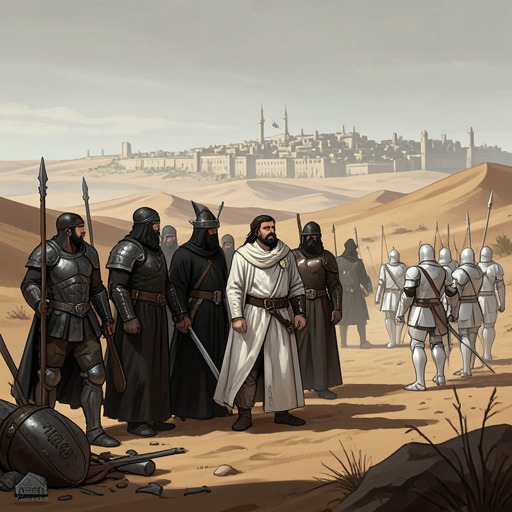
The assault draws its force from more than the promise of plunder. Tars Tarkas raises an army by appealing to the Tharks’ appetite for loot, but the march also brings their separate hordes together against Zodanga, whose campaigns of extermination have targeted the Green Martians, especially their incubators. The Zodangans’ attacks turn old quarrels among the Tharks outward: as the army approaches, hostility toward the city helps suppress rivalries within the coalition.
Three days after the call to arms, the Tharks begin marching toward Zodanga one hundred thousand strong. They travel by night and shelter by day in deserted cities, keeping even their animals indoors. Along the route, Tars Tarkas persuades warriors from additional hordes to join. Ten days after setting out, the force reaches the city at midnight with one hundred and fifty thousand warriors. The scale of the army makes the expedition unprecedented in Barsoomian history, while its internal divisions make it difficult to hold together; Tars Tarkas’s political skill is as important as his command of its numbers.
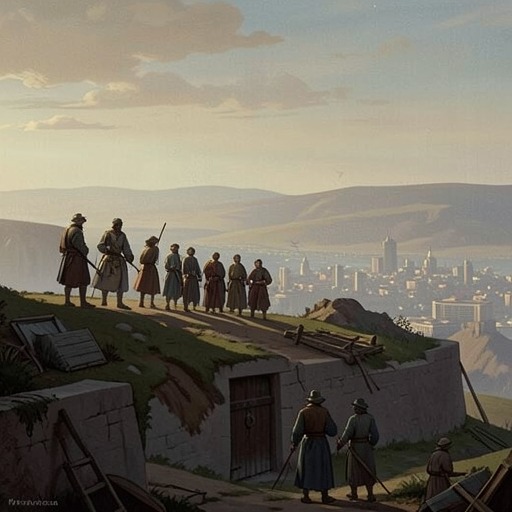
Carter is assigned the problem of getting the force inside walls regarded by his escort as unbreachable. The walls rise seventy-five feet and are fifty feet thick, built of enormous blocks of carborundum. At a small gate, he turns the Tharks themselves into a climbing structure: warriors lock arms against the wall, others mount their shoulders, and Carter runs up the successive human tiers to reach the top. He lowers a joined leather strap down the far side and drops to the avenue, then uses a gate-opening method he learned from Kantos Kan to bring his twenty warriors inside. The breach depends on Carter’s agility and knowledge, not on a direct assault against the masonry.
Infiltration and the Ceremony
Once inside, Carter discovers that he has entered at the lower edge of the palace grounds. Rather than wait for the whole army, he divides the operation: a larger Thark force is to attack the soldiers’ barracks, while he leads a small detachment toward the palace. He sends for fifty warriors and orders that the gates be opened quietly, with no shots and no general advance until his party is in position. The plan works; the sentries and gate guards are overcome without raising an alarm, and Tars Tarkas rides through the opened gate with the Tharks.
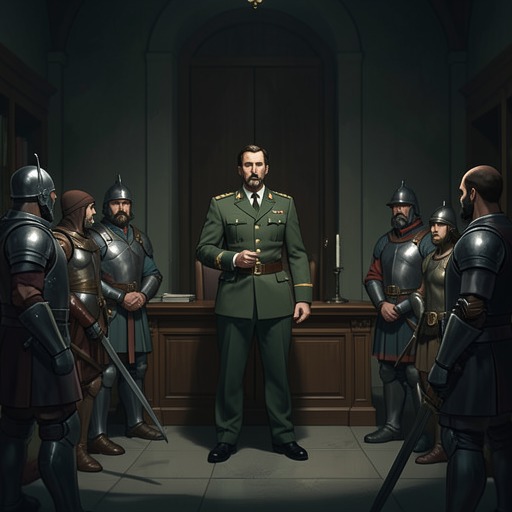
The palace is brightly lit, and its audience chamber is crowded with nobles and their women. From outside, Carter watches a formal procession approach Than Kosis’s throne. Officers carry a golden chain with collars and padlocks, followed by the ornaments of a Zodangan prince and princess. Two figures, concealed beneath scarlet silk, take their places before the ruler. When one is uncovered, Carter recognizes Sab Than; when the other is revealed, he sees Dejah Thoris. The ceremony is not a negotiation or a threatened match but an imminent marriage intended to join the princess of Helium to the prince of Zodanga.
The political stakes of the ceremony reach beyond the couple. Dejah Thoris is a princess of Helium, and her marriage to Sab Than would bind her to the ruling house of the city whose forces have long opposed her people. Carter has also learned that she and her expedition had been on a peaceful scientific mission: they were surveying air currents and atmospheric density, work she describes as necessary to sustaining life on Mars. Her account frames the conflict against the shared environmental dependence of the planet’s peoples, even as the Thark assault turns that conflict into a struggle for control of the palace.
The Rescue and Battle
Seeing Than Kosis raise the golden collar, Carter abandons concealment. He breaks through the great window, reaches the throne platform, and strikes the chain before it can be fastened around Dejah Thoris. Sab Than attacks with a dagger, but Carter restrains him rather than killing him, held back by Barsoom’s custom against killing a member of the opposite sex. The moment places the rescue under the pressure of two codes: the ceremony’s intended binding and the customary limit on Carter’s response to the prince’s attack.
Carter announces that Zodanga has fallen and points toward the entrance, where Tars Tarkas and his fifty warriors ride into the palace. The fighting spreads through the hall as Zodangan soldiers and nobles charge the Tharks. Carter pushes Sab Than away from the platform and draws Dejah Thoris beside him. Than Kosis confronts him with a sword, and Carter engages him while attempting to keep Dejah Thoris safe. When Sab Than comes up to help his father, Dejah Thoris steps between them; Carter’s sword strikes Sab Than, making him the new jeddak even as Than Kosis falls dead.
The death of Than Kosis does not end the danger. Sab Than breaks free, joins several officers, and fights Carter again. Carter is forced to defend himself without killing the new ruler, because Sab Than’s survival remains his last possibility of winning Dejah Thoris. Other officers join the attack, and some call for Dejah Thoris to be killed, accusing her of plotting against them. Carter tries to move her toward a narrow doorway behind the throne, but the officers block his route. Tars Tarkas cuts through the surrounding crowd and reaches the platform, turning a trapped defense into a final stand alongside the Thark leader.
The battle ends only when no Zodangans remain alive in the hall besides Dejah Thoris and Carter. Sab Than lies dead beside his father, and the bodies of Zodanga’s leading nobility and chivalry cover the floor. The narrative makes the cost inseparable from the rescue: the chain is broken and Dejah Thoris is saved, but the palace’s ruling household and a large part of its elite have been killed. The scene’s outcome is not a bloodless change of power but the destruction of the court through which Zodanga’s authority was represented.
Aftermath and Significance
With the fighting over, Carter’s first concern is Kantos Kan, whose mission had failed and who is being held in the palace dungeons. Leaving Dejah Thoris in Tars Tarkas’s care, he takes twelve warriors into the prison. The jailers have gone to join the fighting, so the search proceeds without opposition; calling Kantos Kan’s name through the corridors, Carter eventually hears a faint answer and finds him in a dark recess. The rescue of Dejah Thoris therefore opens directly into a second recovery: the assault brings Carter’s imprisoned ally back into the action as well.
As an adventure plot, the episode joins invasion, infiltration, rescue, and personal rivalry in one sequence. Carter’s practical knowledge opens the city; Tars Tarkas supplies the organized force; the ceremony gives the attack its immediate deadline. The turning point comes when Carter’s attempt to remain concealed becomes an intervention at the throne, and the rescue then forces him to fight under constraints that complicate straightforward victory. The private aim of saving Dejah Thoris is fulfilled through a public conquest, while the scale of the Thark victory exposes the cost of treating the city and its people as spoils of war.
The event also holds a tension between the novel’s language of political and cultural reform and its military resolution. Dejah Thoris had urged the Tharks toward amity, shared work, and a renewed commitment to the survival of a dying planet; the Tharks’ march is instead mobilized by the promise of Zodanga’s loot and their hatred of its attacks on Green Martian incubators. The assault can be read as answering a history of violence, but its ending does not establish reconciliation: the old ruler and his heir are dead, the city’s elite has been destroyed in the hall, and the immediate achievement is the liberation of a captive princess and the victory of an army.