Five-year Martian egg incubation period
A Princess of MarsThe five-year Martian egg incubation period is both a biological interval and a governing institution in Green Martian society. Eggs are selectively preserved and incubated on a tightly managed schedule; children are then raised communally, without knowledge of their biological parents. The system’s effort to control survival and population also creates the conditions for Sola’s concealed birth, the loss of her mother, and the revelation that Tars Tarkas is her father.
Biological and Communal Framework
Green Martians emerge from eggs after five years, already developed except for their smaller size. Their mothers are not identified to them, and the community assigns child-rearing to the females who capture the newly hatched young. The hatchlings are taught to speak and use weapons, while parental and filial attachment has no recognized place in the social order.
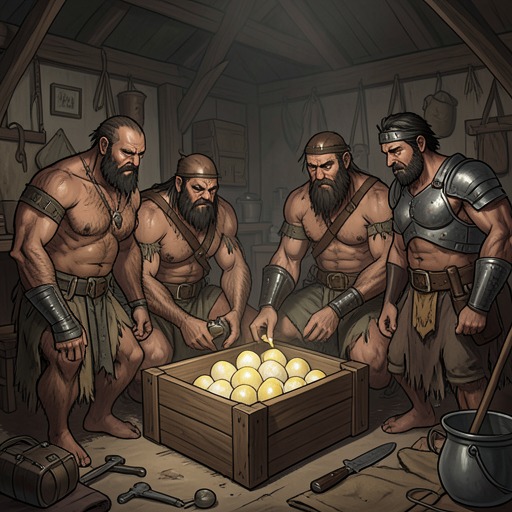
The timetable is part of a broader effort to regulate population on a planet described as losing resources. Adult females produce about thirteen eggs a year. Eggs that meet tests of size, weight, and specific gravity are kept in cool subterranean vaults, where they remain before incubation; a council of twenty chieftains examines them each year and destroys all but about one hundred of the most promising eggs from each annual supply. After five years of selection, roughly five hundred eggs are placed in nearly airtight incubators, where the sun’s rays bring them to hatching over another five-year period.
The hatching witnessed by John Carter was presented as typical: all but about one percent of the eggs hatched within two days. The fate of eggs that did not hatch was unknown, but they were not wanted because a tendency toward prolonged incubation might be inherited and disrupt the timetable. Incubators were built in remote places to protect a community’s future supply of children; discovery by another tribe could leave that community without children for another five years.
Sola’s Hidden Birth
Sola’s history shows how a private parent-child bond could exist beneath the communal system. Her mother was considered too small for the responsibilities of maternity under a society that bred chiefly for size. She also recoiled from the cruelty of her people and, while wandering among the hills near Thark, formed a relationship with a young warrior who guarded the feeding Thoats and Zitidars. Their attachment violated Green Martian custom, and they kept it secret for six years.
Sola’s egg was concealed beneath a large glass vessel on the highest, least accessible of the partly ruined towers of ancient Thark. During the five years of incubation, her mother visited once each year. Her lover advanced as a warrior, hoping eventually to take the metal of Tal Hajus and gain the power to claim and protect his family. Before he could do so, he was sent on a four-year expedition to the southern regions.
The egg hatched about a year after his departure. Sola’s mother kept the child hidden in the tower and visited her nightly, giving her the care that communal upbringing would have denied. When a returning caravan brought young Tharks back to the city, she slipped onto a chariot and carried Sola into the plaza. There she mixed the child with the other hatchlings, who were gathered, fed, and assigned to chieftains’ retinues the next day. The public distribution concealed Sola’s origin, but it also separated her from her mother for good.
Consequences and Revelation
Tal Hajus imprisoned Sola’s mother and sought the identity of the child’s father. She said she had killed Sola to spare her from the same fate, while Sarkoja alone disbelieved the story and suspected the child’s true origin. Sola later learned that Sarkoja had betrayed her mother, whose loyalty to her lover had kept the father’s name secret. Sola eventually entrusted John Carter with that name: Tars Tarkas. He did not know her as his daughter, and Sola’s disclosure made the hidden biological relationship available as knowledge that could affect him, Dejah Thoris, or herself.
The incubation period therefore carries two sharply different meanings. Publicly, its measured duration and selective procedures serve collective survival by controlling which eggs hatch and when; privately, the same five-year interval shelters a child whose existence depends on a concealed family bond. The system can produce a predictable population, but it cannot erase the kinship and affection that its rules refuse to recognize.