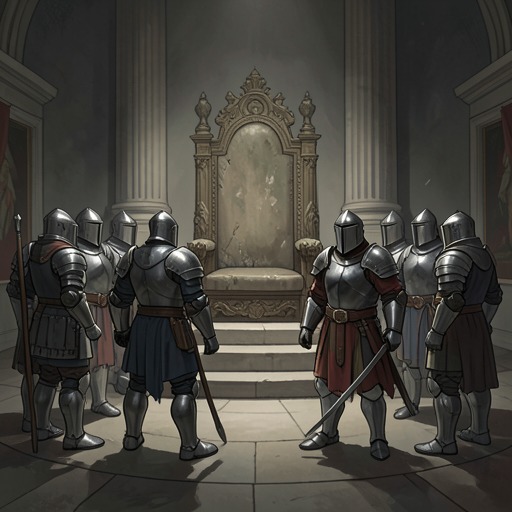
Green Martian Combat Succession Custom
A Princess of MarsGreen Martian Combat Succession Custom makes a ruler’s authority answerable to combat: when a jeddak’s fitness is challenged, a sanctioned fight can decide who rules, and victory transfers the title. Its operation is visible among the Warhoons and the Tharks, where public challenges and communal assent turn personal violence into a political verdict. The custom gives martial achievement formal consequence, but its legitimacy is inseparable from the brutal cost of proving it.
Authority and Custom
The custom does not make every challenge an automatic transfer of power. Among the Warhoons, Bar Comas, the young jeddak, first asserts that Dak Kova will die only as the ruler decides. Dak Kova answers by challenging Bar Comas’s authority and accusing him of weakness. Bar Comas responds by attacking without drawing a weapon; the dispute becomes a contest between ruler and challenger, rather than an execution ordered by the ruler.
The episode distinguishes a ruler’s decision from the eventual basis of his authority. Bar Comas refuses to yield to Dak Kova’s demand, but the outcome is settled by their combat and the survival of one claimant. The contest therefore functions as a test of rule as well as a physical encounter: the claim to lead is made public, and victory supplies the answer.
Warhoon Succession
Bar Comas initially has the advantage. The narrative describes him as stronger, quicker, and more intelligent, and the fight appears close to its conclusion when he slips while breaking away from a clinch. Dak Kova uses that opening to turn the encounter, and both warriors lie dead after the fight. The apparent victor cannot immediately claim the title: Bar Comas is dead, and Dak Kova is so badly injured that the succession remains unsettled for three days.
When Dak Kova can walk without assistance, he goes to the body, places a foot upon the neck of his former ruler, and assumes the title of Jeddak of Warhoon. The public, bodily gesture marks the change in authority; the delayed claim makes clear that victory alone does not complete the succession until the survivor can take up the role. Bar Comas’s remains are treated according to the custom surrounding the defeated ruler, while the fighting has also delayed a Warhoon expedition. Succession thus resolves a contest for command but carries consequences beyond the two combatants.
Thark Succession
A second succession takes place at a Thark council, where John Carter argues that Tal Hajus has failed to demonstrate the bravery expected of a jeddak. Carter contrasts Tal Hajus’s absence from the day’s fighting with his treatment of defenseless people, then points to Tars Tarkas as a warrior whom the assembled chieftains respect. His speech makes the standard of fitness explicit: rule should belong to the warrior able to meet the demands of combat, not merely to the incumbent.
Lorquas Ptomel puts the claim to the council. The twenty chieftains around the rostrum raise their swords in assent, and the decision leaves Tal Hajus no alternative but to fight Tars Tarkas. The council’s action is essential: it turns Carter’s accusation into an authoritative challenge under Thark custom. Tars Tarkas kills Tal Hajus and, with his foot upon the dead ruler’s neck, becomes jeddak. Unlike the Warhoon encounter, this succession ends with one contender surviving; in both cases, however, the new ruler’s claim is made legible through a public victory over the former authority.
Recognition and Consequences
Succession by combat belongs to a wider social order in which martial conduct is publicly evaluated and rewarded. In an earlier audience, John Carter’s single blow against a warrior earns the approval of the assembled Martians; he later learns that the dead man’s equipment and position have been accorded to him as the honors due a conqueror. The episode does not itself transfer a jeddak’s title, but it shows how combat can alter rank and status before it determines political leadership.
The custom also constrains how challenges are fought. When Zad strikes one of Carter’s thoats, Carter understands that he must answer with Zad’s chosen weapon or a lesser one; he cannot claim the right to use a firearm or spear against an opponent armed with a long-sword. This rule is not itself a succession procedure, but it illustrates the customary framework in which combat has recognized terms. Across the episodes, the system grants authority through strength while limiting how that strength may be demonstrated.
The narrative sets these public contests against the surrounding violence of Green Martian life: combat can win a chieftain’s standing, decide a ruler’s fitness, and redirect a community’s political course, while the death of a claimant may delay an expedition or change who commands a people. Carter’s speeches can expose and mobilize the custom, but the decisive act remains the community’s recognition of a fight and its outcome. The custom is therefore both a mechanism of succession and a stark measure of the society it governs: political legitimacy is tested in combat, and the victor’s authority emerges from a practice that treats lethal force as an accepted means of judgment.