Green Martian communal social system
A Princess of MarsThe Green Martian communal social system makes the community, rather than the household, the primary unit of ownership, reproduction, and child-rearing. Its elaborate controls answer the pressures of a resource-poor, declining planet, but they also detach children from their parents, regulate intimacy, and make survival conditional on physical fitness. The concealed family history of Sola shows how private love persists within this order—and how it can become a source of danger and political consequence.
Collective Property and Retinues
Among the Green Martians, nearly all property belongs to the community. An individual’s recognized possessions are limited to personal weapons, ornaments, and sleeping silks and furs; even these cannot be accumulated beyond actual need. What exceeds that need is held in custody and passed to younger members when required. When John Carter inherits the belongings of two slain chieftains, women and youths arrive in successive loads to transfer the goods, demonstrating that the community treats individual holdings as a responsibility subject to established custom, not unrestricted private wealth.
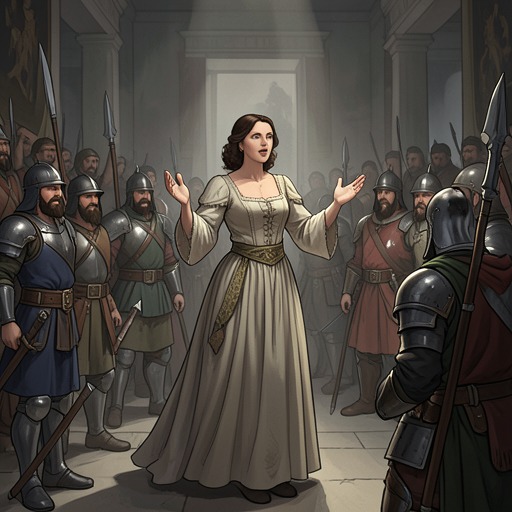
A chieftain’s retinue is likewise not a family or household in the ordinary sense. The women and children attached to a man’s group form something like a military unit for which he is responsible: he oversees their instruction, discipline, and sustenance as the community moves and fights. The women are not wives, and Green Martian society has no word corresponding to that institution. The arrangement places care within a public and martial structure rather than a private bond, even as it makes the leader answerable for the people assigned to him.
Reproduction and the Selection of Children
The communal system begins before birth. Green Martian females produce about thirteen eggs each year. Eggs that pass tests of size, weight, and specific gravity are kept in cool underground vaults, where incubation does not begin. Each year a council of twenty chieftains examines the stored eggs and destroys all but about one hundred of the most perfect. After five years, roughly five hundred selected eggs are moved to nearly airtight incubators, where the sun’s rays hatch them after a further five-year period.
The resulting hatch is not simply a matter of allowing all young to survive. In the representative hatching Carter witnesses, all but about one percent of the eggs hatch within two days. The account says that the fate of any later hatchlings is unknown; they are not wanted, because prolonged incubation could be inherited and disrupt the system’s ability to estimate when the adults will return to the incubators. Incubators are built in remote strongholds to protect them from other tribes: discovery could leave a community without children for another five years.
Once the young emerge, they are caught and assigned to adult women and older children. The women and young people form lines through which the newly hatched children run, and each is captured in turn; those caught by young men are later handed to women. The foster parent need not have contributed an egg. Sola, for instance, had only begun laying eggs less than a year before she became responsible for another woman’s child. Biological maternity and the work of raising a child are thus deliberately separated.
The account describes early education as teaching children to speak and to use weapons, which are placed upon them from their first year. Children are understood as common to the community, and their upbringing falls to whichever women capture them at the hatchery. Those judged deformed or defective are killed; the system selects for hardiness and permits the young to live only if they demonstrate the physical capacity to survive. The passage stresses that adults do not necessarily act from deliberate cruelty: their practices are framed as an answer to the burden each additional life imposes on a community with dwindling natural resources. By careful selection, the Green Martians seek to make births offset deaths rather than increase the population.
Intimacy, Kinship, and the Cost of the System
The council of chieftains controls mating as a matter of community interest, directing it without reference to natural selection. The narrator compares this management to the controlled breeding of a racing stud, a comparison that makes explicit how reproduction is treated as a collective resource. In the system’s own terms, individual desire and parenthood carry little weight beside the community’s calculation of offspring and survival.
Carter judges the consequences harshly. He links the priority given to communal offspring over a mother’s attachment, and the long practice of managed reproduction, to the Green Martians’ coldness and lack of humanitarian feeling. The social order may appear efficient in theory, but its resulting lives are described as gloomy and loveless. His interpretation is not that every adult intends harm to children; rather, an unforgiving environment has produced institutions in which a child’s worth is measured by usefulness and physical capacity, while affection has little recognized place.
The system’s severity also connects to a broader pattern of mortality. Only a small minority of Martians are said to die of disease, while most deaths result from violence, including duels, hunting, aviation, and war; many children are killed by the great white apes. Adult life expectancy is about three hundred years, though it could approach one thousand without violent deaths. The narrator connects the planet’s waning resources, the long lives made possible by medical skill, dangerous sports, and continual warfare to a society that treats life lightly. He also notes that Martians of either sex are never voluntarily without a weapon. These details place the reproductive controls within a world where population, survival, and violence are tightly entangled.
Sola’s Hidden Family and the Limits of Communal Control
Sola’s history reveals what the system excludes from its official account of kinship. Her mother was considered too small to be entrusted with maternity under a culture that bred principally for size. She was also less cruel than other Green Martian women and often withdrew from society to walk alone among Thark’s deserted avenues or sit among the wildflowers in the nearby hills. There she met a young warrior guarding the feeding Thoats and Zitidars. Their conversations moved from communal concerns to their own hopes and ambitions; when she confided her repugnance for the cruel and loveless life imposed by their society, he responded with affection rather than denunciation.
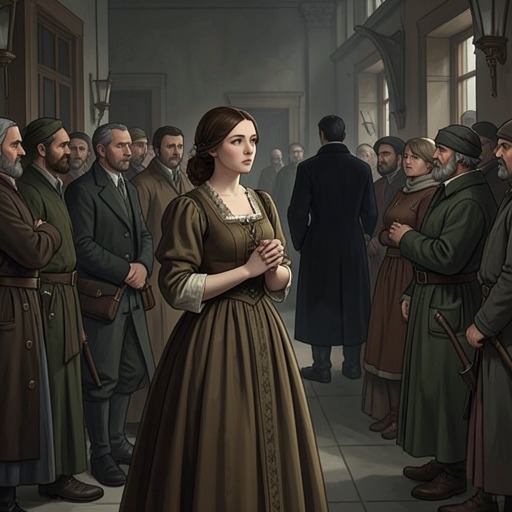
Their relationship remained secret for six years. Sola’s mother belonged to the retinue of Tal Hajus, while her lover was a simple warrior. Discovery would have exposed them to punishment before Tal Hajus and the assembled Tharks. When a returning caravan brought young Tharks to the city, Sola’s mother hid in its shadow, carried her child into the confusion, and mixed her with the other newly arrived children. The young were gathered, fed, and the next day distributed among the chieftains’ retinues. Sola never saw her mother again.
Tal Hajus imprisoned Sola’s mother and tried to force her to name the child’s father. She did not disclose him and eventually died under torture. To protect Sola, she claimed to have killed her child and cast the body to the white apes. Sarkoja alone doubted the story and suspected Sola’s origins, though she did not reveal what she believed she knew. The episode shows how communal assignment can erase the visible connection between a parent and child, while the hidden bond remains dangerous enough to invite betrayal and punishment.
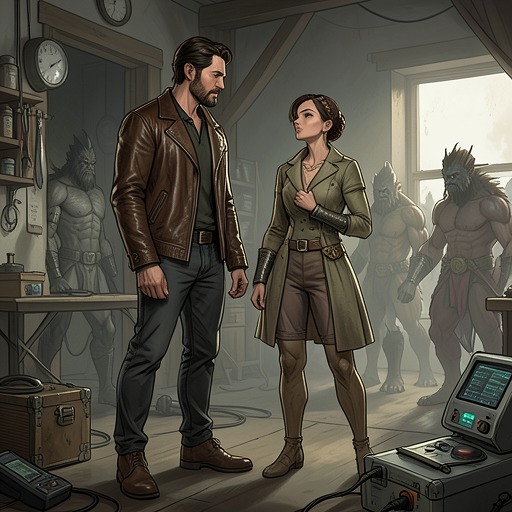
Sola eventually tells John Carter that her father is Tars Tarkas. She says that she trusts Carter to use the truth if it may help him, her father, Dejah Thoris, or herself, and places no restriction on what he may say. Her disclosure makes private descent politically significant: the system that separates children from parents cannot entirely extinguish knowledge of ancestry, loyalty, or love. Sola’s story therefore does more than illustrate an exception to communal practice. It reveals the emotional and political ties the system suppresses, and the human consequences that follow when those ties are forced into secrecy.