Green Martians and Red Martians
A Princess of MarsThe conflict between the Green Martians and Red Martians shapes both the violence of the story and its central question of whether Barsoom’s peoples can cooperate to preserve their world. It is not simply a succession of attacks: military hostility persists alongside practical interdependence, as Red Martian science helps sustain the air and water on which every people depends, while Green Martian resistance and customs obstruct that work. The contrast between those realities gives the conflict its political and planetary stakes.
Military Hostility and Unequal Encounters
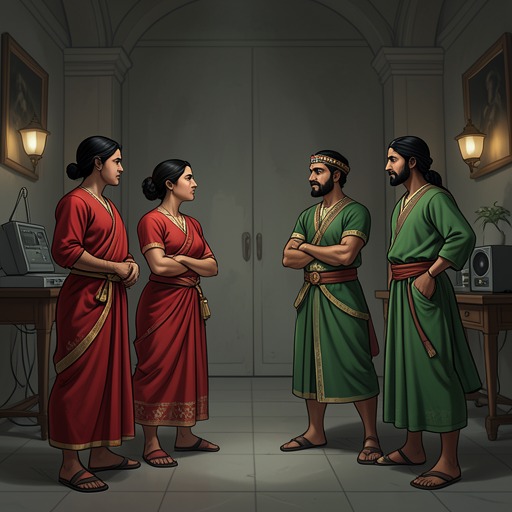
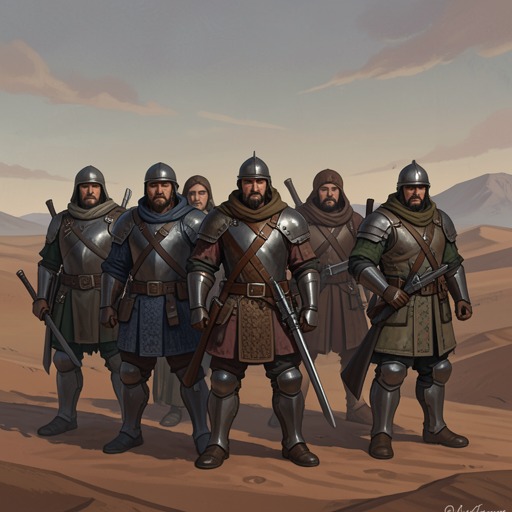
Green Martian warriors attack a Red Martian expedition that Dejah Thoris identifies as a peaceful scientific party. It had been sent by her grandfather, the Jeddak of Helium, to rechart air currents and measure atmospheric density; its banners and vessel colors, she says, identified its nonmilitary purpose. The Green Martians nevertheless open fire on the approaching airships from buildings facing the valley. The Red fleet returns fire, but the first volley has caught its crews and gun-sighting apparatus unprepared, and the Green warriors’ organized accuracy disables vessels and drives the fleet away. After twenty minutes, the surviving ships retreat; one badly damaged craft drifts back toward the city, apparently helpless. The encounter demonstrates how rapidly an expedition presented as peaceful can become a battle, and how the Green Martians’ coordinated fire gives them an advantage over an unprepared force.
The military imbalance has a material basis as well as a tactical one. Green Martian rifles are light, long-barreled weapons that fire explosive radium projectiles; their theoretical effective range is three hundred miles, though the best operational range with wireless finders and sights is a little over two hundred. The weapons’ reach and destructive power help explain why an attempt to flee on foot beneath the rifles of a Green Martian party seems hopeless. The encounter is therefore shaped not only by the opposing peoples’ hostility but by a technology that makes the battlefield exceptionally dangerous.
The Prisoner and the Political Stakes
The capture of Dejah Thoris turns the conflict into a personal and political crisis. Lorquas Ptomel identifies her as the granddaughter of the greatest Red Martian jeddak and the ruler’s bitter enemy. He considers her safe delivery to Tal Hajus so important that her capture is described as unprecedented in a thousand years. Her identity makes her more than a prisoner: she is a high-value representative of a power the Green Martians oppose.
John Carter occupies an unstable position within this conflict. Though a prisoner himself, he has gained authority among the Green Martians through his prowess and is treated as a Tharkian chieftain, while remaining an alien who owes them no allegiance. Lorquas Ptomel warns that plotting to escape with a prisoner of another race could warrant execution, and says the Green Martians may kill Carter without Tal Hajus’s orders if he attacks in self-defense or is caught escaping. The warning makes the political stakes of Dejah Thoris’s captivity immediate: any attempt to help her risks being treated as both a personal escape and a violation of Green Martian authority.
The hostility is reinforced by the society Carter encounters among the Green Martians. Dejah Thoris says they resent her ancestry and the status she represents, while she describes their communal system as one in which they possess women and children in common. Her criticism frames the conflict not only as a contest between rival powers but as a dispute over social life, kinship, and care. Carter’s account elsewhere emphasizes the gulf between their customs and his own, including a common amusement built around prisoners’ deaths. The narrative thus presents antagonism as reproduced through institutions and habits, not merely through a single military incident.
Dejah Thoris’s Appeal for Cooperation
After identifying the expedition’s scientific purpose, Dejah Thoris argues that its work serves the Green Martians as well as the Red. Red Martian labor and scientific operations, she maintains, have kept Mars’s air and water supply at nearly the same level for ages, despite Green Martian interference. She asks why the peoples cannot live in amity, and presents cooperation as a possible means of helping to regenerate a dying planet. Her appeal directly contests the assumption that the other people’s work is simply an enemy concern: environmental survival is a shared interest that war puts at risk.
The address briefly unsettles the Green Martian leaders. Lorquas Ptomel and the assembled warriors remain silent after she speaks, and Carter believes they have been moved. He sees an inward struggle in Tars Tarkas as the warrior rises to answer, a moment in which inherited custom and the possibility of kindness appear to pull in opposite directions. Yet the scene offers no confirmed political settlement. Its importance lies in exposing a possibility—Red and Green Martians acting together—that the entrenched conflict has so far prevented from becoming an agreement.
Shared Dependence and the Conflict’s Reach
The dependence Dejah Thoris describes is grounded in the machinery that sustains the Martian atmosphere. At the Atmosphere Plant, the ninth ray is separated from sunlight by instruments on the roof, stored in reservoirs occupying three-quarters of the building, and combined with refined electrical vibrations. Pumps send the resulting compound to five principal air centers, where contact with the ether of space transforms it into atmosphere. The account gives the plant enough stored ninth ray to maintain the existing atmosphere for a thousand years, but identifies a failure of the pumping apparatus as the danger. The planet’s life-support system makes the cost of political division larger than the fortunes of either people: their wars unfold within a world whose continued habitability depends on specialized knowledge and functioning infrastructure.
Later, the crisis becomes explicit when Tardos Mors reports that the atmosphere plant’s keeper has failed to send a wireless report for two days. A searching cruiser returns with the assistant keeper’s body, and instruments register rapidly decreasing air pressure across Barsoom: the engine has stopped. This emergency gives concrete force to Dejah Thoris’s earlier warning about the stakes of the Red Martians’ scientific work. The conflict’s central contradiction is stark: peoples who oppose one another militarily inhabit a shared, vulnerable environment, and the consequences of failure cannot be contained within the boundaries of a single faction.
Narrative Significance
The conflict is rendered through repeated contrasts between combat and cooperation, capture and fellowship, and factional interest and planetary need. Dejah Thoris gives the Red Martian position a direct voice, presenting scientific work as a public necessity rather than merely a tool of power. The Green Martians’ coordinated attack, their treatment of prisoners, and their resistance to Red influence show the force of the opposing order. The story does not treat a moment of apparent sympathy as an achieved reconciliation; instead, it places the possibility of cooperation beside the customs and political interests that continue to frustrate it. In that tension, the war becomes a test of whether shared dependence can overcome inherited enmity before Mars’s vital systems fail.