James K. Powell
A Princess of MarsJames K. Powell, a former Confederate officer and mining engineer, is John Carter’s partner in a late-1865 Arizona prospecting venture and the friend whose death precipitates Carter’s flight from their claim. Powell appears only briefly in the narrated events, but his practical expertise, trust in Carter, and sudden loss establish the personal stakes at the beginning of Carter’s account.
Identity and Background
Powell is introduced as Captain James K. Powell of Richmond, a fellow Confederate officer who prospecting with Carter after the Civil War. Carter describes himself and Powell as fortunate partners: after nearly a year of work and many hardships, they found a remarkable gold-bearing quartz vein. Powell, trained as a mining engineer, estimated that they had uncovered more than a million dollars’ worth of ore in a little over three months.
The scale of the discovery created an immediate practical problem. The partners’ equipment was crude, and developing the mine required machinery and a properly equipped workforce. Since Powell knew both the country and the mechanical demands of mining, the two men agreed that he should return to civilization to obtain what they needed. Carter would remain at the claim to guard it against the possibility that another prospector might take it.
Departure and the Attack
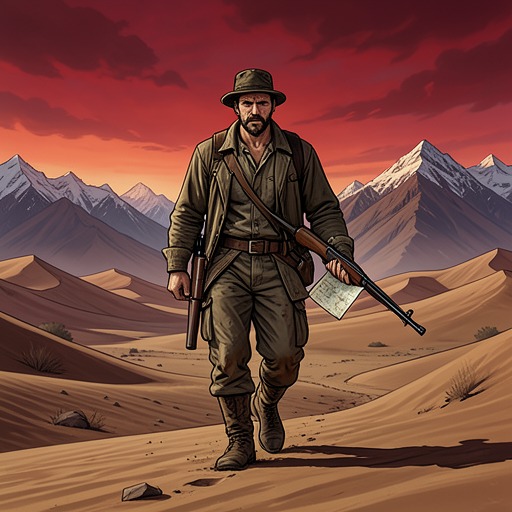
On March 3, 1866, Carter and Powell packed provisions onto two burros. Powell mounted his horse, said goodbye to Carter, and began the journey down the mountainside toward the valley. Carter watched him and the pack animals descend, catching further glimpses of them as they crossed the terrain. His last clear sight of Powell came at about three in the afternoon, as Powell entered the shadows of the range on the far side of the valley.
About half an hour later, Carter noticed three small figures near the place where he had last seen his friend. He tried to reassure himself that they were antelope or wild horses, but his unease grew. When he finally saw an attack under the Arizona moon, he reacted at once, drawing his revolvers and charging toward the warriors. Carter believed Powell was the center of the danger; his sudden approach scattered the attackers and revealed Powell lying on the ground, already pierced by arrows. Carter was convinced that Powell was dead, but he still acted to prevent the attackers from mutilating his friend’s body.
Carter reached Powell, pulled him across his horse, and chose to flee over the plateau rather than return by the route he had taken. The attackers realized Carter was alone and pursued him with arrows and rifle fire. The darkness, their surprise, and Carter’s movement helped him reach the surrounding mountain shadows before they could organize a more effective pursuit. Powell’s body, carried with Carter through the escape, remained the focus of the flight even as Carter sought safety.
Death and Carter’s Grief
After following a trail to a cave, Carter dismounted and laid Powell on the ground. He examined him carefully but found no sign of life. Although he knew that Powell was dead, Carter spent nearly an hour trying to revive him: he gave him water, bathed his face, and rubbed his hands. The effort ended only when Carter finally accepted that nothing could be done.
Carter’s account makes clear that Powell was more than a business associate. He remembers him as a polished Southern gentleman, a steadfast and true friend, and a man he was deeply fond of. That attachment explains why Carter’s effort to save him continued after death seemed certain, and why the loss marks the beginning of the story’s movement away from the mine and toward the cave. Carter left Powell’s body on the ledge before entering the cave to reconnoiter; there, after the strain of the ride and pursuit, he began to feel drowsy.
Narrative Role and Significance
Powell’s role is concentrated in the opening chain of cause and consequence: the partners’ discovery leads to the decision that he should travel for supplies; his departure places him on the route where he is attacked; Carter’s attempt to save him becomes a desperate escape; and the escape brings Carter to the cave. Powell does not accompany Carter beyond this opening episode, but his death gives Carter’s departure from ordinary life a concrete human cause rather than making it a simple adventure-seeking choice.
The episode also establishes a defining feature of Carter’s narrated character through action. He describes himself as someone who moves toward danger before considering alternatives, and his charge toward the attackers demonstrates that pattern. Yet the rescue attempt is not only an instance of courage: it is an act of loyalty to a friend whose partnership had begun in hardship and mutual trust. Powell’s brief presence therefore anchors the fantastic narrative in a specific loss, a failed rescue, and the enduring bond Carter recalls after the fact.