John Carter and Dejah Thoris
A Princess of MarsJohn Carter and Dejah Thoris are brought together as prisoners in the ruined city of Korad, where a missed signal first makes their relationship appear to be one of indifference and rejection. It becomes a bond of trust and love through acts of protection and honest disclosure: Carter risks himself for Dejah at the Thark council, while she comes to believe his extraordinary account of his origins. Their connection links the intimacy of two individuals to their shared vulnerability among the Tharks, and culminates in Carter recognizing that his love began at their first meeting.
First Meeting and Misunderstanding
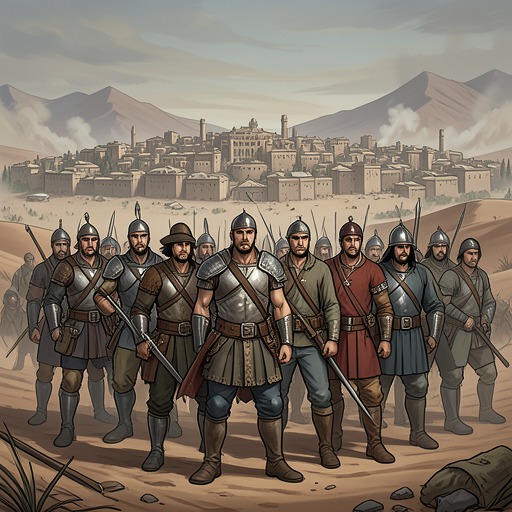
Carter first sees Dejah Thoris being taken from the battle craft and dragged toward a building by two Green Martian females. Her appearance recalls the women of his former life on Earth, but the first decisive exchange between them is not verbal. As she turns at the building entrance, she makes a small sign with her free hand. Carter does not understand it and fails to respond. Hope and renewed courage leave her face, replaced by dejection, contempt, and apparent loathing; Carter realizes that she had appealed to him for aid and protection, and that his ignorance made his silence look like a refusal.
That failure becomes the emotional starting point of their relationship. Carter’s first sight of Dejah brings hope and happiness mixed with fear and uncertainty, while her first impression of him is shaped by his apparent unwillingness to help. Their circumstances make the misunderstanding especially consequential: she disappears into confinement, and he is left to understand only afterward what her signal meant. The relationship begins, therefore, not with mutual recognition but with an act of attempted communication that neither can yet interpret correctly.
Protection and Recognition
At the Thark council, the earlier misreading is answered by action. When a young warrior strikes Dejah, Carter understands the danger before the blow lands and rushes across the hall. He attacks the warrior, fights at close quarters, and kills him. The other Martians do not intervene. Afterward, Carter helps Dejah to a bench and uses a piece of silk from his cape to stop the bleeding from her nose. His intervention transforms the meaning of their first encounter: the man who seemed to ignore her appeal now places himself at risk and protects her openly.
Dejah directly contrasts these two moments. She asks why Carter failed to acknowledge her when she was first in danger, yet now risks his life and kills one of his companions for her sake. The apparent contradiction makes her question who he is, since he has the form of her people but lives among Green Martians. Carter does not yet give her the full story; he tells her that he is her friend and, as far as their captors allow, her protector and servant. He describes his history as too strange to explain at that moment and too difficult to believe. The relationship is thus defined first by a concrete act of rescue, then by Dejah’s effort to understand the man behind it.
Trust and Disclosure
Carter and Dejah’s conversations gradually make trust possible. At one point, she asks him about places and beliefs associated with Dor and the River Iss. Carter replies that he is not from Dor, has never seen the Iss, and knows no lost sea of Korus. He is anxious that she believe him, an anxiety he himself recognizes as unusual. His concern is not fear of the consequences of being disbelieved; it is the importance her judgment has acquired for him.
Dejah says that she believes him. She does not know what a gentleman is and has never heard of Virginia, but she explains that on Barsoom a person who does not wish to speak truthfully remains silent rather than lying. This exchange gives Carter a way to explain his identity across their different worlds: he says that he is from Earth, a planet they know as Mars, and that he cannot explain how he came to Barsoom. Dejah’s belief does not resolve the mystery of his arrival, but it establishes a foundation of confidence between them. Her willingness to accept his account matters precisely because it is extraordinary and because she judges it by a moral custom of her own.
Companionship and Growing Attachment
After the council, Carter, Dejah, and Sola settle in a room on the second floor overlooking the plaza. Carter assigns the room to Dejah and Sola, with an adjoining room for cooking and supplies, and asks Sola to fetch bedding, food, and utensils. He remains behind to guard Dejah. She responds with a faint smile and gently points out that, as his fellow prisoner, she has nowhere to escape except with him; she also asks his pardon for the cruel thoughts she had harbored in the preceding days. Carter agrees that neither can escape unless they go together. Their shared captivity has become not merely a circumstance but a practical basis for mutual dependence and companionship.
As departure approaches, Carter has had little time with Dejah because Tars Tarkas has been teaching him Martian warfare and training his thoats. Dejah and Sola have explored nearby streets and buildings, accompanied by Woola, while Carter has warned them against wandering far because of the great white apes. On the evening before the departure, he seeks a private conversation with Dejah and sends Sola back to her quarters on an errand. He explains that Dejah represents the agreeable companionship he left behind on Earth, and feels that bonds of mutual interest connect them despite their birth on different planets, separated by roughly forty-eight million miles.
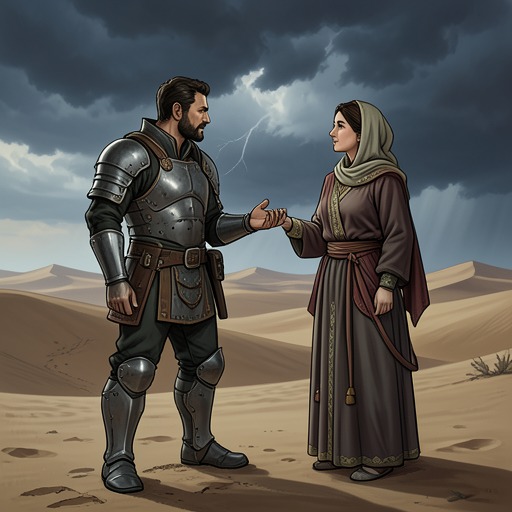
Dejah’s welcome confirms that the attachment is not solely Carter’s perception. As he approaches, the hopeless expression on her face gives way to a joyful smile, and she places her right hand on his left shoulder in the red Martian salute. She reports that Sarkoja has told Sola he has become a true Thark and that Dejah will see no more of him than of any other warrior. Carter rejects the report and calls Sarkoja a liar, despite the Tharks’ proud claim to absolute truthfulness. The exchange brings affection, social pressure, and distrust of Sarkoja into the same scene: Dejah has feared their closeness might be lost, while Carter makes clear that his growing place among the Tharks has not erased his regard for her.
Love and Narrative Significance
During a later walk beneath Barsoom’s two moons, with Earth visible in the sky, Carter removes his silks and places them across Dejah’s shoulders against the night chill. The gesture is small, but his account makes it a turning point in his understanding of their relationship. He feels an intensity he has experienced with no other person and is uncertain whether Dejah leans toward him; what he knows is that she does not draw away while his arm remains across her shoulders. The scene leaves the feeling partly unspoken rather than resolved through a declaration from both of them.
Carter nevertheless names his own realization plainly: he loves Dejah, and understands that the attachment began when their eyes first met in the plaza of Korad. In retrospect, the early sequence acquires a clear shape. Their first meeting is marked by her appeal and his inability to answer; the council scene reverses that failure through his immediate defense of her; belief and shared danger deepen their companionship; and the walk gives Carter a moment in which he recognizes what those actions and feelings have become. The relationship’s development is therefore conveyed through gestures and changes of expression as much as through explanation, with trust formed in the space between an initially misunderstood signal and a later, unmistakable act of protection.