John Carter is trapped on Earth and separated from Dejah Thoris
A Princess of MarsJohn Carter’s return to Earth at the end of A Princess of Mars reverses the apparent direction of his adventure: after ten years on Mars, he wakes in an Arizona cave, alive but cut off from Dejah Thoris and the world he had made his home. His return does not resolve the dangers he left behind. Instead, it leaves the fate of Mars and the woman he loves unknowable, making separation—not homecoming—the story’s final condition.
Return to the Arizona Cave
Carter opens his eyes in darkness wearing strange, stiff garments that crack and crumble as he sits up. He remembers having been naked when he fell unconscious at a little doorway; now he is clothed, and his hands find pockets and a small packet of matches wrapped in oiled paper. A match gives him enough light to see a vast cave and, at the back, the mummified remains of an old woman hunched over a charcoal burner and a copper vessel holding greenish powder. The scene establishes his return through physical evidence rather than explanation: his body has crossed back into an earthly setting, but neither the clothing nor the dead woman tells him what happened after he lost consciousness.
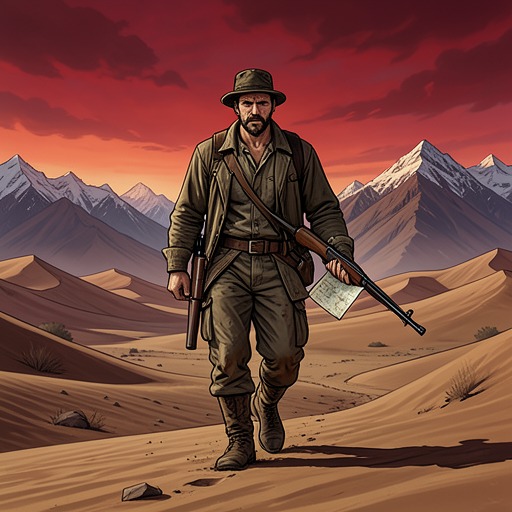
He leaves the cave and steps onto the ledge before its entrance. The moonlit mountains, cacti-studded valley, and nearly stationary moon are unmistakably Arizona, not Mars. Carter recognizes the place as the same ledge from which, ten years earlier, he had looked toward Mars with longing. The repeated vantage point makes the return a painful reversal: the landscape is familiar, but the longing has changed direction. He turns down the trail sorrowfully, while Mars shines above him, distant and silent.
The Unanswered Fate of Mars
The return leaves Carter with questions that have no answer on Earth. He does not know whether the Martian reached the pump room or whether vitalizing air reached the people of Mars in time. Most urgently, he cannot tell whether Dejah Thoris is alive or lies dead beside the tiny golden incubator in the palace garden of Tardos Mors, ruler of Helium. These are not separate uncertainties: the planet’s survival and the fate of the person he loves are joined in the unresolved crisis he has left behind.
For ten years on Earth, Carter waits and prays both for an answer and for a chance to return to the world of his lost love. He says he would rather lie dead beside her than remain on Earth millions of miles away. The strength of that wish makes clear that the return has not restored him to a settled home. It has placed him in a life defined by distance, with no means of knowing whether the catastrophe he fears has occurred.
Time, Wealth, and Separation
Carter discovers that the old mine remains untouched and makes him fabulously wealthy. The fortune has a concrete earthly consequence, but no power over the separation: he asks what wealth matters to him when the world he longs for lies beyond his reach. Material success thus sharpens rather than repairs the contrast between his circumstances on Earth and his attachment to Mars.
The frame of the account measures the loss across two spans of time. Carter has spent ten years waiting on Earth, and, as he writes from a small study overlooking the Hudson, twenty years have passed since he first opened his eyes on Mars. Mars is visible through the window, but its appearance in the sky supplies no communication from the people below. The passage of years enlarges the separation without answering the questions that began it.
The Closing Vision and Suspended Hope
On the night of his account, Carter feels that Mars is calling to him again. Across the distance, he imagines Dejah Thoris standing in a palace garden, a little boy with his arm around her as she points toward Earth, and Woola at their feet. The image offers a sharply specific counterpoint to the unknown: it is a vision of Dejah Thoris alive, a child beside her, and a faithful companion present, but it remains something Carter thinks he sees rather than proof that these figures are truly waiting.
Carter believes they are waiting for him and feels that he will soon know. The ending therefore turns the return into an open threshold rather than a completed homecoming. It permits hope, but does not confirm reunion, explain how Carter might cross the distance, or settle Mars’s fate. His final condition holds two worlds together in sight and keeps them apart in fact: Earth is where he waits, while the red planet remains the home whose answer he cannot yet reach.