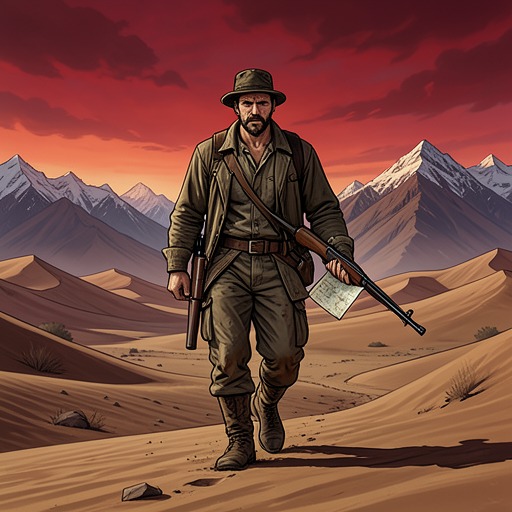
John Carter’s Journey to Barsoom
A Princess of MarsJohn Carter’s Journey to Barsoom is the passage from an Arizona cave to the surface of Mars, presented as both a bodily separation and a sudden journey through space. Its decisive turn comes when Carter, after an uncanny night beside his apparently lifeless body, fixes on Mars in the sky and is drawn toward it; he then awakens on the planet with immediate certainty that he has arrived. The episode converts an unexplained paralysis into the threshold of the novel’s planetary adventure.
The Cave and the Divided Body
For hours Carter remains unable to move, aware of his surroundings but unable to explain his paralysis. The silence is broken by a strange moan and the sound of movement in the cave. In response, he makes an effort of will rather than muscle: he cannot move even a finger, yet something seems to give, and he finds himself standing against the cave wall. The sequence makes the transition feel at once deliberate and beyond his control: his effort releases him, but it does not restore his ordinary physical condition.
Moonlight reveals the unsettling result. Carter sees his own body still lying on the cave floor, its eyes directed toward the ledge and its hands resting limply on the ground, while he stands elsewhere, naked. The contrast between the clothed body and the newly upright, unclothed figure makes his separation from his former physical position visible. For a moment, he interprets the change as possible death, but his pounding heart, quick breath, and cold sweat persuade him that he remains physically alive. The scene offers no explanation of the separation; it establishes the event as an experience that Carter must confront before he can understand it.
The Red Star as a Call
Carter’s attention shifts from the threatening darkness of the cave to the open night landscape. He looks over the moonlit Arizona gorge and plain, then raises his gaze to the stars. Among them, Mars appears as a large red star near the horizon. Its attraction is personal as well as celestial: as a fighting man, Carter has long felt its power, and now the planet seems to call across the distance and draw him toward it.
That fascination becomes the immediate cause of his departure. Carter closes his eyes and stretches out his arms toward Mars; he feels himself carried through space with the suddenness of thought. The passage compresses the journey into a brief interval of extreme cold and darkness rather than describing a route or a mechanism. His movement is therefore framed less as a navigational undertaking than as an irresistible crossing, initiated by his focused longing and realized in an instant.
Arrival on Mars
When Carter opens his eyes, the scene has changed completely. He knows at once that he is on Mars and does not treat the perception as a dream or question his sanity. That certainty marks the arrival as the outcome of the preceding passage, not a vision he later dismisses. The novel’s shift of setting is also a shift in the terms of reality: what began as an inexplicable bodily rupture has carried him to another world.
Carter finds himself lying on yellowish, mosslike vegetation in a broad basin, with low hills visible around its outer edge. It is midday, and sunlight falls on a landscape unlike the Arizona night he has left. These concrete features establish the new world through direct observation, while the abrupt change of time and place emphasizes the discontinuity of the crossing. The episode ends at the threshold of exploration: Carter has reached Mars, but the unfamiliar landscape and the conditions of his arrival still require him to discover what the planet holds.