John Carter's capture by the Tharks
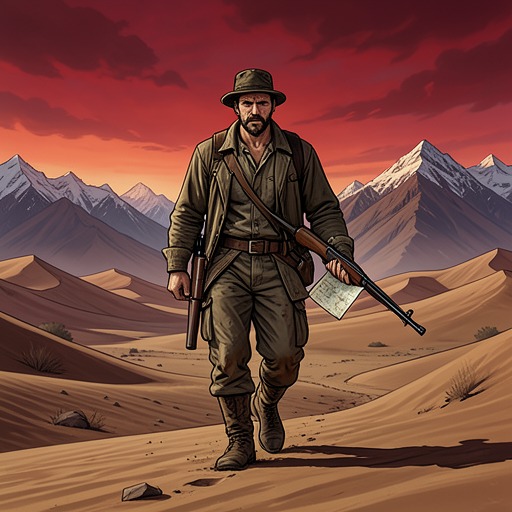
A Princess of MarsJohn Carter’s capture by the Tharks is the turning point that carries him from solitary danger into the society of the green Martians. A moment of physical escape prevents an immediate attack, but his extraordinary leap makes him an object of curiosity rather than freeing him: the warriors accept a tentative gesture of peace, take him to Korad, and place him before their ruler.
The Encounter at the Incubator
Carter is watching young Martians emerge from their eggs when he fails to notice twenty adult warriors approaching over the soft moss. The leader’s spear comes within ten feet of him. Carter is unarmed and naked, and the group’s weapons make a dash for safety untenable; their rifles use radium projectiles, and he judges the warriors capable of handling them with deadly effectiveness.
His immediate answer is to leap onto the incubator. The jump carries him thirty feet into the air and lands him a hundred feet away, on the far side of the enclosure. It both removes him from the spear’s reach and changes how the warriors assess him. Some check that he has not harmed the young; others stare in astonishment. Carter recognizes that his agility, extraordinary in the Martian environment, has interrupted the attack and made him a curiosity to be captured and shown to others.
Tars Tarkas and the Gesture of Peace
After conferring, the warriors ride away but leave their leader by the enclosure. Tars Tarkas dismounts, sets down his spear and other weapons, and approaches Carter without arms. He removes a large metal armlet and holds it out. Carter cannot understand his language, but reads the discarded weapons and the troop’s withdrawal as signs of peaceful intent.
Carter answers with gestures rather than intelligible speech: he places a hand over his heart, bows, takes the armlet from Tars Tarkas, and fastens it above his elbow. Tars Tarkas smiles, links an arm with him, and turns with him toward his mount. When the others run forward, Tars Tarkas signals them to stop, apparently wary that a renewed rush might frighten Carter into another leap. Their initial hostility has become controlled contact, though Carter’s later description makes clear that he regards the encounter as a capture, not as a freely chosen alliance.
Tars Tarkas then directs that Carter ride behind one of the warriors. The designated rider lifts him onto the mount, where Carter holds on to the belts and straps securing the warrior’s equipment. The party sets off together, carrying him away from the incubator and toward the hills. This is the practical beginning of his captivity: the armlet and shared ride establish a temporary accommodation, but the Tharks control where he goes.
Arrival at Korad
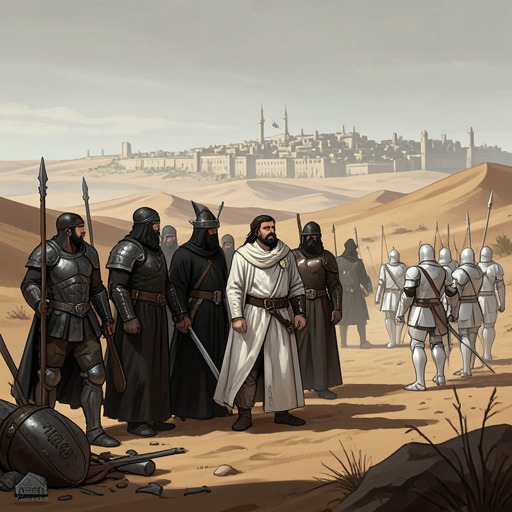
After traveling about ten miles, the party climbs toward a mountain range and passes through a narrow gorge into an open valley. On a low tableland Carter sees a great city. The riders enter by a ruined roadway that stops at the tableland’s edge in a broad flight of steps. The city’s buildings appear deserted and only moderately decayed, as if they have been unoccupied for years or possibly ages.
Near the center, a plaza and its surrounding buildings serve as a camp for roughly nine or ten hundred members of the same people. The scale of this encampment makes the meaning of the capture plain: Carter has not simply been intercepted by a small patrol but brought into a larger Thark community. The ruined urban setting, now occupied by the warriors, places his personal captivity within a society settled amid the remnants of an older city.
Presented to the Thark Ruler
At the audience chamber, Tars Tarkas lowers Carter to the ground and enters with him, keeping an arm linked with his. The approach to the chieftain is relatively informal. Tars Tarkas advances to the rostrum, where the ruler rises and speaks his name; Tars Tarkas answers with the ruler’s name and title. Carter learns later that this exchange is the customary greeting among green Martians. When strangers cannot exchange names, peaceful parties exchange ornaments, while hostile ones may exchange shots or fight their introduction with other weapons.
Tars Tarkas is identified as the community’s virtual vice-chieftain, as well as a capable statesman and warrior. He reports the expedition’s events, including Carter’s capture, and the chieftain addresses the newcomer. Carter answers in English, knowing the ruler cannot understand him, and notes that both the ruler and Tars Tarkas had returned his smile. That apparent point of common ground proves limited: Carter discovers that Thark ideas of humor can include amusement at prisoners’ deaths. His arrival therefore leads not into familiar hospitality but into a social order whose customs he must learn while held among its people.
Significance and Consequences
The capture is shaped by a reversal: Carter escapes the spear not through a weapon or a negotiated advantage, but through a leap that astonishes his pursuers. The same feat that saves him also helps determine his fate. The warriors no longer treat him simply as a target; they regard him as a remarkable specimen worth taking back to their community. His physical difference thus becomes both protection and the means of his removal.
The encounter also establishes Tars Tarkas as Carter’s first crucial point of contact with the Tharks. He is the armed party’s leader, yet he approaches after disarming, offers an ornament, restrains his followers, and escorts Carter into the city. Those actions make communication possible without erasing the imbalance between captor and captive. The armlet is a sign of temporary peace, while the journey to Korad and presentation before the chieftain confirm that Carter has entered Thark custody.
The encounter’s consequences reach beyond the city. Later, Dejah Thoris identifies herself as the daughter of Mors Kajak of Helium and explains that her expedition was a peaceful scientific party dispatched to measure atmospheric density and chart air currents. She argues that red and green Martians depend on cooperation to preserve the planet’s air and water, and condemns the Thark communal order for suppressing homes, affection, and fellowship. Her appeal draws attention to the contrast between the Tharks’ capacity for organized power and their hostility toward the red Martians. Much later, Carter learns that the atmosphere plant sustains life on Mars through the ninth ray, and that a breakdown in its pumping system can threaten the entire planet. In this wider context, his forced entry into Thark society becomes the start of an involvement with Martian political conflict and planetary survival, although the capture itself begins with no knowledge of those stakes.