Mars Atmospheric Crisis and Recovery
A Princess of MarsThe atmosphere plant crisis is the novel’s planetary-scale emergency: when the machinery sustaining life on Mars stops, the threat to the atmosphere makes the survival of every community depend on a secret remembered by John Carter. The crisis joins the book’s engineering exposition to its final race against time, and turns a seemingly obscure key into the means by which life on Mars can continue.
The system behind the crisis
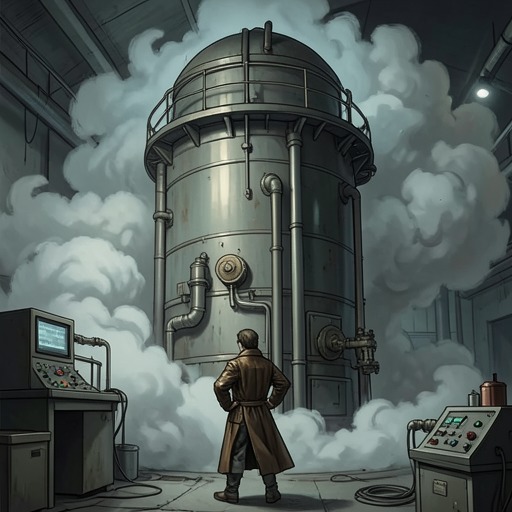
The crisis becomes intelligible through what John Carter learned at the atmosphere plant earlier in the story. Its machinery produces the artificial atmosphere on which Mars depends, using the ninth ray, separated from sunlight by instruments on the building’s roof. Three-quarters of the vast structure is devoted to reservoirs that store the ray; electrical vibrations are then incorporated into it, and pumps send the resulting compound to the planet’s five principal air centers. Contact with the ether of space transforms the compound into atmosphere.
The plant appears to hold a large reserve: its stored ninth ray is sufficient to maintain the existing atmosphere for a thousand years. But that reserve does not make the system invulnerable. The plant’s keeper warned that the principal danger was an accident to the pumping apparatus. Inside, twenty radium pumps could each supply all Mars with atmosphere, but they were used alternately, one at a time, in shifts lasting a little over twenty-four and a half Earth hours. The system’s extraordinary capacity rests on machinery that must keep operating.
Its human custodians share the plant’s isolation. The keeper had watched the pumps for eight hundred years, with one assistant dividing the watch; each spent half a Martian year—about 344 Earth days—alone in the immense facility. This earlier account gives the later emergency its particular force: Mars has stored enough of the substance needed to make air, but the planet’s survival still depends on a small number of people and equipment at one remote site.
Failure and the three-day deadline
The crisis reaches the council after the atmosphere plant’s keeper has made no wireless report for two days. Repeated calls from a score of capitals bring no answer. The governments of Barsoom ask Helium to intervene, and a thousand cruisers search for the missing assistant keeper. One returns with his body, establishing that he has been killed and that an assassin has reached the people responsible for maintaining the system.
The discovery is followed by an alarming measurement: instruments show air pressure falling rapidly across Mars. The pumping engine has stopped. The plant’s immense walls cannot readily be breached; the work of penetrating them has already begun, but it would take months. The reserve of stored ninth ray offers no immediate remedy if the pumps cannot move the atmosphere compound into the planetary distribution system. The council is told that Mars has, at most, three days to live.
The silence that follows the announcement makes the scale of the danger plain. A young noble answers not with a plan to escape the approaching end but with a call for Helium’s people to continue their duties as if a thousand useful years still lay ahead. That response presents the crisis as a test of civic conduct as well as a practical emergency: the threatened atmosphere has made the ordinary future disappear, but the people still have to decide how to meet what remains of it.
The forgotten key and the race to the plant
As the failing air approaches its final consequence, John Carter sees Dejah Thoris collapse beside the incubator and understands that her condition will become fatal if the supply is not restored. In that moment, nine long-forgotten sounds return to his conscious mind. Their meaning becomes clear: they are the key to the atmosphere plant’s three great doors. The technical secret that makes action possible is not a new device or a forceful attack on the walls, but a remembered sequence that can open the sealed entrance.
Carter obtains a flier and races toward the plant. With the air already too thin for him to travel high, he follows a straight course over an old sea bottom, discarding everything but the engine and compass to reduce the burden. An hour before dark, he reaches the plant and lands at its small door. A large crew has been trying to break through the walls, but has made little progress; most of its members are no longer conscious. The emergency at the plant has become more advanced than it was at Helium.
A surviving man tells Carter that the two people who knew the locks’ secret are dead and that no one else on Mars knows how to open them. For three days, people driven by fear have surged around the entrance without solving its mystery. Carter has arrived with the answer, but the failing atmosphere has left him weak, and he can barely control his thoughts. The remembered sounds therefore matter not as information alone: he must still use them while he is close to losing the strength to act.
The doors open and the air returns
Carter sends the nine thought waves at the first door. It slowly recedes, and he cannot rise to follow it. He urges his companion to continue to the pump room and release all the pumps, explaining that this is Barsoom’s only chance to exist the next day. The companion’s survival and ability to reach the machinery now carry the action beyond Carter’s own physical capacity.
From the ground, Carter opens the second door and then the third. He sees the other man crawling through the final doorway toward the pump room, and loses consciousness. The immediate outcome established in the scene is thus the opening of the whole sequence of barriers and the passage of a surviving man into the machinery’s interior; Carter’s instruction makes clear what must happen there for the atmosphere to be restored. The larger recovery is inseparable from the actions of both men: one remembers and opens the locks, while the other is sent to the pumps.
The crisis brings together the novel’s explanation of artificial air and its climactic danger. A world sustained by an enormous reserve and twenty individually powerful pumps can still be brought to the edge of extinction when its engine stops, its custodians are killed, and its locks remain inaccessible. The solution depends on knowledge preserved in memory, the machinery’s ability to function once reached, and a fragile handoff made when Carter can no longer continue himself. In that reversal, the atmosphere plant shifts from a remote technical marvel to the single point on which Mars’s threatened future depends.