Mars as a dying planet
A Princess of MarsMars as a dying planet is not merely a setting but the material pressure shaping Barsoom’s agriculture, settlement, population policy, and warfare. As seas recede and fertile areas diminish, inhabitants respond with vast engineering systems and tightly managed reproduction; yet scarcity also feeds social harshness and conflict. The result is a world where extraordinary technical ingenuity sustains life even as the conditions of that life become increasingly precarious.
Environmental Decline and the Demographic Response
The planet’s dwindling resources are linked directly to a population problem. The narration describes Martians as exceptionally long-lived after maturity, but says their average life expectancy at that stage is about three hundred years and would approach one thousand without the many causes of violent death. Therapeutics and surgery have extended life, while limited resources make each additional person a burden on the community. The account connects this pressure to dangerous sports, nearly continuous warfare, and a social disregard for life. It also notes that very few adults die from illness, while most deaths result from violence; childhood mortality, including deaths caused by the great white apes, forms another substantial loss.
Green Martian population policy is presented as a deliberate answer to this imbalance. Adults select for hardiness and regulate births to offset deaths, while the narrator links the system to the harsh conditions of a planet whose natural resources have dwindled. This does not make the social order humane: children are raised communally, and the absence of parental attachment is described as one source of lost compassion. The account thus places ecological pressure behind institutional choices without treating those choices as inevitable or cost-free.
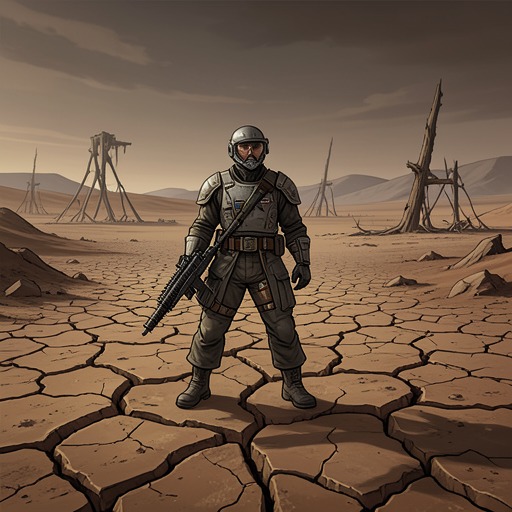
The green community’s territory gives that scarcity a geographical scale. It numbers about thirty thousand and ranges over a broad zone of arid and semi-arid land between forty and eighty degrees south latitude, bounded by two more fertile tracts. Its headquarters stand near the crossing of two Martian canals, while an incubator lies far to the north in an area thought uninhabited. The distance between territory, water routes, and protected reproductive infrastructure makes survival a matter not just of local resources but of movement and defense.
Retreating Seas and Engineered Settlement
The history of the higher Martians is also told as a history of retreat. Dejah Thoris explains that the drying seas forced three major divisions of the higher Martians into alliance: they had to seek the few fertile areas that remained and defend themselves under changed conditions against green Martian hordes. Over long periods of association and intermarriage, those peoples formed the red race. The alliance was therefore both political and ecological, a response to shrinking habitable ground and pressure from other populations.
The abandoned city of Korad preserves the physical outline of that retreat. It was once a center of commerce and culture beside a natural harbor enclosed by hills. By the time John Carter sees it, a small valley is all that remains of the harbor, and a pass through the hills marks the former channel by which ships reached the city. The old shorelines were dotted with comparable cities; as the waters receded, populations followed them toward the ocean centers until necessity drove them toward the Martian canals. A lost maritime world is thus legible in the city’s geography, even after its records and much of its literature have disappeared.
The canals and their associated farms represent a different stage of adaptation: water is collected from melting polar ice and carried through long conduits to inhabited districts. Cultivated tracts along these routes are administered by government officers. Rather than flooding fields and losing water to evaporation, a network of smaller pipes delivers it to plant roots. The carefully controlled crops are described as protected from drought, rain, high winds, insects, and destructive birds. This engineering makes agriculture dependable, but it also reveals how much settled life depends on managing a scarce resource from distant sources.
Air, Water, and the Infrastructure of Survival
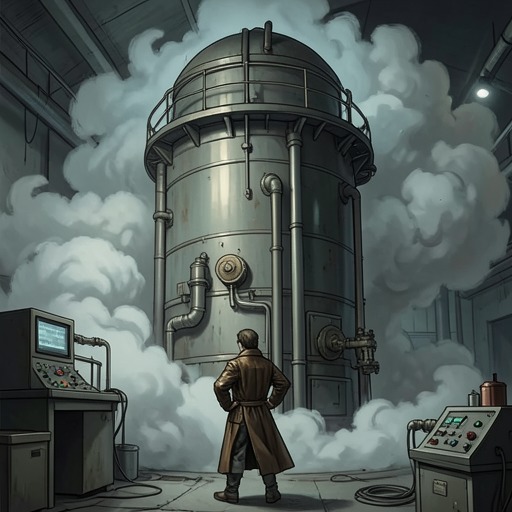
The same dependence extends to the atmosphere. The machinery in the great building where John Carter meets an old man produces the artificial atmosphere that sustains life on Mars. Its process depends on the ninth ray, separated from sunlight by instruments on the roof and stored in reservoirs occupying three-quarters of the building. Electrical treatment incorporates refined vibrations into the stored material; pumps then send it to the planet’s five principal air centers, where contact with the ether of space transforms it into atmosphere. The reserve is sufficient to maintain current conditions for a thousand years, but the account identifies failure of the pumping machinery as the central danger.
That reserve is at once evidence of technical mastery and a measure of dependence. A planetary-scale system can preserve the atmosphere for centuries, yet continued life rests on a complex apparatus whose breakdown could imperil everyone. The story’s crisis is therefore not simply that Mars has lost resources: it is that survival has come to rely on systems that must keep functioning despite the planet’s decline.
Water infrastructure likewise links natural reserves to governmental organization. The polar reservoirs, conduits, and supervised farms make the supply of food dependent on both engineering and administration. In the farm communities John Carter visits, government officers oversee the land while labor is performed by convicts, prisoners of war, delinquent debtors, and impoverished bachelors unable to pay a celibacy tax. The contrast is telling: the machinery of survival is collective in scale, but its work and benefits are distributed through social hierarchies.
Scarcity, Conflict, and Political Possibility
The narration repeatedly connects ecological pressure with social violence. Green Martian life is described as a hard struggle on a dying planet, where each additional life taxes the community. Their system’s severe selection and population controls are presented as responses to that condition, while their warfare and dangerous practices further reduce population. The explanation does not erase the cruelty of the society; it shows how scarcity becomes part of its rationale and how a rationale can harden into custom.
Dejah Thoris challenges that custom before the green Martian council. She argues that red Martian scientific work maintains the planet’s air and water supply and that, without it, Mars could not support life. She calls for the green communities to abandon continual hostility and join the red people in efforts to regenerate the planet. Her appeal links environmental interdependence to political cooperation: the systems that sustain life cannot be secured by one people’s warfare against all others. The council’s silence and the visible inward struggle of Tars Tarkas leave open the possibility that inherited custom might be challenged, even though no immediate transformation is assured.
The novel’s environmental vision is consequently double-edged. Mars’s decline is slow enough to be registered through receding shores, shrinking fertile areas, and elaborate supply systems rather than one sudden disaster. Yet the daily consequences are profound: populations are managed, labor is stratified, settlements cluster around water, and political alliances are forged under pressure. The planet’s ingenuity has postponed collapse, but it has not removed the underlying scarcity; the question raised by the narrative is whether technical survival can endure without a change in the social order that turns shared vulnerability into continual conflict.