Martian gravity
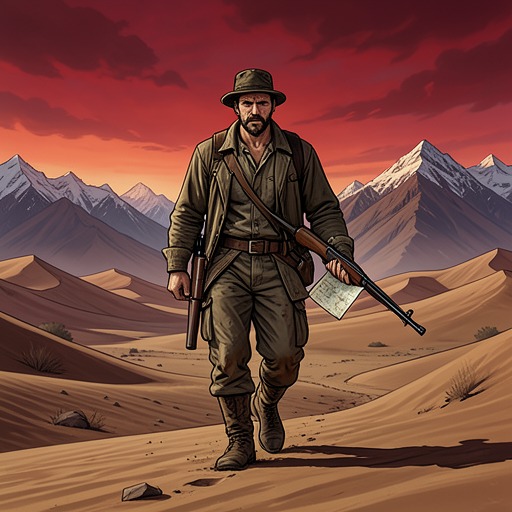
A Princess of MarsMartian gravity is the environmental difference that first makes John Carter's body seem unfamiliar to him and then turns that same body into an unexpected advantage. The lesser force of gravity, acting together with Mars's lower air pressure, unsettles movements learned on Earth; once Carter begins to adapt, it helps him leap beyond the reach of his pursuers and fight with a mobility that contributes to his survival.
Definition and First Effects
Carter encounters Martian gravity through action rather than measurement. On the open plain, he springs to his feet expecting an ordinary rise, but the effort sends him about three yards into the air. He lands without a severe impact, yet the unexpected height immediately reveals that the physical conditions of Mars will not obey his Earth-trained expectations.
Walking proves harder to master than the initial leap. Muscular effort that had been natural on Earth now produces repeated hops: Carter rises a couple of feet with each step and falls onto his face or back after a few hops. He attributes this awkwardness to muscles accustomed to Earth's gravity trying to work under Mars's lesser gravity and lower air pressure. To reach the nearby enclosure, he abandons upright walking and crawls, making adaptation a practical necessity before it becomes an advantage.
A Source of Extraordinary Leaping
The contrast between Carter's early stumbling and his later leaps is established at the enclosure where he first encounters Martian warriors. Unarmed and naked, he faces an immediate threat and jumps toward the top of the structure he takes to be a Martian incubator. The leap carries him roughly thirty feet upward and lands him about a hundred feet away, on the enclosure's opposite side. He reaches the ground safely, while the warriors remain at the far wall.
The leap changes how the warriors regard him. They had approached as pursuers, but after seeing his feat they become interested in capturing him as a remarkable specimen to show their companions. Carter concludes that his agility matters more to them than the fact that he has not harmed the young inside the enclosure. The scene thus gives the physical law a social consequence: a bodily capability that initially helps him escape also alters the attention he attracts.
The Imbalance Between Earth and Mars
Carter explains the difference by comparing the bodies and environments of the two worlds. Martian warriors are enormous, but their large bones and muscles are proportioned to the gravity they normally overcome. In his view, their strength and agility relative to their weight are far below those of an Earth man; he doubts that a Martian transported suddenly to Earth could lift his own weight from the ground.
That comparison reverses the apparent advantage suggested by the warriors' size. On Mars, Carter's Earth-conditioned body can perform feats that seem extraordinary to its inhabitants. His leap is therefore not simply an act of will: it arises from the relation between his physical capacities and a world whose gravity differs from the one for which he has learned to move. What first appears as poor coordination becomes, in a different circumstance, an exceptional form of mobility.
Combat and Adaptation
The same advantage reappears in Carter's duel with Zad. Zad is a skilled swordsman who initially relies on powerful rushes, then shifts to a more careful and technically controlled approach. Carter avoids the charges through speed and sidesteps, and he identifies both his greater endurance and the agility afforded by Martian gravity as reasons he can sustain the fight against Zad's strength and skill.
Gravity does not make the duel effortless or guarantee safety. The contest continues for a long time, and Zad eventually attempts to finish it with a close attack. A flash temporarily blinds Carter; his attempt to evade the blow is only partly successful, and he is wounded in the shoulder. The episode qualifies the advantage that gravity has given him: it improves his ability to move and endure, but it does not remove the danger of combat or substitute for judgment and skill.
Narrative Significance
The book introduces Martian gravity as a difference that must be learned bodily. Carter cannot rely on the movements that once served him, and his first response is a sequence of awkward failures. Later, those same changed conditions allow him to make leaps that astonish the warriors and to maneuver against Zad. The physical environment therefore changes the practical meaning of Carter's familiar strength: on Mars, his Earth-trained body is at first clumsy and then unexpectedly formidable.
This progression also links the novel's planetary setting to its action. Gravity is not an abstract description of Mars but a cause that shapes movement, escape, social attention, and combat. Its effects are presented through contrasts—ordinary effort producing an extraordinary rise, a giant warrior's size set against Carter's agility, and a mobility that helps him without making him invulnerable. The resulting pattern makes adaptation, rather than simple superiority, the key to understanding Carter's physical advantage.