Mors Kajak
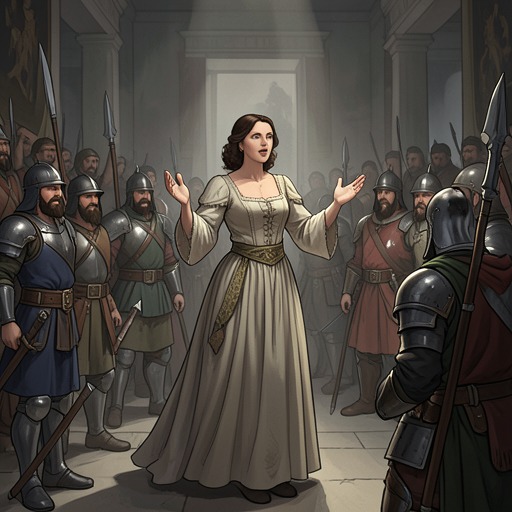
A Princess of MarsMors Kajak is the Jed of lesser Helium and the father of Dejah Thoris. A renowned fighter whose public ferocity contrasts with the emotion he shows at his daughter’s rescue, he embodies the personal loyalties at the heart of Helium’s resistance to the proposed marriage between Dejah Thoris and Sab Than. His role is brief but consequential: he is identified through his daughter’s captivity, appears among the family and political leaders who welcome her back, and helps turn an alliance with the Tharks into a renewed bond of peace.
Identity and Family
Dejah Thoris identifies herself before her captors as the daughter of Mors Kajak of Helium. That identification establishes both her place in Helium’s ruling family and the political importance of her imprisonment. She is not an anonymous member of the captured scientific expedition: she is the child of a leading Heliumite, and the captive whose fate will become central to the conflict between Helium and Zodanga.
The narrative later makes Mors Kajak’s position more precise, presenting him as the Jed of lesser Helium and the father of Dejah Thoris. He is also the son of Tardos Mors, Jeddak of Helium. These relationships place Mors Kajak between two generations of Helium’s ruling house: the father whose authority shapes policy and the daughter whose captivity and intended marriage threaten to shape it in turn.
His daughter’s words illuminate the status he represents. She describes herself as descended from ten thousand jeddaks and traces her ancestry back to the builder of the first great waterway. Her pride in this lineage is not simply personal ornament: it distinguishes the hereditary history of Helium from the Tharks’ communal system, in which parentage and family attachment have been suppressed. Mors Kajak is named as her father, but the story gives that bond its fullest meaning through what his daughter and the people of Helium feel for one another.
The Crisis over Dejah Thoris
During his account of the search for Dejah Thoris, Kantos Kan explains that Mors Kajak’s daughter has been hidden in Zodanga and that Sab Than has fallen in love with her. Than Kosis, Jeddak of Zodanga, has made her marriage to his son the price of peace between the rival countries. The marriage is presented as voluntary in the demand, but the circumstances make its coercive political purpose plain: Dejah Thoris is held in Zodanga while the fate of peace is made to depend on her consent.
Tardos Mors refuses to yield to that demand. Kantos Kan reports that he would rather see his princess dead than have her marry anyone other than the man she chooses. The account locates the refusal explicitly in Tardos Mors’s words and policy; it does not assign a separate speech or decision to Mors Kajak. Yet as Dejah Thoris’s father and the Jed of lesser Helium, Mors Kajak is part of the ruling family whose intimate bonds give the dispute its human cost. The contest is not only between two states over peace, but over whether Dejah Thoris will be treated as a person able to choose or as the price of a treaty.
That contrast becomes sharper against the Green Martian system described elsewhere in the narrative. Green Martian children are communal offspring, raised by women who capture them at hatching, while parental and filial love are said to be unknown. Mors Kajak’s relationship to Dejah Thoris belongs to the opposing social order: her identity includes a named father, a political lineage, and a family whose response to her danger is intensely personal. The comparison does not make every Heliumite custom explicit, but it gives the father-daughter bond a clear place in the book’s wider conflict between inherited kinship and a society organized to deny it.
Reputation and Reunion
When Dejah Thoris returns to Helium, Mors Kajak follows close behind Tardos Mors and is presented to John Carter as the girl’s father. His response is immediate but difficult to express. He tries repeatedly to thank Carter, yet emotion catches in his voice and prevents him from speaking. The silence is significant: a man known for ferocity and fearlessness in battle is, in this family encounter, overcome by what his daughter has survived.
The narrative underscores the contrast by noting that Mors Kajak’s reputation as a fighter is remarkable even on warlike Mars. Helium worships Dejah Thoris, and he cannot contemplate the danger from which she has escaped without deep feeling. His gratitude to Carter therefore carries more than formal courtesy. The rescue has returned his daughter to the family and community that cherish her, and his halting effort to speak makes the cost of her captivity visible in a private gesture rather than a political declaration.
The scene also situates Mors Kajak within a wider family reunion. Tardos Mors welcomes John Carter as a son and grants him Dejah Thoris, calling her the most precious jewel in Helium and on Mars. Mors Kajak is present for this recognition, but the specific words belong to Tardos Mors. The distinction matters: Mors Kajak’s contribution is shown not through a competing pronouncement but through his emotional response and his place beside the father who formally welcomes Carter into the family.
Peace with the Tharks
After the Heliumites’ victory and the formation of ties with the Tharks, the alliance is given a tangible, ceremonial form. The Thark hordes and their allies spend ten days being feasted and entertained in Helium. They then depart for their own lands with costly presents, escorted by ten thousand Helium soldiers under Mors Kajak’s command. The father who had awaited his daughter’s return now leads the armed escort that accompanies Helium’s former enemies home.
Mors Kajak does more than command the escort. With a small party of nobles, he accompanies the Tharks all the way to Thark to strengthen the new bonds of peace and friendship. His journey gives the alliance a public and diplomatic expression: hospitality in Helium is followed by a guarded return and personal participation by one of the kingdom’s leading figures. The movement from military escort to friendship is not instantaneous or abstract; it is carried by people, gifts, soldiers, and a journey between the two territories.
Sola accompanies Tars Tarkas on this return, and Tars Tarkas has acknowledged her as his daughter before his chieftains. That recognition echoes the importance of parentage and restored family ties in the closing sequence. Three weeks later, Mors Kajak and his officers return with Tars Tarkas and Sola aboard a battleship dispatched to bring them back in time for the ceremony joining Dejah Thoris and John Carter. Mors Kajak’s presence links the consolidation of peace with the marriage of his daughter: the political alliance and the family celebration arrive together, without being reduced to the same event.
Characterization and Narrative Significance
Mors Kajak is drawn through a small number of sharply contrasted details rather than through an extended account of his private history. The text names him as Dejah Thoris’s father, establishes his rank, records his standing as a formidable fighter, and then shows his voice failing when he tries to thank the man who rescued her. His character emerges from the distance between martial reputation and visible paternal feeling.
That contrast also gives his appearances structural weight. Dejah Thoris’s capture turns her descent and family identity into political stakes; her rescue brings her father into the reunion; the later escort places him at the center of the new relationship between Helium and the Tharks; and his return helps carry the peace into the marriage ceremony. He does not dominate these developments, and the story does not provide a separate account of his policies or inner thoughts. Instead, it makes his significance legible through his place in the ruling family and through concrete acts of welcome, command, and accompaniment.
His arc therefore follows the consequences of a threat to kinship rather than a personal transformation. Dejah Thoris is held as a proposed instrument of peace, but she returns to a father who can barely voice his gratitude, then becomes part of a settlement celebrated by both Helium and its former enemies. Mors Kajak’s movement from reunion to escort and back again gives the ending a human continuity: the peace that follows conflict is not merely declared by rulers but carried home by a father who has his daughter beside him once more.