Powell's death and John Carter's flight into the Arizona cave
A Princess of MarsPowell's death and John Carter's flight into the Arizona cave is the episode that turns a rescue attempt into a personal loss and carries Carter to the threshold of the story’s extraordinary next phase. Carter charges alone into an Apache camp to recover his friend, finds Powell pierced by arrows, and escapes with the body across his horse; after confirming Powell’s death and trying in vain to revive him, Carter collapses inside a cave. The sequence binds action to grief, then ends at the point where ordinary explanations no longer suffice.
The Rescue Attempt
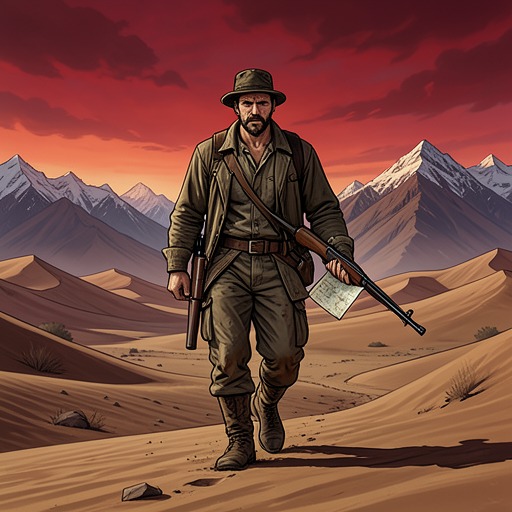
Carter reaches a level stretch of land crowded with Indian tepees and warriors gathered around something at the camp’s center. His first clear interpretation is that Powell is the object of their attention. Although the camp has not noticed Carter and he could withdraw safely into the gorge, he does not consider escape until the following day. The narration later qualifies any heroic reading of his choice: in dangerous situations, he says, an alternative course does not occur to him until hours after he has acted. His charge is presented as immediate action, not as a decision weighed against safer options.
Carter draws his revolvers and rushes the assembled warriors, firing rapidly and shouting. The unexpected attack makes the Apache warriors think a much larger force is upon them, and they scatter to retrieve their bows, arrows, and rifles. That momentary confusion opens the way to Powell, but it does not make the rescue secure: once the warriors recognize that Carter is alone, they pursue him with arrows, rifle shots, and imprecations.
Powell’s Death and the Escape
The rout exposes the scene Carter feared. Under the Arizona moon, Powell lies with hostile arrows bristling from his body. Carter is convinced that Powell is already dead, yet he is determined to prevent the body from being mutilated as well as to have saved his friend’s life. He rides close, reaches down from the saddle, catches Powell by his cartridge belt, and draws him across the withers of his mount.
The route back is no longer an easy retreat. A glance persuades Carter that returning the way he came would be more dangerous than crossing the plateau, so he spurs the horse toward a distant opening in the range. The Apache warriors discover that their target is alone and pursue him, but moonlight, their disordered reaction to his sudden attack, and the moving horse help him reach the shadows of the surrounding peaks before an orderly pursuit can form. The escape succeeds by a narrow margin, while leaving the destination to the horse’s judgment: Carter knows the trail less well than the animal and lets it travel practically unguided.
The Cave and Powell’s Death
The horse takes a defile toward the summit rather than the pass Carter had hoped would lead to the valley and safety. Carter later recognizes that this wrong turn may have shaped the remarkable adventures of the following ten years. In the immediate sequence, however, the trail brings him to a large cave. A sharp turn around a high cliff reveals an opening roughly four feet high and three to four feet wide; there the trail ends.
By daylight, Carter dismounts and lays Powell on the ground. A careful examination reveals no trace of life. Carter forces water between Powell’s dead lips, bathes his face, and rubs his hands, continuing for nearly an hour even though he knows that his friend is dead. This effort does not change the outcome; it makes the loss concrete through the small, futile acts of care that follow the violent, hurried rescue.
Carter describes Powell as a polished Southern gentleman and a staunch, true friend, and says that he was very fond of him. Only after giving up his attempts to revive Powell does Carter leave the body on the ledge and enter the cave to reconnoiter. Their friendship is therefore not merely the reason for the charge into the camp: it governs the episode’s emotional ending, as Carter moves from armed resistance to an intimate effort to restore a life he already knows is gone.
Collapse and Narrative Transition
The cave is a large chamber, perhaps a hundred feet in diameter and thirty or forty feet high, with a smooth, well-worn floor and signs of habitation in the distant past. Its back disappears into dense shadow, leaving Carter unable to tell whether further apartments lie beyond. The cave seems defensible: Carter believes that a single man could hold its trail against an army. That sense of comparative safety makes his sudden physical failure the episode’s final reversal.
Carter attributes the pleasant drowsiness that comes over him to exhaustion after the long ride and the reaction from the fight and pursuit. He knows that lying down would leave him vulnerable if the Apache warriors reached the cave, and he struggles toward the entrance instead. He reels against a side wall and falls prone on the floor. The next chapter is titled “THE ESCAPE OF THE DEAD,” placing the collapse directly beside a new, suggestive narrative threshold without yet explaining it in this episode. In that structure, Powell’s confirmed death and Carter’s unexplained fall form contrasting endpoints: one life cannot be restored, while the other is carried into the story’s next transformation.