Red Martian airships
A Princess of MarsThe Red Martian airships are a fleet of twenty vessels whose appearance over a Green Martian city leads to a sudden battle and the destruction of one disabled ship. Their encounter with the Green warriors establishes both the lethal precision of Martian warfare and the fragility of the fleet’s technology; for John Carter, the burning, unmanned vessel also becomes an unexpected object of sympathy for an enemy he has never met.
Appearance and Arrival
The fleet comes into view on the third day after the Green Martians’ egg-incubator ceremony, as the procession begins its return toward home. The mounted warriors retreat into nearby buildings with practiced speed, clearing the open ground in less than three minutes. From an upper-floor window, Carter sees the cause: a long line of twenty gray-painted craft, long and low, moving slowly above the nearest hills and advancing toward the city.
The ships carry distinctive banners above their upper works and devices painted on their prows. Figures crowd their forward decks. Carter cannot tell whether the crews have noticed the Green Martians or are simply examining the apparently deserted city. The approach initially looks peaceful, but the vessels’ formation and visible crews give way, without warning, to a battle initiated from the buildings.
The Ambush and the Fleet’s Retreat
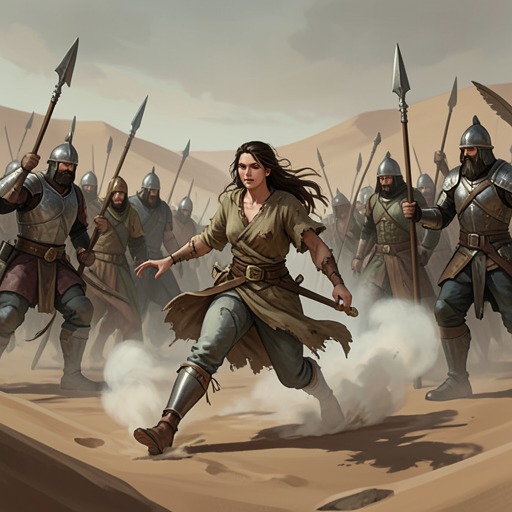
The Green warriors fire a concentrated volley from windows facing the valley. The lead ship swings broadside and answers with its guns, moving along the Green firing line before turning to make another pass; the remaining vessels follow its circuit and fire in turn. Their attack is badly compromised by the suddenness of the first volley: the crews are unprepared, and the guns’ sighting apparatus is exposed to the Green marksmen.
The defenders’ accuracy is not random. They divide their fire among specific targets, disabling the wireless finding and sighting equipment, smaller guns, gunners, officers, crew, steering gear, propellers, and exposed upper works. This organized distribution of aim helps explain why the fleet cannot convert its guns into an effective answer. After twenty minutes, the vessels turn away with their fire stopped and their depleted crews struggling to control them. Several are visibly damaged as they retreat toward the hills, while the Green warriors continue firing from the rooftops.
Capture and Destruction of a Disabled Ship
One vessel, which has borne the brunt of the attack, turns back in an erratic course. The Green warriors cease shooting when it becomes clear that the ship is helpless rather than a continuing threat. Its low drift gives them time to prepare: some race ahead to a building in its path, while others remain on the roofs in case the fleet returns or reinforcements arrive. As the craft nears the building, warriors reach it through windows and use their spears to ease its collision; they then secure grappling hooks and haul it down.
The boarding party searches the vessel from end to end, examines its dead crew for signs of life, and brings out a small surviving prisoner, less than half the height of the Green warriors. The captured craft is then systematically stripped over several hours. The haul includes arms and ammunition, silks and furs, jewels, carved stone vessels, food and drink, and casks of water—an especially notable find to Carter, who has seen none since arriving on Mars.
After removing the cargo, the Green warriors tow the vessel farther into the valley. Some board it again and spread the contents of containers over the dead sailors, decks, and works. The warriors withdraw, and the last to leave throws a missile aboard; when flame appears, the lines are released. Lightened by the cargo’s removal, the burning ship rises and drifts southeast, its wooden parts consumed as it climbs. Carter watches it until it disappears into the distance. Its destruction follows a precise sequence—disable, capture, strip, burn—rather than a final exchange of fire.
What the Ships Reveal About Martian Technology
The battle places the airships within a wider technological world. Carter has already observed the Green Martians’ rifles: their long barrels, small-caliber explosive radium projectiles, and wireless finders and sights give them a theoretical effective range of three hundred miles, though their best practical range is a little over two hundred. The airship fleet’s vulnerability to attacks on its finding and sighting apparatus makes clear that sophisticated weapons depend on exposed systems and trained operators, not simply on their range or firepower.
Elsewhere, Carter learns that a small, one-person aircraft is approximately sixteen feet long, two feet wide, and three inches thick, and is propelled by a noiseless radium engine. Its buoyancy comes from the eighth Barsoomian ray, contained within the craft’s thin metal walls. This explanation places aerial movement within a broader account of Barsoomian engineering, but the fleet episode emphasizes its practical limits: a vessel can be driven off course and left unmanned when its crew and control systems are overwhelmed.
Carter’s Response and the Episode’s Significance
Carter’s view of the defeated fleet exceeds a straightforward account of Green Martian victory. As the derelict burns and drifts away, he feels, to his own surprise, that he has witnessed the defeat of a people akin to him rather than merely the routing of another hostile group. He cannot explain the attachment, but hopes the fleet will return and demand an accounting from the warriors who attacked it. The airships’ significance is therefore not only military. Their destruction gives form to Carter’s growing unease with the Green Martians’ violence and anticipates the discovery that the captured survivor belongs to a different Martian people, whose scientific expedition and peaceful purpose will be explained later.