Red Martians
A Princess of MarsThe Red Martians are Barsoom’s humanlike, technologically accomplished population, distinguished from the Green Martians by their organized scientific institutions and by a historical identity formed through alliance and intermarriage. The novel introduces them through Dejah Thoris, a captured researcher whose account links the red people’s survival to the planet’s air and water systems—and whose plea for cooperation exposes the distance between their practical achievements and the continuing violence among Barsoom’s peoples.
Identity and historical formation
John Carter first glimpses a Red Martian as a small, upright figure dragged from a captured airship by Green Martian warriors. The captive is Dejah Thoris, whose appearance recalls human women to Carter and sharply contrasts with the immense Green Martians surrounding her. At the council, she identifies herself as the daughter of Mors Kajak of Helium and the granddaughter of Helium’s Jeddak. Her family places her within the political elite of a Red Martian state, while her presence among Green Martian captors makes the intersocietal conflict immediate rather than abstract.
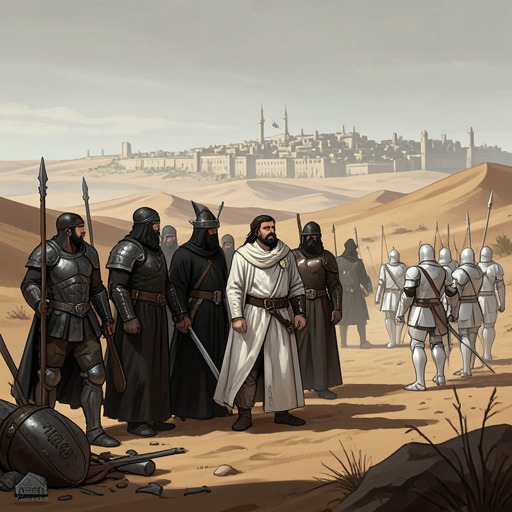
Dejah Thoris explains that the Red Martians descend from a population formed through the joining of three ancient divisions of the higher Martians. Her account describes one fair-haired people, another very dark people, and a reddish-yellow people who flourished in the same distant era. As the seas dried and fertile land became scarce, these groups were compelled to ally: they needed both to secure the remaining productive regions and to defend themselves against Green Martian forces. Centuries of association and intermarriage produced the red race to which Dejah Thoris belongs.
This history makes Red Martian identity a product of adaptation and alliance rather than an untouched, single-origin lineage. The people endured hardship and warfare both among their constituent groups and against the Green Martians. Dejah Thoris says that much of the earlier civilization and many of the arts of the fair-haired Martians were lost before the population adjusted to changing conditions. The Red Martians of the present, in her account, have partly compensated through new discoveries and a more practical civilization, while acknowledging that much of the ancient inheritance has disappeared beneath the intervening ages.
Scientific work and planetary survival
The Red Martians’ scientific role is introduced through the expedition that brings Dejah Thoris into the Green Martians’ power. She describes it as a peaceful research party sent by her father’s father, the Jeddak of Helium, to rechart air currents and measure atmospheric density. The mission’s stated purpose is not conquest: its instruments and observations concern conditions on which life across Barsoom depends.
Dejah Thoris argues that the expedition’s work serves the Green Martians as well as the Red Martians. She claims that without the Red people’s labor and scientific operations, Barsoom would not retain enough air or water to sustain human life. For ages, she says, they have maintained the supply of both without appreciable loss, despite interference from Green Martians. The claim gives the Red Martians a planetary responsibility extending beyond their own political territory, while also placing their technological knowledge at the center of the conflict: the very people whose work supports life are attacked by a population she portrays as failing to understand its consequences.
The capture of the expedition dramatizes that contradiction. Its peaceful purpose and identifying colors, Dejah Thoris insists, should have made its nonmilitary character evident, yet the party was unprepared for battle. Green Martian warriors search the disabled vessel, remove its surviving prisoner, and carry away arms, ammunition, clothing, ornaments, and provisions. The ship’s mission in atmospheric research is thus interrupted by an encounter in which its scientific and diplomatic significance does not prevent it from being treated as a source of captives and loot.
Political appeal and cultural conflict
At the Green Martian council, Dejah Thoris turns her captivity into an appeal for a different political relationship. She asks why the Green Martians will not live in amity with their fellows and warns that continuing along their present course may leave them little above the level of animals. Her argument joins criticism of their customs to an offer: the Red Martians are prepared to cooperate, and the two peoples might do more together to restore a declining planet.
Her indictment focuses on the Green Martian communal system, which she says extends common ownership even to women and children. In her account, a society that claims to own everything collectively has left its members owning nothing in any meaningful sense; mutual hatred has displaced fellowship. She contrasts this order with the Red Martians’ appeal to kindliness, written language, art, homes, and affection. The speech frames cultural differences as more than local custom: it presents them as rival explanations of what enables a people to survive and build a shared future.
The council’s response is significant precisely because it is not simple dismissal. Lorquas Ptomel and the assembled warriors listen in silence, and Carter believes that Dejah Thoris has moved them. Tars Tarkas rises with an expression Carter has never seen on a Green Martian warrior, one that appears to register a struggle against inherited custom. The possibility of a turning point remains fragile: Carter’s narration suggests that a leader strong enough to break with convention could have begun a new era, but the scene does not establish that the appeal succeeds. The Red Martians’ offer of alliance therefore appears as a real political possibility constrained by the Green Martians’ established social order.
Political and narrative significance
The Red Martians enter the story not through a general description of their society but through a sequence of encounters that makes their status visible: a captured researcher, a family connection to Helium’s rulers, a scientific mission, and a public argument for cooperation. Dejah Thoris embodies the connection between political rank and practical knowledge. Her account of atmospheric research gives the Red Martians a role in maintaining conditions necessary for life, while her speech makes their prospective alliance a response to the same environmental pressures that helped shape their ancestry.
The narrative also places their claims to civilization beside the circumstances in which those claims are voiced. Dejah Thoris criticizes the Green Martians’ lack of written language, art, homes, and love, and contrasts their customs with Red Martian fellowship and scientific service. These are her arguments, spoken by a captive trying to avert continuing hostility, rather than a neutral survey of every Red Martian practice. The episode grants her words political and ethical weight, but presents them within a conflict where the Red expedition has already been attacked and its prisoner taken.
That tension complicates the story’s civilizational hierarchy. Red Martian scientific work is presented as indispensable to planetary survival, and their history includes adaptation through alliance; at the same time, their appeal for peace is voiced from within a struggle marked by ethnic division and armed power. Their significance lies in this double position: they represent knowledge and the possibility of cooperation, yet the novel introduces them through captivity and conflict, leaving the proposed reconciliation both urgent and uncertain.