River Iss pilgrimage
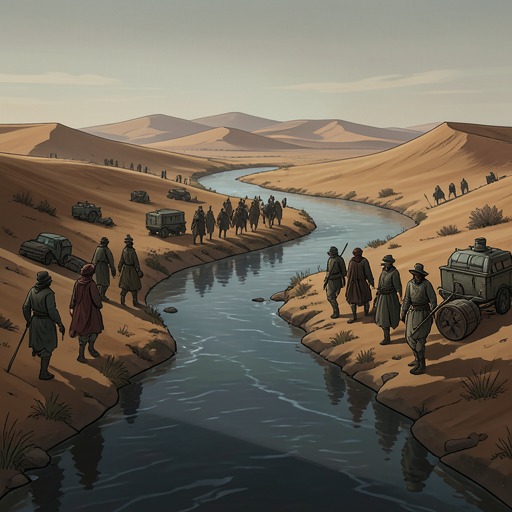
A Princess of MarsThe River Iss pilgrimage is the voluntary final journey Martians undertake at about one thousand years of age, descending into an unknown destination from which no living traveler is known to have returned. It stands at the far end of a society where most people die violently, and where one character’s bleak account makes the journey seem less like a celebration than an accepted departure from a life of unending conflict.
The journey and its unknown destination
Martians show little visible sign of extreme age, and their appearance changes very little from maturity, which comes at about forty, until the approach of the pilgrimage age. At roughly one thousand, they set out voluntarily down the River Iss. The river leads, in the narrator’s account, to a place no living Martian knows; no one who embarks returns. The journey is therefore defined by both choice and irreversibility: it is a recognized passage, but its end remains beyond the knowledge of those who stay behind.
The mystery carries a powerful social prohibition. Dejah Thoris explains that the Iss empties into the lost sea of Korus in the valley of Dor, where a different language is supposedly spoken. She knows of no record, outside ancestral legends, of a Barsoomian returning upriver from Dor. Her immediate alarm at the possibility that John Carter might have made such a return shows that the issue is not merely geographical: a return from the pilgrimage’s destination would be regarded as dangerous, and she fears he would be killed if the claim were true. The evidence does not establish that anyone has actually returned; instead, the threat and the legends preserve the boundary between the known world and the river’s unrecovered end.
A society organized around violent death
The pilgrimage belongs to a life cycle in which natural death is uncommon. Only about one Martian in a thousand dies of sickness or disease, while about twenty in a thousand undertake the voluntary journey. The remaining 979 die violent deaths in duels, hunting, aviation, and war. Childhood is itself especially perilous, with vast numbers of young Martians falling victim to the great white apes of Mars.
The average life expectancy after maturity is about three hundred years, though the narrator estimates that it would approach one thousand if violent deaths did not intervene. Martians’ skill in therapeutics and surgery has made long life possible, but the planet’s waning resources are presented as a counterpressure. In that setting, life is held lightly: dangerous sports and almost continual warfare between communities reflect a society in which survival is not secured by the rarity of disease. The account adds that male and female Martians are never voluntarily without a weapon of destruction, connecting everyday readiness for violence to the many deaths that occur long before the pilgrimage age.
Sola’s view of the pilgrimage
Sola gives the journey its most explicit emotional meaning. When Sarkoja condemns Sola’s compassion for a captive and calls such sentiments weakness and atavism, Sola answers by setting the present against an imagined earlier world, when water filled the land’s hollows and its peoples were supposedly softer. She rejects the idea that fellow-feeling is a defect: the captive has not harmed them, she argues, and would not have harmed them if their positions were reversed.
Sola’s criticism widens from the treatment of one captive to the Green Martians’ pattern of conflict. She contrasts the Red Martians, who live peacefully with their fellows except when duty requires war, with her own people, who fight other communities and one another. In her description, bloodshed begins in childhood and continues until the old willingly embrace the River Iss. She calls an early death fortunate and says that Tars Tarkas could impose no fate worse than continued existence under the conditions they endure. Her speech turns the pilgrimage from a distant custom into the measure of her despair: the journey is desirable not because its destination is known, but because it ends a life she sees as intolerably violent.
Narrative significance
The River Iss pilgrimage links the book’s account of Martian longevity to its account of social brutality. A lifespan that might reach a thousand years is not usually lived out: most Martians die violently, while the small proportion who reach the traditional age depart by choice into a final, unmapped passage. The river thus marks both the society’s limit of knowledge and the limit Sola imagines for suffering. Its mystery remains unresolved, but its presence gives the narrative a stark contrast between a long potential life and a culture that makes continued life difficult to welcome.