Talei Daqi Gongchang
A Princess of MarsEscape from the atmosphere factory is a narrow, suspenseful flight from a fortress that sustains life across Mars. John Carter discovers that its doors answer to thought, overhears the keeper’s intention to kill him, and escapes with Woola by using the very secret the keeper had tried to protect. The doors open; the danger does not end. Beyond them, Carter and Woola are free but exhausted, without a clear refuge or route to safety.
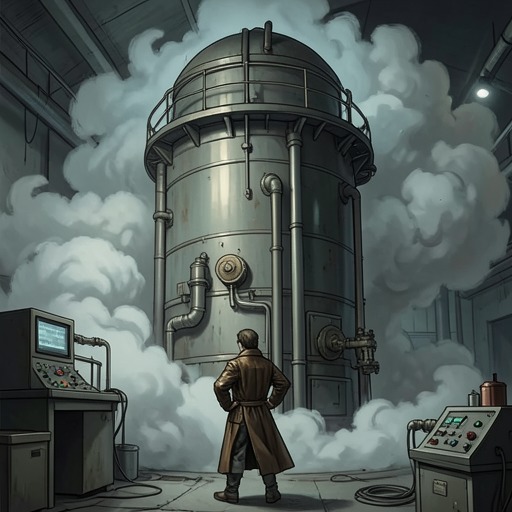
The factory and its guarded secret
The escape is shaped by the extraordinary security of the atmosphere factory. Its outer doors are controlled not by an ordinary key but by a combination of thought-waves, a mechanism Carter learns about by watching the keeper’s thoughts. When he casually asks how the massive doors were opened for him from within, nine Martian sounds flash through the keeper’s mind before he refuses to disclose the secret. Carter has inadvertently obtained what he needs: the keeper’s unspoken thought has supplied the means of entry and escape.
That knowledge carries unusual weight because the factory is not merely a stronghold. The machinery inside sustains life on Mars, and Carter recognizes that its continued operation matters to every inhabitant. He considers killing the keeper after discovering the threat against himself, but understands that the keeper’s death could leave him unable to escape and could stop the machinery, endangering the planet’s inhabitants. The immediate danger to Carter is therefore set against a danger far larger than his own survival.
The threat in the keeper’s thoughts
The keeper’s outward manner remains fair, but after the exchange about the doors his thoughts turn suspicious and fearful. Before nightfall he promises Carter a letter to an agricultural officer who could help him travel toward Zodanga, while warning him not to reveal that his destination is Helium, then at war with Zodanga. The offer of onward assistance makes the keeper’s concealed intention more unsettling: Carter sees in his thoughts an image of a dagger thrust and a justification framed as service to Barsoom.
The threat becomes concrete when Carter moves through the factory’s corridors at night. He hides with Woola as the old man passes close by, carrying a long, thin dagger and sharpening it on a stone. Carter also perceives the keeper’s immediate plan: first to inspect the radium pumps for about thirty minutes, then to return to the bedchamber and kill him. The intended murder is thus disclosed before it happens, giving Carter a short interval in which to act without confronting the keeper directly.
Opening the doors
As the keeper disappears down the runway toward the pump-room, Carter leaves his hiding place and crosses the great hall to the inner one of the three doors between him and freedom. He concentrates on its massive lock and sends the nine thought-waves against it. The door moves softly aside. He then opens the remaining portals in turn, turning the keeper’s mental lapse into a practical escape route.
Woola accompanies Carter through the doors and out into the darkness. The escape depends on the contrast between physical force and mental access: a building designed to be unassailable yields not to a weapon or siege, but to a thought-pattern Carter has overheard. Yet the open doors resolve only the confinement. They do not provide supplies, directions, or a secure destination, and the fugitives emerge with little more than full stomachs from their earlier meal.
Freedom without safety
Carter hastens away from the formidable building and aims for the nearest crossroads, hoping to reach the central turnpike. By morning he reaches it and enters the first enclosure he encounters, searching for signs of habitation. Instead, he finds low, rambling concrete buildings with heavy, impassable doors. His hammering and calls bring no response.
Sleepless and exhausted, Carter finally throws himself on the ground and orders Woola to stand guard. The ending preserves the escape’s mixed result: Carter has evaded the dagger and passed beyond the factory walls, but he has not yet found shelter or secured his onward journey. The sequence converts a brief discovery into a life-saving action, then immediately tests what freedom means when the fugitive remains alone, worn out, and dependent on his vigilance and Woola’s protection.