Tardos Mors
A Princess of MarsTardos Mors, Jeddak of Helium, is a ruler whose authority rests not only on command but on the values he is willing to defend. He rejects a peace purchased through Dejah Thoris’s unwanted marriage, welcomes John Carter into his family, and, when the atmosphere plant fails, faces planetary catastrophe with the same public steadiness that has shaped his rule.
Identity and Political Background
Tardos Mors governs Helium during its conflict with Zodanga. The crisis around Dejah Thoris makes the terms of his leadership explicit: Sab Than, the Zodangan prince, has concealed her in the city and fallen in love with her, while Than Kosis, Jeddak of Zodanga, makes her voluntary marriage to his son the price of peace. Tardos Mors refuses that demand. His answer is that Helium would rather see its princess dead than have her wed to anyone against her own choice; he adds that he himself would sooner see Helium engulfed in ashes than join his house to that of Than Kosis.
The refusal is at once dynastic, political, and personal. It denies Zodanga the marriage alliance it seeks, but it also makes Dejah Thoris’s consent the boundary that peace cannot cross. The account says the response is the deadliest affront Tardos Mors could offer Than Kosis. Yet the affront strengthens his standing at home: his people love him more, and his influence in Helium is greater than ever. His authority thus grows not by yielding to an expedient settlement but by making his principle unmistakable.
Rule in Crisis
Tardos Mors’s public role extends beyond the dispute between the two kingdoms. When the keeper of the atmosphere plant fails to send a wireless report for two days, governments across Barsoom seek Helium’s help. The assistant keeper is sent toward the plant, while a thousand cruisers search for the missing keeper. One returns with his mutilated body, discovered in the pits beneath his house. The instruments register air pressure falling rapidly across the planet: the pumping engine has stopped.
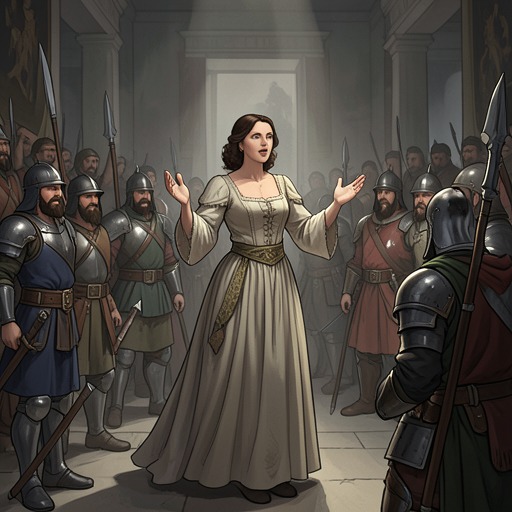
In the council chamber, Tardos Mors paces on the raised platform of the throne, his face tense as the assembled members take their seats. He explains the failed reports, the dead keeper, and the danger posed by a machine that has sustained the atmosphere for hundreds of years. Its massive walls would take months to penetrate, while the failing system leaves no such time. His conclusion is stark: Barsoom has, at best, three days to live. The announcement turns a technical failure into a shared political emergency and places the ruler who had resisted a coerced peace before a threat no single kingdom can settle by itself.
The silence that follows lasts several minutes. Then a young Helium noble rises with a drawn sword and calls on the people to show Barsoom how a nation of red men should die, continuing their duties as though a thousand useful years remained. The speech belongs to the noble, not to Tardos Mors; its position after the Jeddak’s report nevertheless shows the immediate atmosphere of the council. Faced with an almost unimaginably shortened future, Helium’s public response is framed as a demand for composure and continued service.
Alliance and Reconciliation
After the defeat of Zodanga and the rescue of Dejah Thoris, Tardos Mors receives the victorious party at his palace. Officers greet Tars Tarkas, his jeds, and the jeddaks and jeds of his allies, and ask them to dismount so that the Jeddak can express his gratitude. At the palace steps, Tardos Mors descends from the royal party to meet them. John Carter recognizes him at once as a tall, straight, powerfully built ruler, but the encounter’s importance lies less in his appearance than in whom he greets first.
Tardos Mors approaches Tars Tarkas before the others. He says that meeting the greatest living warrior on Barsoom is a priceless honor, but that being able to lay a hand on a friend and ally is a still greater boon. The greeting marks the new friendship between the races in public, personal terms. The green leaders are not treated merely as useful auxiliaries in a campaign; Tardos Mors names alliance itself as the greater honor.
He then greets each green jeddak and jed with words of friendship and appreciation. When he reaches John Carter, he places both hands on his shoulders and welcomes him as a son. He says that Carter has been granted, gladly and without opposition, the most precious jewel in Helium—and, he adds, on all Barsoom. The gesture and words affirm the marriage to Dejah Thoris as freely accepted by her family, sharply contrasting with the Zodangan demand that she marry Sab Than as a condition of peace.
Family and Significance
The welcome also establishes Tardos Mors’s relationship to John Carter as more than ceremonial approval. Carter is received into the family without opposition, and Tardos Mors describes the union with Dejah Thoris as a gift granted willingly. His response makes the earlier defense of her choice concrete: the same ruler who rejected a forced marriage now publicly accepts the marriage she has chosen.
Tardos Mors’s brief appearances connect private kinship to the government of Helium. In the dispute over Dejah Thoris, his refusal costs him no domestic authority; in the palace welcome, his hands on Carter’s shoulders turn political reconciliation into family recognition; in the council chamber, he reports the atmosphere crisis plainly, without disguising the three-day limit. Across these scenes, rule is shown as a sequence of consequential acts—refusing coercion, recognizing former enemies as allies, and naming danger to the whole planet—rather than as title alone.