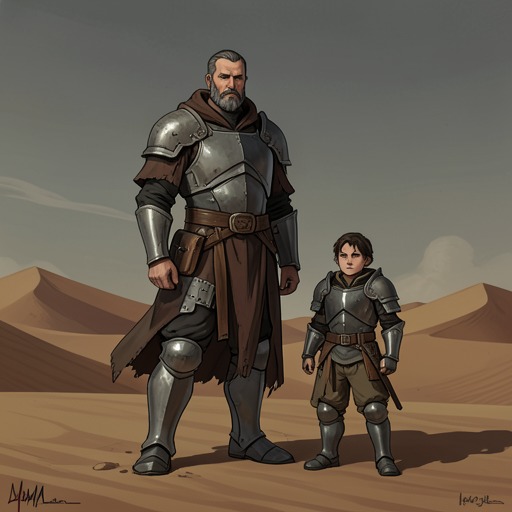
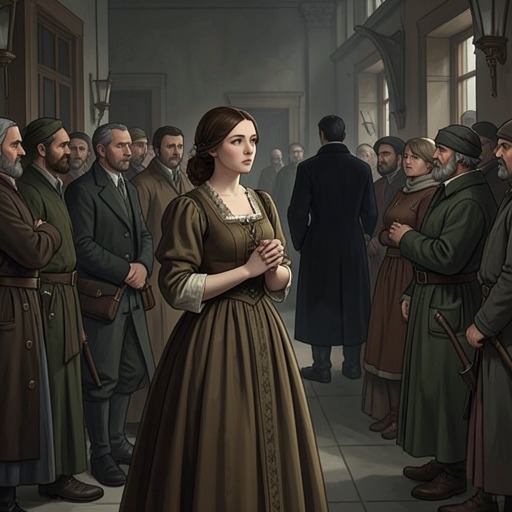
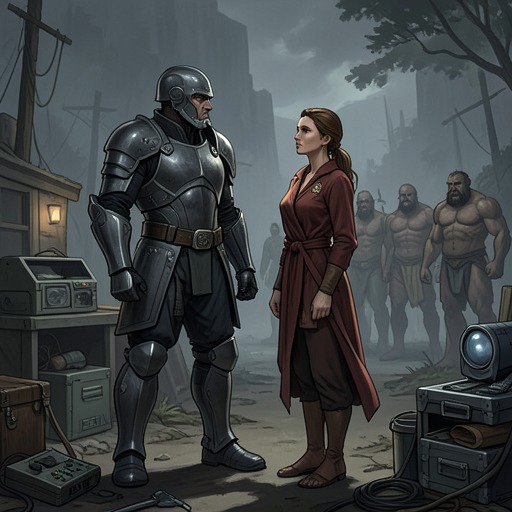
Tars Tarkas and Gozava
A Princess of MarsTars Tarkas and Gozava’s hidden love is the private bond that exposes the emotional cost of Thark society’s rules and gives Tars Tarkas’s later vengeance its personal source. Their daughter, Sola, preserves the truth of the relationship; Tars Tarkas, outwardly impassive when told of Gozava’s death, carries a love that, in Sola’s understanding, remained powerful nearly forty years later.
A Secret Bond and Its Separation
Gozava was the woman Tars Tarkas loved, and Sola was their daughter. The relationship unfolded under a social order in which intimate bonds were difficult to sustain openly. Sola explains that after the expedition’s return, the children were separated from their guardians and distributed among chieftains’ retinues. She never saw her mother again: Tal Hajus imprisoned Gozava and sought the identity of the child’s father.
Gozava protected both her daughter and Tars Tarkas by concealing the truth. She told her captors that she had killed Sola to spare her a similar fate, and claimed to have thrown the child’s body to the white apes. Sola survived, but her mother’s account left her isolated from her family and unable to reveal her parentage. Gozava’s silence was therefore not simply a refusal to name Tars Tarkas; it was also a means of keeping Sola’s survival and identity from those who might harm her.
Gozava’s Death and Tars Tarkas’s Response
Tal Hajus eventually tortured Gozava to force her to identify Sola’s father. She remained loyal and died without exposing him. Sola says that her mother’s death occurred amid the laughter of Tal Hajus and his chieftains. The betrayal that led to Gozava’s persecution was known to Sola, Tal Hajus, and Sarkoja, but Tars Tarkas did not yet know who had carried the accusation to his enemies.
When Tars Tarkas returned and Tal Hajus told him what had happened, he gave no outward sign of emotion. Sola recalls that not even a twitch revealed what he felt; the one visible distinction was that he did not laugh as Tal Hajus recounted Gozava’s death. That restraint concealed, rather than disproved, his grief. Sola interprets the change that followed as evidence of a terrible, enduring loss: from then on, Tars Tarkas became exceptionally cruel, while waiting for an opportunity to avenge Gozava.
The Truth Revealed to Sola and John Carter
Sola eventually tells John Carter that Tars Tarkas is her father. She places the disclosure in his hands without restricting what he may do with it, trusting him to speak truthfully when useful—or to lie if deception could spare someone suffering. The confidence she places in him makes the family secret consequential beyond its original concealment: knowledge of Tars Tarkas’s attachment may help Sola, Tars Tarkas, or Dejah Thoris.
The disclosure also changes the meaning of Tars Tarkas’s earlier silence. When John Carter later recounts Sola’s account to him, Tars Tarkas says little, but the muscles of his face register both passion and agony as he remembers what was done to the only person he had ever loved. The knowledge does not erase the decades of separation or restore Gozava; it brings private grief into the present as a conflict with the people responsible.
Vengeance, Restraint, and the Relationship’s Legacy
Tars Tarkas’s resentment is directed first toward Tal Hajus, who imprisoned and killed Gozava, and also toward Sarkoja, whom Sola identifies as the person who betrayed her mother. When Tars Tarkas returns to Thark with John Carter, he no longer resists going before Tal Hajus. Before that confrontation, however, he visits Sarkoja and warns her that the warrior who loved Gozava knows of her role. He does not kill her; instead, he invokes the possibility of a test involving a wild thoat and tells her that the River Iss pilgrimage is near. His warning makes his pursuit of justice deliberate, while also placing it within Thark customs rather than presenting it as an immediate act of violence.
Gozava and Tars Tarkas’s relationship has no reunion or resolution in the events recalled. Its continuing force appears through what survives: Sola, the truth she carries, Tars Tarkas’s grief, and his long wait to answer Tal Hajus. The contrast between his public composure and private suffering reveals the limit of Thark’s hardening customs: they can suppress the visible signs of love, but they cannot make the bond cease to matter. Their story also gives Tars Tarkas’s ambition a personal history, turning his eventual opposition to Tal Hajus into more than a struggle for power.