Wohong Arena Grand Prix
A Princess of MarsThe Warhoon Great Games are a ten-day spectacle in which captives and animals are compelled to fight for survival, and the only prize is freedom for the final victor. For John Carter and Kantos Kan, the contest becomes both a lethal trial and an opportunity: their mutual trust allows them to deceive the crowd, fake Carter’s death, and escape after dark rather than fight each other to the end.
Setting and Rules
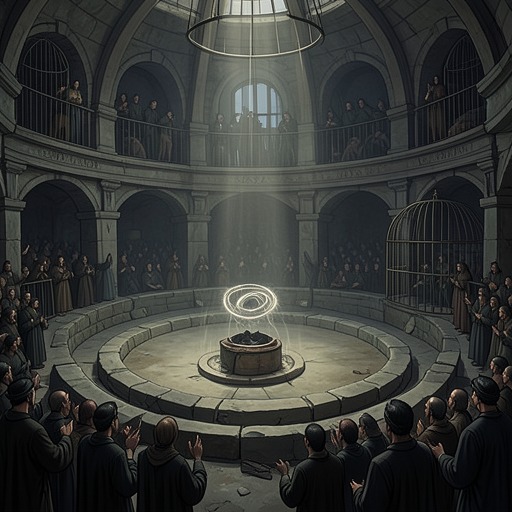
During their imprisonment, Carter and Kantos Kan are brought to an enormous amphitheater excavated below ground in the ruins of the Warhoon city. Debris partly fills the excavation, making its original size difficult to judge, but its remaining seating can hold the assembled twenty thousand Warhoons. The arena itself is uneven and neglected. Stones taken from ruined buildings form barriers around it, while cages at either end hold the next combatants until their turn.
The cages contain a varied succession of victims: calots, thoats, mad zitidars, green warriors, women from other hordes, and unfamiliar wild beasts. Kantos Kan explains the contest’s central rule: at the end of each day, only one prisoner will be alive and free; the other contestants will have died in the arena. Winners of individual bouts are set against one another until a final victor remains. On the following morning, new victims fill the cages, and the process continues through the ten days of games.
The Day’s Contests
The amphitheater fills within an hour. Dak Kova, accompanied by his jeds and chieftains, watches from a raised platform at the center of one side. At his signal, a dozen green Martian females are brought into the arena, each with a dagger, and set against twelve released calots. Carter turns away from the encounter; when he looks back after Kantos Kan tells him it is over, three dogs remain. The contest proceeds through further pairings, including a mad zitidar released among the surviving animals.
Carter is matched against both men and beasts. Armed with a long sword, and possessing greater agility and generally greater strength than his opponents, he wins repeatedly. His victories earn applause from the crowd, which eventually calls for him to be taken from the arena and admitted to the Warhoon hordes. That acclaim does not alter the rules: his survival depends on continuing to win, and the contest narrows until only Carter, Kantos Kan, and a towering green warrior from a northern horde remain.
The Final Three
The green warrior has defeated everyone he has faced. Carter doubts that Kantos Kan can overcome him: the opponent stands nearly sixteen feet tall, while Kantos Kan is just under six feet. Kantos Kan, however, has survived his own earlier fights, at times by only a narrow margin, especially against green warriors. Their unequal size makes the next bout appear to favor the giant, but Kantos Kan relies on a technique Carter has not previously seen.
At roughly twenty feet from his opponent, Kantos Kan draws his sword arm back over his shoulder and hurls his weapon point-first. The throw strikes the green warrior in the heart and kills him, making Kantos Kan the winner of the first of the two final encounters. The outcome leaves the two friends to face one another for the game’s promise of liberty.
Deception and Escape
Carter whispers to Kantos Kan to prolong their fight until nearly dark, hoping the delay will give them a chance to escape. The Warhoons appear to suspect that neither man wants to kill the other and respond with angry cries when they fail to land a fatal thrust. As darkness approaches, Carter gives Kantos Kan a way to make the contest appear finished: Kantos Kan thrusts his sword between Carter’s left arm and body, and Carter falls while holding the weapon so that it seems to protrude from his chest.
Kantos Kan then performs the expected finishing gesture, placing a foot on Carter’s neck and drawing his sword away. In the darkness, the blade slips harmlessly into the sand, but the spectators cannot distinguish the deception from a genuine death. Carter tells Kantos Kan to claim his freedom and then look for him in the hills east of the city. Kantos Kan leaves; once the amphitheater has emptied, Carter climbs to the top and slips away. Because the excavation lies far from the plaza, in an uninhabited part of the dead city, he reaches the hills without much difficulty.
Significance
The games make survival a public performance governed by the Warhoons’ rules: victory appears to require killing every remaining opponent, and the crowd’s applause can accompany the same system that keeps prisoners in danger. Carter and Kantos Kan escape not by overpowering the assembled horde but by exploiting its assumptions about what a final victory and a death must look like. The staged ending preserves their friendship while turning the darkness, rather than the arena’s promised prize, into their route to freedom.