Woola
A Princess of MarsWoola is the fierce Martian animal initially set to guard the captive John Carter, but he becomes much more than a sentry: he is Carter’s steadfast protector and companion, repeatedly choosing to follow and defend him even when distance, danger, or his assigned duties intervene. His relationship with Carter also gives practical force to the story’s contrast between command through violence and trust cultivated through kindness.
Identity and Introduction
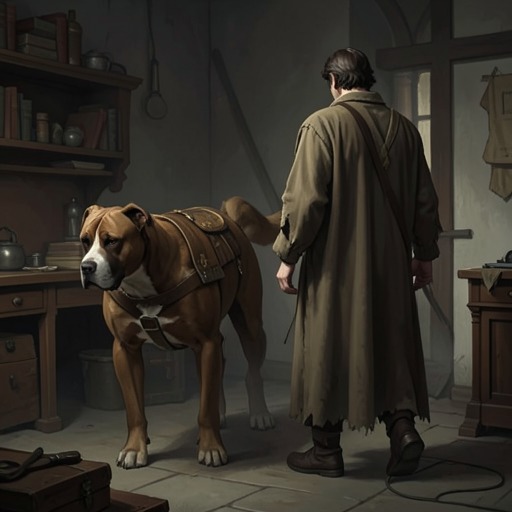
Sola leaves Woola alone with Carter in the captive’s chamber after giving the animal a brief command and indicating the prisoner. Carter expects the apparently dangerous creature to threaten him. Instead, Woola crosses to the chamber’s only street exit and lies across the threshold, blocking the way out. This first encounter defines his role as a guard, but not as an attacker: his vigilance is directed toward keeping Carter in place.
Woola’s watchfulness lasts beyond that initial assignment. Carter says the animal guards him throughout his captivity among the Green Martians, never voluntarily leaving his side, and saves his life twice. The repeated acts change the meaning of the imposed guard duty. Woola may have been placed there by Carter’s captors, but his own decisions become central to their bond.
Protection and Loyalty
Woola’s first major act of protection comes when Carter is in danger from the great white apes of Mars. As one ape holds Carter down and another approaches, Woola bursts into the chamber and attacks the immediate threat. Carter survives, and the encounter establishes that Woola will act independently when his companion is endangered.
Later, a Martian warrior draws a pistol and prepares to shoot Woola. Carter strikes the warrior’s arm aside, then helps Woola to his feet and motions for him to follow. Tars Tarkas allows Carter to act as he wishes, and Woola accompanies him back to the plaza. Carter’s intervention matters as much as Woola’s rescue: their loyalty is reciprocal, with Carter refusing to treat the animal as disposable after it has served him.
The bond is tested when Carter approaches the boundary of the city. Sola has warned that Woola is expected to prevent him from leaving and may bring him back dead or alive if he persists. Carter nevertheless decides to test whether Woola’s affection will outweigh the duty imposed by his masters. Woola runs ahead and presses against Carter’s legs, pleading rather than threatening. Carter sits, embraces the animal’s heavy neck, and speaks to him in Martian as he would to a familiar animal at home. Woola responds with an expression Carter reads as a smile. The scene turns a test of obedience into an exchange of affection: Woola’s resistance to Carter’s departure does not erase their attachment.
Kindness and Animal Training
Carter applies what he has learned from Woola to his treatment of the thoats assigned to him. The Green Martian practice he observes relies on blows to force the mounts into obedience; resistance can escalate into a struggle in which either rider or animal may be killed. Carter instead first establishes that the thoats cannot unseat him, then gradually wins their confidence, drawing on his experience with animals on Earth.
Within a few days, the thoats follow Carter like dogs, rub their snouts against him, and respond readily to his commands. The warriors interpret this unusual docility as evidence of an unknown power. Carter explains to Tars Tarkas that kindness makes the animals more dependable in battle and on the march: because they obey, they improve their rider’s fighting effectiveness. Woola’s relationship with Carter thus informs both a personal ethic and a practical alternative to the Green Martians’ coercive handling of animals.
Separation and Reunion
After Carter, Dejah Thoris, and Sola become lost in the wilderness, they travel for days while exhausted and without finding the waterways that mark the great routes across Barsoom. Woola is not with them. When Carter wakes early one morning, however, the animal is nestled close beside him. He has followed the party across the trackless waste, arriving to share whatever fate awaits them. Carter embraces him and is moved to tears by the evidence of his devotion.
The journey continues, and the party has to leave an exhausted thoat behind when it collapses and cannot rise. Woola’s continued presence makes the harshness of the journey personal: loyalty brings him to Carter, but does not remove the dangers of hunger and fatigue. Later, after Carter has become separated from his companions, he spends two weeks wandering and sleeping outdoors. During a night attack by a large creature, Woola again intervenes, overcoming the danger and saving Carter. The moonlight reveals the rescuer, who has become only a shadow of his former self and is more than half-starved. After feeding on the dead animal, Woola continues with Carter. His rescue is inseparable from his own deprivation; he arrives not untouched by the wilderness, but having endured it to reach his companion.
Woola’s loyalty also persists through a further separation. After the battle in which Carter fights alongside the Green Martians, he returns to Thark and waits in Tars Tarkas’s quarters. Woola rushes into the room and nearly knocks him down. Tars Tarkas explains that the animal had gone to Carter’s former quarters and kept watch there, apparently expecting him to return. Even when Carter is absent and his return seems uncertain, Woola’s attachment takes the form of waiting as well as rescue.
Companionship and Significance
Carter describes Woola as one of his two friends on Mars, alongside Sola, and contrasts the animal’s love, loyalty, and gratitude with the Green Martians’ limited capacity for compassion. That comparison grows out of specific actions rather than an abstract claim: Woola guards Carter, intervenes in mortal danger, follows him across the wilderness, and resumes his vigil after they are separated. Carter, for his part, protects Woola from the armed warrior, embraces him, and treats animal trust as something to be earned rather than beaten into submission.
Woola remains beside Carter and Dejah Thoris in the palace garden during the crisis in which the failing air supply threatens life across Barsoom. As the royal family gathers and the prospect of death weighs on them, Woola presses close to the couple and whines. His presence extends the bond from their earlier flight and hardship into the book’s threatened ending. He is not merely a device that saves Carter at key moments: his repeated acts of attachment give the narrative a nonhuman companion whose loyalty is sustained across captivity, escape, separation, and reunion.