Boar
Aesop's FablesBoar appears in two fables in contrasting situations: one prepares his weapons before danger is present, while another stops fighting when the sight of waiting scavengers reveals the cost of continuing. These brief appearances use familiar animal traits to stage lessons about foresight and the consequences of rivalry.
Preparations Before Danger
In “The Wild Boar and the Fox,” a Wild Boar stands beneath a tree, rubbing his tusks against its trunk. A Fox passing by asks why he is sharpening them when neither a huntsman nor a hound threatens him. The Boar answers that preparation should come before danger, not at the moment his weapons are needed. His action turns an apparently unnecessary routine into a practical expression of foresight.
The scene depends on contrast: the Fox judges the moment by the absence of an immediate threat, while the Boar considers what may be required later. The brief exchange gives the Boar the decisive insight; readiness is useful precisely because danger may leave no time to prepare.
Rivalry Interrupted
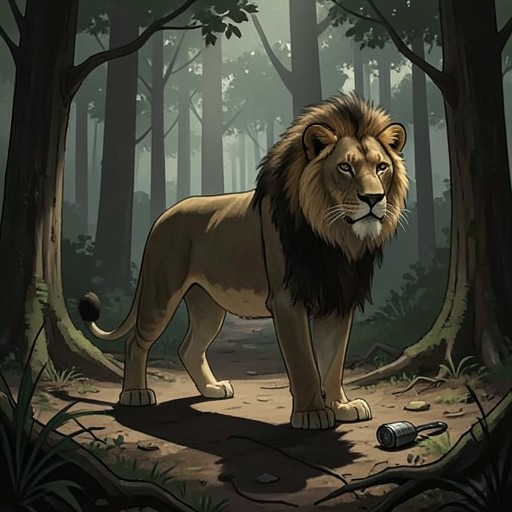
“The Lion and the Boar” places a Lion and a Boar at a small well on a hot summer day, when thirst has driven the animals to seek water. Arriving at the same moment, they dispute which should drink first, and their quarrel escalates into a potentially mortal fight. The contest begins over immediate access to a scarce resource, but its stakes change when both pause to catch their breath.
During that pause, the Lion and the Boar see Vultures waiting in the distance for whichever combatant falls first. The birds make the likely consequence of continued fighting visible: one rival’s defeat would feed scavengers. The Lion and the Boar therefore end their quarrel and make peace rather than become carrion. Their choice does not arise from affection or from settling who should drink first; it follows from recognizing that their conflict benefits those waiting for its outcome.
Fable Roles and Significance
The two episodes give the Boar different but compatible roles. In the tusk-sharpening story, he represents deliberate preparation; at the well, he is one of two rivals capable of revising their course when new evidence changes the calculation. The first fable’s lesson is stated directly through the Boar’s explanation, whereas the second lets the sight of the Vultures precipitate the decision to make friends.
The collection’s preface describes fable as a short narrative whose fictitious characters carry instruction, and notes that animal figures often retain recognizable qualities while depicting human motives. The Boar’s prepared tusks and his participation in a dispute over water fit that method: each action is concrete, but the consequences extend to human questions of foresight and rivalry. His appearances do not make him a continuous character with a personal history; each tale gives him a distinct role suited to its moral action.