Mouse
Aesop's FablesMouse is a recurring figure in the fables, appearing as both an individual and a collective of Mice. The stories place Mouse among powerful adversaries and make smallness consequential: it can invite dismissal, yet also enable escape, resistance, and repayment. Across these episodes, Mouse’s fortunes depend not on strength alone but on opportunity, caution, and the limits of those who dominate.
Identity and Fable Convention
The collection’s preface describes fables as brief narratives that use fictitious characters to teach a moral or social lesson, often by giving speech to animals. It also argues that animal characters should retain recognizable traits even as they represent human motives and conduct. Mouse accordingly occupies a familiar position as a small, vulnerable creature, but the stories do not confine that role to helplessness: Mouse can answer a threat with resourcefulness, while groups of Mice can expose the difficulty of turning a clever proposal into effective action.
The preface cautions that not every fable in the collection achieves the same unity between its action and moral. That distinction matters for Mouse’s appearances: some stories close with an explicit maxim, while others let the contrast between a small creature and a powerful opponent carry much of the lesson. In either form, Mouse’s scale makes the relation between apparent weakness and actual capacity central to the narrative.
Rescue and Reciprocity
In The Lion and the Mouse, Mouse runs across a sleeping Lion’s face and wakes him. The Lion catches Mouse and is ready to kill him, but Mouse pleads to be spared and promises to repay the kindness. The Lion laughs at the prospect and lets him go, making the first encounter a meeting between overwhelming force and a promise that seems implausible.
The balance changes when hunters capture the Lion and bind him to the ground with ropes. Recognizing the Lion’s roar, Mouse comes to him and gnaws through the ropes with his teeth, freeing him. Mouse then recalls that the Lion had ridiculed the possibility of receiving help from so small a creature. The rescue turns the earlier act of mercy into practical reciprocity: the Lion’s strength could not release him, while Mouse’s size and persistence made the rescue possible. The tale’s resolution makes the rejected promise true and demonstrates that a favor may be repaid in an unexpected form.
Evasion and Reversal
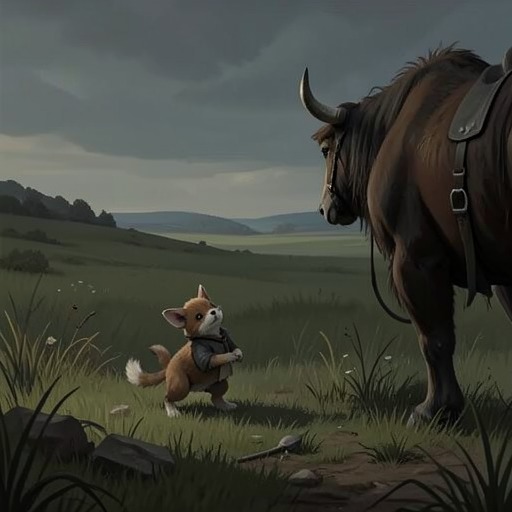
In The Mouse and the Bull, Mouse bites a Bull, and the Bull tries to catch him in anger. Mouse reaches his hole safely. The Bull digs at the walls with his horns but tires before he can force Mouse out, then crouches outside and falls asleep. Mouse emerges, creeps up the Bull’s flank, bites him again, and retreats to the hole. The Bull rises, perplexed and unable to decide what to do.
Mouse’s advantage here is not the power to defeat the Bull in a direct contest. The hole provides refuge, the Bull’s effort exhausts him, and Mouse chooses when to emerge and withdraw. The closing observation—that the great do not always prevail, and that the small and lowly can sometimes do the most mischief—fits the action’s reversal: the Bull’s physical superiority remains real, but it does not give him control of the encounter.
Collective Plans and Their Limits
In The Mice in Council, Mice gather to find a way to warn themselves of the approach of their enemy, the Cat. They favor a proposal to tie a bell around the Cat’s neck, since its sound would alert them and give them time to hide in their holes. The council’s difficulty appears only when they consider who will undertake the dangerous task. No one volunteers, leaving the plan without an agent.
The story’s ending turns on the gap between a strategy that sounds effective in discussion and the risk of carrying it out. Unlike the solitary Mouse who can use a hole to escape a Bull, the council cannot convert collective agreement into action against the Cat. The proposed bell promises advance warning, but the Mice’s deliberation reveals that a plan’s usefulness depends on someone being willing and able to execute it.
Narrative and Thematic Role
Mouse’s appearances set contrasting forms of smallness beside one another. In the rescue and Bull stories, an individual Mouse acts at the decisive moment: one repays a spared life by freeing a Lion, and another uses shelter and timing to frustrate a Bull. In the council story, the Mice identify a plausible precaution but cannot agree to bear its risk. The contrast distinguishes resourceful action from an unimplemented idea without making size itself a guarantee of success.
The preface presents the fable as instruction conveyed through an animal narrative, with the moral intended to arise from the action rather than from an adviser’s authority alone. Mouse’s encounters enact that method through reversals: the powerful may need help, the pursuer may be outlasted, and the soundest proposal may fail at the point of execution. Mouse is therefore more than a token of weakness; the character makes visible how strength, safety, and agency change with circumstance.