Old age and infirmity
Aesop's FablesOld age and infirmity are recurring conditions in these fables, changing the balance between strength, skill, and vulnerability. They may prompt deception, expose a gap between a person’s enduring spirit and declining capacity, or sharpen judgment through experience. The collection does not treat age as a single moral quality: the aged Lion and Weasel exploit weakness to prey on others, while the old Hound asks to be judged in light of both his past service and his present limitations.
Declining Strength and Changed Fortune
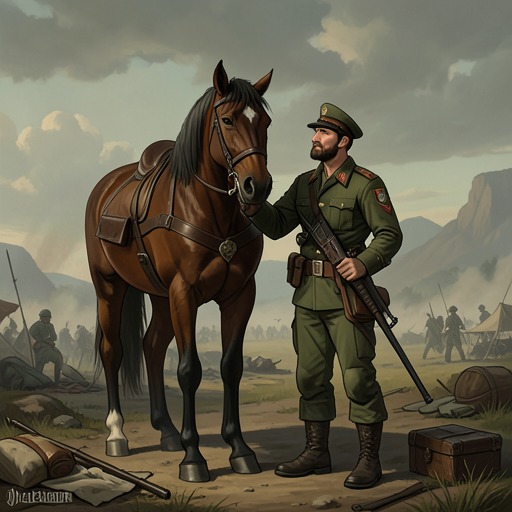
In “The Charger and the Miller,” a Charger’s age and infirmity bring an abrupt change of work: instead of going to battle, he is sent to grind at a mill. He laments the loss of his former role, remembering that he once campaigned protected from counter to tail and accompanied by a groom. His regret is not simply for lost strength but for the reversal of a life in which battle had seemed preferable to the labor now imposed on him. The Miller answers that he should stop dwelling on the past, since mortals commonly endure the ups and downs of fortune. The story makes aging the occasion for a change in status and occupation, and frames that change as part of a wider instability in human circumstances.
The old Hound’s story offers a more intimate account of bodily decline. Once strong enough never to yield to any beast of the forest, he meets a Boar during a hunt and seizes him boldly by the ear. His decaying teeth can no longer maintain the hold, and the Boar escapes. When his master catches up and reproaches him, the Hound says that his spirit remains as good as ever, even though infirmity has made him unable to perform as before. He argues that his record deserves praise rather than blame for what he can no longer do. The fable thus distinguishes willingness from capacity: the failure lies not in a loss of courage, but in the bodily limits of age.
Age as a Resource for Predation
In “The Sick Lion,” old age and infirmities leave the Lion unable to obtain food by force. He responds not by withdrawing from the hunt but by replacing force with artifice: he returns to his den, pretends to be sick, and makes his supposed illness publicly known. The other beasts come one by one to visit him, and he devours them. The Fox, arriving only at the entrance, asks after the Lion from a respectful distance. Invited inside, he refuses, having observed that many tracks lead into the cave but none lead out. The ending’s warning—that wisdom comes from attending to the misfortunes of others—makes observation a counter to the Lion’s calculated exploitation of trust. Age limits the Lion’s physical power, but his cunning keeps him dangerous.
The Weasel in “The Weasel and the Mice” likewise turns declining ability into a reason to deceive. No longer active enough to catch mice as before, he covers himself in flour and lies in a dark corner. Mice mistake him for food and are caught one after another. An old Mouse who has escaped many traps and snares recognizes the trick from a safe distance and addresses the Weasel with a pointed wish that his success match the truth of his assumed appearance. The old Mouse’s experience makes caution possible where the younger victims’ mistaken trust proves fatal. Here age belongs on both sides of the encounter: it weakens the predator’s ordinary method but also gives the survivor a history of traps from which to reason.
Age, Judgment, and Moral Framing
Across these tales, physical decline does not dictate a character’s moral position. The Lion and Weasel compensate for reduced hunting ability through deception, making infirmity part of the circumstances behind their schemes without excusing their predation. The Hound, by contrast, remains willing to serve and asks for a distinction between the courage he retains and the bodily ability he has lost. The Charger’s lament adds another dimension: aging can mean not only reduced performance but displacement from a former identity and a changed place in the world.
The collection’s preface describes the fable as a short narrative designed to convey instruction, often by clothing human motives and conduct in fictitious animal characters. It also stresses that animal figures should retain recognizable characteristics while representing human passions. The stories of aging use that concise form to make different consequences legible: the Charger’s reversal invites reflection on changing fortune, the Hound’s defense challenges judgment that ignores a lifetime of service, and the Fox and old Mouse show how attention and experience can expose danger. Taken together, these episodes make old age and infirmity a condition with varied effects—not a moral verdict, but a change in capacity, position, and the risks others may seek to exploit.