Raven
Aesop's FablesRaven is a bird whose reputation and appearance become the focus of two fables. In one, its status as an omen is contrasted with Crow’s attempt to claim the same significance; in the other, Crow’s envy of its white plumage leads to a failed imitation and death from hunger. The paired episodes make Raven a measure against which another bird’s ambition is tested, rather than a developed character with an independent plot.
Reputation and Imitation
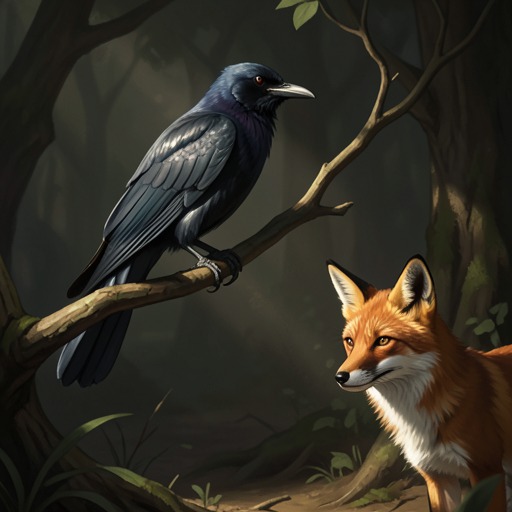
In “The Crow and the Raven,” Raven is known as a bird of good omen. People watch its flight for indications of whether future events will take a good or bad course. That public belief gives Raven a social standing Crow envies: its importance lies not in any action in the fable, but in the meaning people attach to its presence.
When travelers approach, Crow perches in a tree and caws loudly, hoping to attract the same attention. The travelers turn toward the sound and wonder what it foretells, but one explains to the other that it is only Crow’s cry and carries no omen. Raven’s recognized reputation therefore cannot simply be acquired through imitation. The fable’s stated lesson is that those who assume a character that is not theirs make themselves ridiculous.
Plumage and Consequence
“The Raven and the Swan” gives Raven a different distinction: its beautiful plumage, especially its splendid white color. Crow longs to obtain the same appearance and supposes that the Swan’s whiteness comes from washing in the water where it swims. Acting on that mistaken explanation, Crow leaves the nearby altars where it had found its living and settles by lakes and pools.
Repeated cleansing does not change Crow’s feathers. Meanwhile, having abandoned its former food source, it goes without food and perishes. Raven does not cause this outcome; its appearance instead becomes the model for a change of habit that cannot deliver what Crow wants. The moral states that change of habit cannot alter nature, while the plot makes the cost concrete: the attempt to imitate another bird’s appearance also sacrifices the means of survival.
Role in the Fables
Across the two tales, Raven functions as a point of comparison in stories about misplaced aspiration. In the omen story, Crow tries to borrow a reputation that belongs to Raven; in the plumage story, Crow attempts to reproduce the Swan’s appearance. Both efforts fail, but their mechanisms differ: social recognition is not won by making a similar sound, and an inherited physical quality cannot be acquired by copying another creature’s habits.
These short narratives illustrate the collection’s account of fable as instruction conveyed through fictitious characters. Each builds a simple action around a familiar distinction and draws a moral from its outcome. Raven’s two appearances thus help frame warnings against assuming another’s identity and against mistaking imitation for transformation.