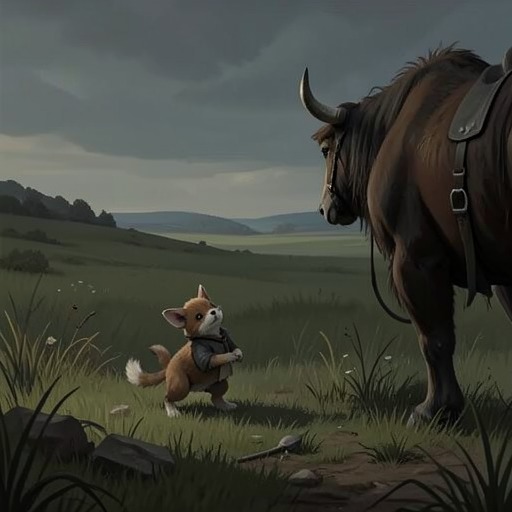
The Hare and the Tortoise’s Race
Aesop's FablesThe Hare and the Tortoise’s Race turns a boast about speed into a contest that exposes the cost of complacency: the Tortoise keeps moving, while the Hare’s confidence leads him to stop, sleep, and lose. The race’s plain sequence makes its lesson inseparable from its outcome: steady effort carries the Tortoise to the goal before the swifter Hare can recover his lead.
Challenge and Terms
The contest begins when the Hare ridicules the Tortoise’s short feet and slow pace. Rather than accept the insult as a final judgment of her ability, the Tortoise answers that she can beat him in a race. The Hare considers this impossible but agrees to compete. Their wager therefore pits visible speed against a claim that the Hare dismisses before the test begins.
The competitors also agree that the Fox will choose the course and set the goal. The Fox’s role is limited but important: the race has an agreed route and finish, so its result rests on how the contestants proceed rather than on a change of terms.
The Race
On the appointed day, the Hare and the Tortoise start together. The Tortoise does not stop; she continues directly along the course at a slow, steady pace. The narration emphasizes persistence rather than any sudden burst of speed: her advantage accumulates because she keeps advancing.
The Hare, by contrast, lies down beside the way and falls asleep. When he wakes, he moves as fast as he can, but the delay has already changed the contest. His speed cannot make up the time he has surrendered. He sees that the Tortoise has reached the goal and is comfortably dozing after the effort of the race.
Result and Moral
The finish reverses the expectation established by the Hare’s mockery. The Tortoise, the slower runner, arrives first; the Hare’s greater speed proves insufficient because he treats the result as settled before completing the race. The story makes neither a complicated strategy nor an external obstacle responsible for the outcome: the contrast is between uninterrupted progress and self-defeating rest.
The closing maxim, “Slow but steady wins the race,” states the lesson directly. In the collection’s preface, a well-constructed fable is described as a short narrative whose moral is plain and closely bound to what happens. This race exemplifies that design: the Tortoise’s steady movement enacts the maxim, while the Hare’s sleep supplies its counterexample.
Form and Narrative Significance
The episode is built around one simple action, from the challenge through the agreed race to the finish. Its animal characters carry a humanly legible contrast: the Hare’s confidence in speed gives way to carelessness, while the Tortoise’s limited pace is offset by constancy. The narrative does not need to explain the lesson at length; the reversal at the goal and the brief moral make the consequence clear.
The preface cautions that not every fable in the collection has the unity of design or close connection between narrative and moral associated with the strongest examples. The race is presented as a clear instance of that close fit. Its outcome supplies the proof, and its moral names the principle the action has already demonstrated.