Event 1
The Hare and the Tortoise’s Race
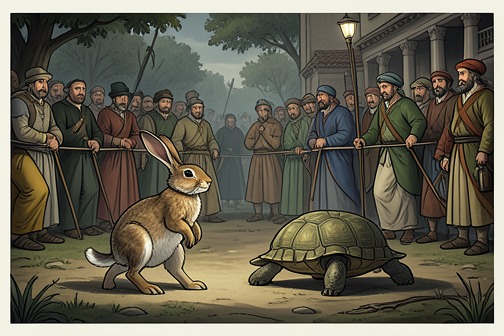
[The Hare and the Tortoise’s Race](entity:event-recall-event-the-hare-and-the-tortoi-189677d4aad2) turns a boast about speed into a contest that exposes the cost of complacency: the Tortoise keeps moving, while the [Hare](entity:creature-recall-creature-hare-eac8b931638a)’s confidence leads him to stop, sleep, and lose. The race’s plain sequence makes its lesson inseparable from its outcome: steady effort carries the Tortoise to the goal before the swifter Hare can recover his lead.
## Challenge and Terms
The contest begins when the Hare ridicules the Tortoise’s short feet and slow pace. Rather than accept the insult as a final judgment of her ability, the Tortoise answers that she can beat him in a race. The Hare considers this impossible but agrees to compete. Their wager therefore pits visible speed against a claim that the Hare dismisses before the test begins.
The competitors also agree that the [Fox](entity:creature-recall-creature-fox-ef8d6f85e3fc) will choose the course and set the goal. The Fox’s role is limited but important: the race has an agreed route and finish, so its result rests on how the contestants proceed rather than on a change of terms.
## The Race
On the appointed day, the Hare and the Tortoise start together. The Tortoise does not stop; she continues directly along the course at a slow, steady pace. The narration emphasizes persistence rather than any sudden burst of speed: her advantage accumulates because she keeps advancing.
The Hare, by contrast, lies down beside the way and falls asleep. When he wakes, he moves as fast as he can, but the delay has already changed the contest. His speed cannot make up the time he has surrendered. He sees that the Tortoise has reached the goal and is comfortably dozing after the effort of the race.
## Result and Moral
The finish reverses the expectation established by the Hare’s mockery. The Tortoise, the slower runner, arrives first; the Hare’s greater speed proves insufficient because he treats the result as settled before completing the race. The story makes neither a complicated strategy nor an external obstacle responsible for the outcome: the contrast is between uninterrupted progress and self-defeating rest.
The closing maxim, “[Slow but steady wins the race](entity:rule-recall-rule-slow-but-steady-wins-the-f24a49641944),” states the lesson directly. In the collection’s preface, a well-constructed fable is described as a short narrative whose moral is plain and closely bound to what happens. This race exemplifies that design: the Tortoise’s steady movement enacts the maxim, while the Hare’s sleep supplies its counterexample.
## Form and Narrative Significance
The episode is built around one simple action, from the challenge through the agreed race to the finish. Its animal characters carry a humanly legible contrast: the Hare’s confidence in speed gives way to carelessness, while the Tortoise’s limited pace is offset by constancy. The narrative does not need to explain the lesson at length; the reversal at the goal and the brief moral make the consequence clear.
The preface cautions that not every fable in the collection has the unity of design or close connection between narrative and moral associated with the strongest examples. The race is presented as a clear instance of that close fit. Its outcome supplies the proof, and its moral names the principle the action has already demonstrated.
Event 2
The Lion and the Mouse Rescue
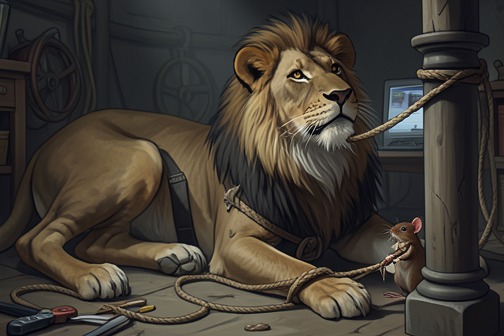
[The Lion and the Mouse Rescue](entity:event-recall-event-the-lion-and-the-mouse-a78500b05280) turns a brief encounter between a powerful [Lion](entity:creature-recall-creature-lion-9c602d24ae73) and a small [Mouse](entity:creature-recall-creature-mouse-a3860c63067d) into a reciprocal rescue. The Lion first chooses to spare the Mouse; later, when hunters bind him, the Mouse gnaws through the ropes and sets him free. The reversal gives concrete form to the lesson that help can come from the very person whose capacity to return it has been underestimated.
## Encounter and First Act of Mercy
The story begins when a Mouse runs over a sleeping Lion’s face and wakes him. Angry, the Lion catches the Mouse and is about to kill him. The Mouse pleads for his life and promises to repay the kindness if spared. The Lion laughs at the prospect that so small a creature could help him, but releases him all the same. His act is not prompted by confidence in repayment: the tale stresses his disbelief, making the later rescue a reversal of his expectation.
## The Lion’s Capture and the Rescue
Shortly afterward, hunters catch the Lion and bind him to the ground with ropes. The Mouse recognizes the Lion’s roar, comes to him, and gnaws through the ropes with his teeth. What the Lion could not imagine becomes the means of his escape: the Mouse’s small size and teeth, initially no match for the Lion’s strength, prove suited to freeing him from the bonds. The rescue answers the earlier plea not with force but with the practical aid the Mouse can provide.
After freeing the Lion, the Mouse reminds him that he had ridiculed the idea of receiving help from him. The concluding point is demonstrated through action rather than left as an abstract promise: the Mouse’s repayment is real, and the mighty Lion depends on the creature he had dismissed. Their positions briefly reverse, but the story does not replace one ruler with another; it establishes that dependence and usefulness cannot be judged by size alone.
## Reciprocal Aid and the Fable’s Design
The episode is structured around two linked acts of mercy and rescue. The Lion’s decision to release the Mouse creates the possibility of later assistance, while the Mouse’s intervention makes the promised reciprocity visible. The first scene sets up an expectation that the Lion’s superiority makes the Mouse’s offer absurd; the hunters’ ropes turn that assumption into the condition the Mouse can overcome. The result is not merely a reward for kindness but a demonstration that a seemingly weak ally may possess a capacity the powerful lack in a particular circumstance.
The book’s preface describes the fable as a short narrative whose fictitious characters convey instruction about human conduct, and emphasizes that a successful moral should be closely interwoven with the action. This story fits that design: its lesson arises from the Lion’s release of the Mouse and the Mouse’s subsequent rescue, rather than depending on an unrelated explanation. The speaking animals preserve familiar contrasts of scale and strength, but the plot complicates any assumption that those qualities determine who can help whom. In the preface’s account, fables may also operate as veiled admonitions, making animal action a way to address human conduct without placing the adviser in the foreground.
## Place in the Collection
The preface cautions that not every piece in the collection achieves the same unity between narrative and moral, while identifying tightly joined action and lesson as a mark of the true [Aesopian fable](entity:concept-recall-concept-aesopian-fable-6f64e3353c0c). The Lion and the Mouse exemplifies that connection through its paired encounters: mercy precedes repayment, and the very difference in the animals’ strength makes the reversal legible. The story’s enduring force lies in that compact causal chain, which makes reciprocal aid—not size, rank, or initial expectation—the measure of what each character can do.
Event 3
The Boy Who Cried Wolf
[The Boy Who Cried Wolf](entity:event-recall-event-the-boy-who-cried-wolf-9926b1155871) is a fable about trust lost through repeated deception. A shepherd-boy summons villagers three or four times with false cries that a [Wolf](entity:creature-recall-creature-d8deebea0dad) is attacking his flock, then laughs at those who come to help. When the Wolf truly arrives, the villagers ignore his desperate warning, and the flock is destroyed. The reversal turns a practical warning about credibility into the story’s central consequence: once the boy has made his words unreliable, the truth cannot restore their force in time.
## The False Alarms
The shepherd-boy watches a flock of sheep near a village. On three or four occasions he cries, “Wolf! Wolf!” The villagers come out to help, but there is no attack; the boy laughs at them for their trouble. The repetition establishes a pattern rather than a single mistake: each invented emergency uses the villagers’ willingness to respond and makes their next response less likely.
## The Real Attack
The Wolf eventually does come. Now genuinely alarmed, the boy calls for help and says that the Wolf is killing the sheep. The villagers pay no heed and offer no assistance. With no one intervening, the Wolf destroys the whole flock at its leisure. The genuine danger therefore repeats the shape of the earlier alarms, but the boy’s previous conduct has changed how the villagers interpret it; the truth arrives after their trust has been spent.
## Moral and Fable Form
The fable states its lesson plainly: “There is no believing a liar, even when he speaks the truth.” Its short sequence links conduct directly to consequence: false cries prompt help at first, ridicule teaches the boy to treat that help as a joke, and the eventual real warning receives none. The loss of the flock makes credibility more than a matter of reputation; it is also what allows a warning to protect others.
The episode exemplifies the collection’s account of fable as a brief narrative that conveys instruction through fictitious characters. Its moral is closely bound to the action rather than supplied as an unrelated reflection: the villagers’ failure to believe the boy is the consequence of the pattern the story has shown. In the preface’s terms, the compact plot makes the lesson legible through events, while the shepherd-boy and the flock carry a judgment about human conduct without leaving the narrative frame.
Event 4
The Crow Raises the Water in the Pitcher
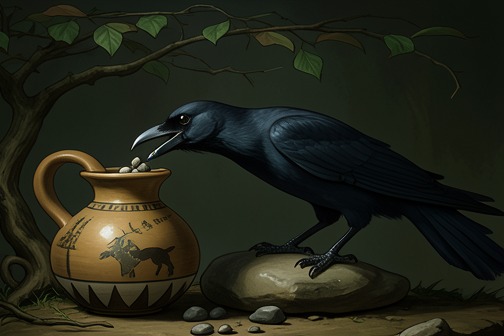
“[The Crow Raises the Water in the Pitcher](entity:event-recall-event-the-crow-raises-the-wat-fc24091e918e)” is a fable of survival through resourceful action: a Crow, unable to reach the little water in a pitcher, raises it by dropping in stones one at a time. Its ending turns this concrete solution into the maxim “[Necessity is the mother of invention](entity:rule-recall-rule-necessity-is-the-mother-af69ac4a7aae).”
## The problem of access
The Crow is perishing with thirst when it sees a pitcher and flies to it in hope of finding water. The vessel contains water, but so little that the bird cannot get at it. The obstacle is not the absence of what it needs, but the distance between the water and its reach.
The Crow tries everything it can think of, but its efforts initially fail. That sequence makes the problem more than a lucky discovery: the bird must keep working after direct attempts prove useless. Its urgent need narrows the stakes to a plain choice between finding a way to drink and failing to survive.
## The solution and its consequence
At last, the Crow gathers as many stones as it can carry. It drops them into the pitcher one by one with its beak, gradually bringing the water within reach. A series of small, deliberate actions changes the conditions that first made the water inaccessible; the Crow then drinks and saves its life.
The solution depends on using the pitcher’s contents and the stones together rather than abandoning the vessel or trying to reach farther. The tale does not describe a tool fashioned separately from the problem. Instead, the Crow alters the situation through repeated acts, and the result follows from their accumulated effect.
## The maxim and narrative design
The closing sentence, “Necessity is the mother of invention,” states the fable’s lesson after the action has demonstrated it. The maxim connects the Crow’s extreme thirst to its discovery of a workable method: need occasions ingenuity, while patient repetition turns that ingenuity into survival.
The narrative moves directly from danger, through failed attempts, to a practical resolution, then names the principle the episode illustrates. Its compact causal structure gives the lesson force: the Crow is not merely clever in the abstract; its resourcefulness answers an immediate problem and saves its life.
Event 5
The Mice’s Failed Plan to Bell the Cat
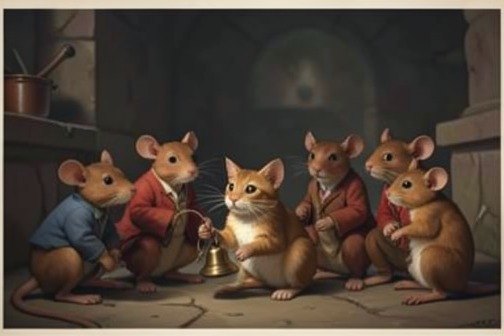
[The Mice’s Failed Plan to Bell the Cat](entity:event-recall-event-the-mice-s-failed-plan-e06388890255) is a fable about the gap between devising a solution and being willing to carry it out. When the Mice assemble to consider how to detect the approach of their enemy, they approve a bell that would warn them in time to hide—but their council cannot find anyone prepared to attach it to the [Cat](entity:creature-recall-creature-eb49f116ab01).
## The Council and Its Purpose
The Mice summon a council to decide how best to warn themselves of the Cat’s approach. Their aim is practical: to hear their enemy coming and escape into their holes before he can reach them. The danger is established by the problem they bring before the assembly, while the gathering itself makes the response a shared responsibility rather than the proposal of a single [Mouse](entity:creature-recall-creature-mouse-a3860c63067d).
The meeting produces several suggestions, but one gains the most favor: tie a bell around the Cat’s neck. Its appeal rests on a simple chain of cause and effect. The Cat’s movements would make the bell sound; hearing it, the Mice could run away and hide. The plan turns the Cat’s presence into a warning signal and appears to give the threatened group advance notice without requiring them to confront him directly.
## The Proposal Meets Its Test
The proposal’s apparent completeness does not last. Once the Mice move from debating the idea to deciding who will carry it out, no volunteer is found. The same Cat whose approach the bell is meant to announce must be approached closely enough for someone to tie it on. The fable thus reveals the practical risk that the attractive plan had left unresolved: the warning device can work only if a Mouse first performs the dangerous act of installing it.
That turn supplies the story’s central irony. The assembly agrees on what should be done, but agreement does not produce an agent willing to do it. The threat remains, and the council ends without a means of putting its favored proposal into effect. The account does not describe a later attempt or a resolution; its ending rests on the absence of anyone willing to take responsibility for the crucial step.
## Form and Significance
The episode is constructed around a compact reversal: deliberation makes the proposed solution seem secure, then the question of who will act exposes its weakness. Rather than lengthening the narrative with an installation attempt, it closes at the moment the Mice must name a volunteer. The unperformed action is therefore the decisive event: the bell exists as an idea, not as a warning the Mice can use.
The preface to the collection describes fable as a short narrative that conveys instruction through fictitious characters and presents a moral or social lesson as an essential purpose of the form. It also emphasizes that a strong fable’s lesson should be closely connected to its action. Here, the assembly’s failure makes that connection plain: a proposal is not a practical solution until someone can and will carry it out. The talking Mice render a familiar collective predicament in a brief animal scene, allowing the gap between counsel and execution to carry the lesson.
Event 6
The Hen That Laid Golden Eggs Is Killed
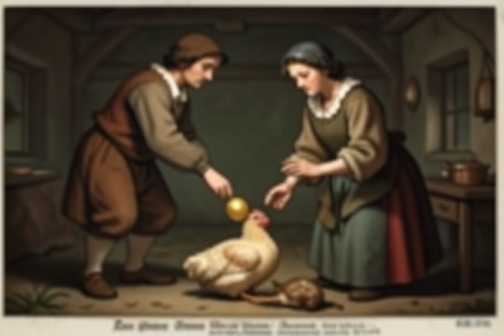
[The Hen That Laid Golden Eggs Is Killed](entity:event-recall-event-the-hen-that-laid-golde-ff070100221c) is a fable about a couple who sacrifice a dependable daily gain in the hope of becoming rich at once. Their hen lays a golden egg every day, but they mistake that repeated yield for proof of a hidden store inside her; killing her brings no treasure, only the loss of what had been assured.
## The Daily Golden Egg
The story begins with a Cottager and his wife who own a hen that lays one golden egg each day. The marvel is not presented as a single windfall: its defining feature is regularity. The couple already receive a valuable return day after day, so the promise of the hen lies in a continuing source of gain rather than a one-time discovery.
Their reasoning converts that reliable pattern into an unsupported assumption. They suppose that the hen must contain a great lump of gold inside her. The egg is evidence of what the hen produces, but the couple treat it as evidence of a larger reserve that can be seized all at once.
## The Killing and Its Result
Seeking the imagined store, the couple kill the hen. The expected transformation—from repeated profit to immediate riches—does not occur. Once they have killed her, they find to their surprise that she differs in no respect from their other hens; the exceptional value had been in the eggs she laid, not in a cache of gold within her body.
The outcome reverses their calculation. They have not exchanged a modest gain for a greater one: they have destroyed the source of the daily golden eggs and found no compensating treasure. The loss is therefore both immediate and ongoing, because the couple have deprived themselves of the benefit they had been receiving each day.
## Moral and Fable Form
The explicit moral identifies the couple's error as hoping to become rich all at once. Their choice pits a known, recurring benefit against an imagined immediate fortune, and the fable makes the cost plain through the sequence of assumption, killing, discovery, and lasting deprivation. Its warning is not merely that greed can fail, but that impatience can destroy a real source of prosperity in pursuit of wealth that exists only in expectation.
The episode also exemplifies the collection's account of fable-making. Its brief narrative gives the moral force through an invented animal whose extraordinary characteristic is central to the human lesson: the golden eggs make the temptation visible, while the ordinary hen revealed after the killing exposes the couple's mistaken inference. In the collection's preface, a fable is distinguished from a simple tale by its instructional purpose and by the use of fictitious characters to represent human motives; this story's compact reversal makes that design especially clear.
## Place in the Collection
The preface cautions that the collection's fables vary in unity of design and in how closely their morals arise from their narratives. It also explains that the body of material attributed to [Aesop](entity:character-recall-character-aesop-65dee389c9d4) is not wholly his immediate work: some fables came from earlier writers and others from later periods. The account names Hesiod, Aeschylus, and Archilochus as sources for other fables, and describes the collection as a tradition assembled across time rather than a uniform set of texts by one author.
That history matters to the hen's story as part of a named collection, but it does not establish this particular fable's origin. The preface describes an early oral tradition, a collection attributed to Demetrius Phalereus around 300 B.C., later adaptations and translations, and a collection of about 150 fables made by Maximus Planudes in the early fourteenth century. These broader details frame the changing transmission of Aesopian material without specifying a separate source or date for this tale.
Event 7
The Dog Loses His Meat to His Reflection
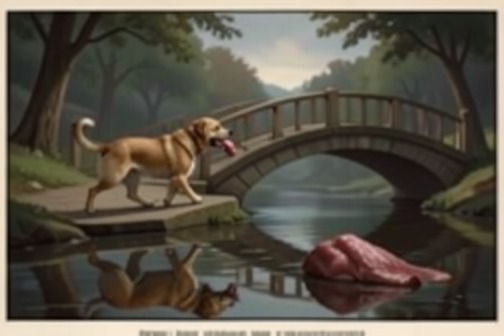
[The Dog Loses His Meat to His Reflection](entity:event-recall-event-the-dog-loses-his-meat-bffb372e2759) is a brief fable in which a [Dog](entity:creature-recall-creature-dog-fad0e60c587f), carrying a piece of flesh across a bridge, mistakes his reflection in the stream for another Dog with a larger piece of meat. He abandons what he has to pursue the apparent double and ends with nothing. The single reversal turns a concrete loss into a moral lesson about grasping after an illusory advantage.
## The Encounter at the Bridge
A Dog crosses a bridge over a stream with a piece of flesh in his mouth. In the water he sees his own shadow, but takes it for another Dog carrying a piece of meat twice the size of his own. The crossing brings together the Dog’s real possession and its deceptive image: the larger prize exists only as a reflection.
## The Choice and Its Consequence
The Dog immediately lets go of his food and attacks the apparent rival, hoping to take the larger piece. His action costs him both prizes. The meat he sees in the water is only a shadow, while the stream sweeps away the flesh he had actually held. The fable’s reversal is direct: in trying to increase his portion, the Dog loses the one thing he possessed.
## Moral and Fable Form
The episode makes its lesson through a single action and its immediate consequence rather than through a separate explanation. The Dog’s misreading prompts the choice; the choice produces the loss. In the preface’s account of fable-making, this unity of action and plainly connected moral is a central strength of the form: instruction is carried by the narrative itself, with fictitious animal characters representing human motives and conduct.
The story also exemplifies the collection’s caution that not every fable achieves the same degree of design or connection between narrative and moral. Here, however, the image of the Dog reaching for a reflected double gives the lesson a precise shape: an imagined gain can draw attention away from a real possession, and the pursuit of more can leave the pursuer with less.
Event 8
The Contest of the North Wind and the Sun
[The Contest of the North Wind and the Sun](entity:event-recall-event-the-contest-of-the-nort-1cbaa93d3fd9) is a fable in which two powers compete to make a Traveler remove his clothes. Its decisive reversal is practical rather than physical: the North Wind’s increasingly strong blasts provoke resistance, while the Sun’s warmth achieves the contest’s goal. The ending makes the action an explicit lesson in persuasion over force.
## The Challenge
The North Wind and the Sun dispute which of them is more powerful, then agree on a test: the victor will be the one who first strips a wayfaring Traveler of his clothes. The contest turns abstract superiority into an observable result, measured not by how much force either contender can unleash but by whether the Traveler changes what he is doing.
## Force Meets Resistance
The North Wind takes the first turn and blows with all his might. Yet each increase in the keenness of his blasts produces the opposite of the intended result: the Traveler wraps his cloak more closely around himself. Unable to win by intensifying his effort, the Wind gives up hope of victory and calls on the Sun to try.
## The Sun’s Reversal
The Sun suddenly shines with all its warmth. As soon as the Traveler feels the genial rays, he takes off one garment after another; overcome by the heat, he undresses and bathes in a stream along his path. The change of method changes the outcome: where the Wind’s pressure tightened the Traveler’s resistance, the Sun’s warmth leads him to remove his clothes of his own accord.
## Moral and Narrative Design
The fable states its conclusion directly: “Persuasion is better than Force.” Its brief contest gives that maxim a causal demonstration: the Wind’s power is real, but its use defeats its purpose; the Sun succeeds without repeating the Wind’s coercive approach. The Traveler’s successive actions—from drawing his cloak tight to removing his garments and bathing—make the contrast visible, while the contest’s simple rule supplies a clear measure of victory.
Event 9
The Fox Fails to Reach the Grapes
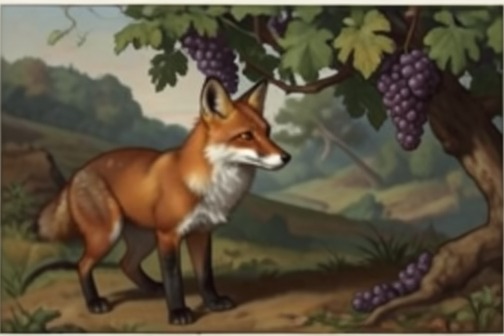
[The Fox Fails to Reach the Grapes](entity:event-recall-event-the-fox-fails-to-reach-659139495863) is the brief fable in which a famished [Fox](entity:creature-recall-creature-fox-ef8d6f85e3fc) fails to reach a cluster of ripe grapes and then dismisses them as sour. Its decisive turn is not the failed attempt itself but the Fox’s effort to disguise that failure: an inaccessible prize is recast as something she never wanted.
## The Attempt
A famished Fox sees clusters of ripe black grapes hanging from a trellised vine. Hunger gives the sight its immediate force, while the vine’s height makes the fruit desirable but out of reach. The Fox tries every trick she can think of to get to it, yet cannot reach the grapes; her effort wears her out without changing the result.
## The Reversal
After the unsuccessful attempts, the Fox turns away. She hides her disappointment by claiming that the grapes are sour and not ripe as she had thought. The explanation contradicts the story’s opening description of the fruit as ripe: the grapes have not changed, but the Fox’s account of them does. Her words offer a face-saving substitute for acknowledging that she could not get what she wanted.
## Meaning and Form
The fable makes its point through a compact reversal between appetite and dismissal. The Fox first treats the grapes as worth strenuous effort; only once they prove unreachable does she call them unappealing. The contrast makes her judgment look less like an assessment of the fruit than a way to protect herself from disappointment. The familiar expression “sour grapes” names this pattern: devaluing something after failing to obtain it.
Event 10
The Ants Refuse the Grasshopper Food

[The Ants Refuse the Grasshopper Food](entity:event-recall-event-the-ants-refuse-the-gra-6f2593c3b6d7) is a seasonal fable about preparation and its consequences: after spending the summer singing instead of storing food, the Grasshopper asks the Ants for help in winter and is turned away. The Ants’ own work supplies the contrast on which the tale’s lesson depends.
## Seasonal Contrast
On a fine winter’s day, the Ants are drying grain they collected during the summer. The Grasshopper, by contrast, passes them in a state of famine and earnestly asks for a little food. The scene sets stored provisions against immediate need, making the difference between the two parties visible before either explains it.
## The Appeal and Refusal
The Ants ask why the Grasshopper did not save food during the summer. He answers that he had not had enough leisure because he spent the days singing. The Ants reject his appeal in derision: because he sang through the summer, they tell him, he must go to bed without supper in winter. The exchange turns his explanation into the grounds for their refusal; the fable does not describe any later change in his circumstances or any reconciliation.
## Moral and Fable Form
The episode gives a compact example of the collection’s stated distinction between a fable and a tale: the brief animal narrative carries an instruction, here by placing the Grasshopper’s past choice beside the Ants’ present stores and his winter need. Its lesson is conveyed through the action and the Ants’ response rather than through a separately stated maxim at the end of this particular story.
The preface describes the fable as a short narrative that uses fictitious characters to represent human motives and guide conduct, with the lesson concealed beneath their animal forms. It also cautions that the collection varies in how closely the moral is connected to the story. This episode’s structure is especially direct: summer singing leads to a winter appeal, and the Ants’ refusal closes the action without a further turn.
## Place in the Collection
The preface explains that the collection includes material from different periods and sources, rather than consisting entirely of works composed by [Aesop](entity:character-recall-character-aesop-65dee389c9d4). It traces an early stage of transmission through oral narration, mentions Socrates versifying some fables he remembered, and says Demetrius Phalereus is credited with making the first collection around 300 B.C. Phaedrus later adapted many into Latin verse, while Aphthonius rendered some in Latin prose and used fables as exercises in rhetoric and grammar. This account provides a broader context for reading the Grasshopper episode as part of a transmitted fable tradition, without establishing a specific origin for this tale.
Event 11
The Fox Tricks the Crow into Dropping the Meat
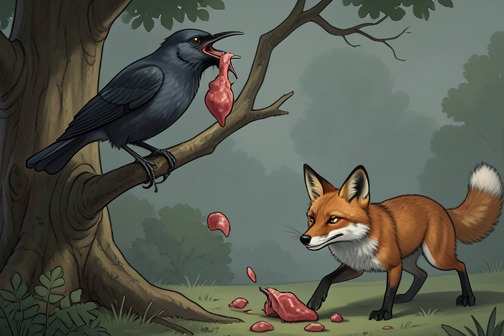
[The Fox Tricks the Crow into Dropping the Meat](entity:event-recall-event-the-fox-tricks-the-crow-5c73ca34d6f9) is a compact fable about calculated flattery and misplaced self-regard. A Crow’s effort to prove her voice worthy of the [Fox](entity:creature-recall-creature-fox-ef8d6f85e3fc)’s praise costs her the meat she has stolen; the Fox’s closing rebuke makes the theft an example of wit used to expose another’s lack of judgment.
## The Theft and the Flattery
A Crow steals a bit of meat and settles in a tree, holding it in her beak. A Fox sees her and wants the food. Rather than try to seize it directly, he addresses the Crow with praise: he admires her shape and complexion, then suggests that a voice to match her appearance would make her the Queen of Birds.
The compliment contains a challenge. The Fox’s praise appears to recognize the Crow’s beauty, but its condition invites her to demonstrate the very quality he claims is in doubt. Wanting to refute the implication about her voice, she caws aloud. The meat falls from her beak, and the Fox quickly picks it up.
## Reversal and Moral
The Crow’s attempt to answer the Fox’s insinuation produces the result he sought: she loses her food, while he obtains it. The exchange turns speech into a practical instrument of deception. The Fox’s words do not merely describe the Crow; they prompt her to act, and that action brings about the theft.
After taking the meat, the Fox tells her that her voice is adequate but her wit is lacking. The rebuke names the judgment the Crow failed to exercise, while also underlining the Fox’s success in using praise as a trap. The fable makes the consequence immediate: the Crow’s concern to answer an implied slight leaves her without the prize she had secured.
## Place in the Fable Tradition
The tale exemplifies the compact form described in the collection’s preface: a single, simple action leads directly to a moral inference. The Crow’s dropped meat supplies the consequence rather than requiring an extended explanation; the Fox’s stratagem makes the lesson visible through the plot itself. The preface specifically identifies the Crow’s loss as an admonition against flattery, observing that the force of the warning is already carried by the action.
The characters also draw on familiar animal traits. In the preface’s account of traditional fable characterization, the Fox is associated with cunning, and here his praise is a deliberate stratagem. The Crow, by contrast, is moved to answer the suggestion about her voice, and her response gives the Fox his opening. The fable uses these roles to stage a human vulnerability through animal characters, in keeping with the preface’s description of fables as instruction conveyed under the disguise of speaking animals.
Event 12
Aesop’s execution at Delphi
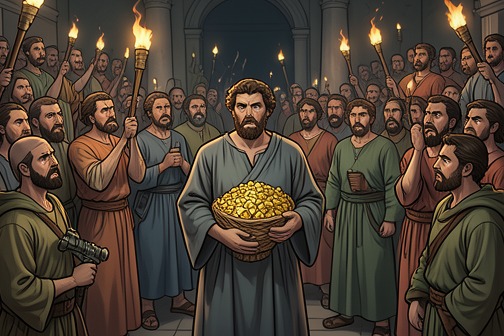
[Aesop’s execution at Delphi](entity:event-recall-event-aesop-s-execution-at-de-7a492608ba2b) was the fatal consequence of a diplomatic mission for [Croesus](entity:character-recall-character-croesus-fb453d61815f): after refusing to distribute a large sum of gold among the Delphians and returning it to his patron, [Aesop](entity:character-recall-character-aesop-65dee389c9d4) was accused of impiety and executed as a public criminal despite his sacred standing as an ambassador. The account makes the episode both a political death and a lasting warning that wrongdoing would not go unpunished.
## Mission and Refusal
Croesus sent Aesop to [Delphi](entity:location-recall-location-delphi-28bf56ecdaa4) with a large sum of gold to distribute among the citizens. The biography presents this as one of the delicate state commissions Aesop undertook for the Lydian king, following his rise from slavery to renown and service at court. His mission therefore placed him in Delphi not as a private traveler but as Croesus’s representative.
Aesop was provoked by what the account describes as the Delphians’ covetousness. Rather than divide the money among them, he refused and sent it back to Croesus. That decision reversed the expected purpose of the embassy: the gold remained undistributed, and the encounter became a confrontation between the envoy and the people to whom he had been sent.
## Accusation and Execution
The Delphians responded with anger, accusing Aesop of impiety. In the biography’s telling, the accusation led to his execution as a public criminal, notwithstanding his sacred character as an ambassador. The contrast is central to the episode: a representative carrying out a royal commission was treated not as protected envoy but as an offender by the citizens whose demands he had resisted.
The account identifies this embassy as the occasion of Aesop’s death. It does not describe a trial or explain the precise grounds of the charge beyond the accusation of impiety, so the reported sequence remains stark: refusal, anger, accusation, execution.
## Reparation and Reputation
Aesop’s death, the biography says, was not left unavenged. Delphi suffered a series of calamities until its citizens made public reparation for their crime. The account thus extends the consequences beyond the execution itself: the community’s misdeed is followed by collective suffering and an eventual public act of redress.
The phrase “[The blood of Aesop](entity:expression-recall-expression-the-blood-of-aesop-e6ae897d59ae)” became a well-known adage, expressing the belief that wrongful deeds would not pass unpunished. The story’s afterlife is also marked by public honor: the account notes that a statue was erected to Aesop at [Athens](entity:location-recall-location-athens-829baca0905a), made by the celebrated sculptor Lysippus. These consequences set the execution against its later remembrance—as an injustice answered by reparation, proverbial warning, and commemoration.
## Historical Account and Limits
The biography presents the circumstances of the Delphian mission among the few incidents it regards as generally established, while cautioning that Aesop’s life as a whole is obscure. It identifies the story as part of the reliable core recovered through study of ancient authors, rather than treating every later narrative about the fabulist as trustworthy.
That distinction matters because the same account rejects the much earlier life by Maximus Planudes, written in the early fourteenth century and prefixed to early editions of the fables. It condemns that version as filled with false, apocryphal, and anachronistic material. The execution narrative therefore appears within a biography that both preserves the Delphian episode as credible and explicitly warns readers against accepting the broader legendary tradition without scrutiny.
Event 13
Fall of Constantinople
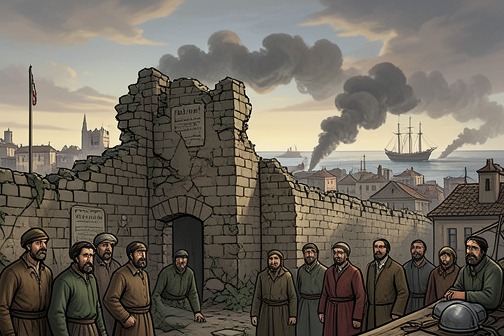
The [Fall of Constantinople](entity:event-recall-event-1453-d16952ee6f60) in 1453 is presented as one of the events that helped shift the recovery of [Aesop](entity:character-recall-character-aesop-65dee389c9d4)’s fables toward the West. The book connects the Eastern Empire’s calamities and the city’s fall with the rapid restoration of learning in [Italy](entity:location-recall-location-125be658b0d0), then traces how translation and printing brought the fables to a wider readership. The event’s significance here is literary and historical: it marks a change in the setting through which older writing returned to prominence, rather than serving as a narrated battle or a detailed account of the city’s capture.
## The Fall and the Western Revival
The account places the fall amid calamities that had gradually gathered around the Eastern Empire. Combined with other developments, the event helped promote a rapid revival of learning in Italy. The book does not describe the military course of the fall; it uses 1453 to frame a change in the intellectual and cultural circumstances through which Aesop’s fables gained renewed attention in Western Europe.
The fables are described as among the first writings from earlier antiquity to attract notice during this recovery. They took their place alongside Scripture and classical authors in the minds of leading students of the period. This juxtaposition makes their revival part of a broader return to older learning, rather than an isolated episode in the history of one collection.
## Translation and Print
The account identifies Lorenzo Valla as one of the prominent promoters of Italian learning and notes that he translated Aesop’s fables into Latin, alongside works by Homer, Herodotus, and Thucydides. His translation situates the fables within the scholarly activity associated with the revival, helping connect their renewed status to the wider work of recovering and translating classical literature.
Printing then extended their circulation. Between 1475 and 1480, Bonus Accursius printed the collection of fables compiled by Maximus Planudes. Within five years, William Caxton translated that collection into English and printed it at [Westminster Abbey](entity:location-recall-location-westminster-abbey-5dcef0841eb8) in [1485](entity:time-recall-time-1485-944faddca945). The sequence—from the fall in 1453, through Italian learning and Latin translation, to print editions—shows how the book makes the event a historical hinge in the fables’ passage into broader European readership.
## Limits of the Historical Claim
The event is invoked as part of a causal account of cultural change, not as proof that the fall alone restored interest in Aesop. The text explicitly combines the Eastern Empire’s troubles and [Constantinople](entity:location-recall-location-constantinople-a234f40d5eca)’s fall with other events in the revival of Italian learning. It therefore assigns the fall a contributing role within a larger process, while giving particular weight to the translators, scholars, and printers who carried the fables into new settings.
That history of transmission sits beside the book’s caution about the evidence for Aesop himself. The biographical account says that his birthplace is disputed among [Sardis](entity:location-recall-location-sardis-ae8908afc37c), [Samos](entity:location-recall-location-samos-79dda41c6b8d), [Mesembria](entity:location-recall-location-mesembria-bd8b3906f899), and [Cotiaeum](entity:location-recall-location-cotiaeum-bf5a1b82d233), and distinguishes a small number of incidents accepted by scholars from later, unreliable traditions. The long interval between Aesop’s reputed life and the fifteenth-century revival thus belongs to a history of preservation and mediation: the fables return to prominence through changing institutions and media, while claims about their ancient author remain subject to scrutiny.
## Fable as Political Counsel
The collection’s revival also matters in light of the book’s account of what fables do. Its preface defines the form as a short narrative that conveys instruction through fictitious characters, often animals, allowing counsel to reach readers without presenting the adviser’s superiority directly. The fable can entertain while directing sympathy toward honorable conduct and indignation toward wrongdoing; its disguise makes it a vehicle for moral and political instruction.
The biographical narrative supplies a political context for that function. At the court of [Croesus](entity:character-recall-character-croesus-fb453d61815f), Aesop is said to have met Solon, Thales, and other sages, and to have won the king’s approval in their discussions. In later missions to [Corinth](entity:location-recall-location-corinth-78dc2d581855) and [Athens](entity:location-recall-location-athens-829baca0905a), he used fables in attempts to reconcile inhabitants to the administrations of Periander and Pisistratus. The preface similarly suggests that some fables began as responses to particular wrongs or political circumstances, yet came to carry lessons of wider application. Against this background, the post-1453 return of the fables to circulation preserves not only old stories but a form of indirect counsel whose immediate occasions could fade while its political and moral force endured.
Event 14
卡克斯顿印行英文《伊索寓言》(1485年)
[Caxton’s 1485 printing of Aesop’s fables in English](entity:action-recall-action-caxton-s-1485-printing-f62c88d97a93) was a landmark in their passage from manuscript and earlier printed collections into vernacular print. Caxton translated the collection made by Maximus Planudes and issued it at his press in [Westminster Abbey](entity:location-recall-location-westminster-abbey-5dcef0841eb8), extending the fables’ reach while also transmitting a body of stories shaped by centuries of compilation and adaptation.
## Source and Preparation
The edition belonged to a textual tradition far older than the printing press. The preface describes the fables as first narrated by [Aesop](entity:character-recall-character-aesop-65dee389c9d4) and then passed down through oral tradition. Socrates was said to have put some into verse from memory while imprisoned; Demetrius Phalereus was credited with the first collection, and later writers including Phaedrus and Aphthonius adapted fables into Latin verse and prose. The tradition therefore reached Caxton not as a single, fixed authorial text, but through successive acts of recollection, collection, and rewriting.
A particularly important stage came in the early fourteenth century, when Maximus Planudes compiled about 150 fables. The preface treats his collection as the foundation for early printed editions, while acknowledging uncertainty about its contents and sources: Planudes may have included a few invented or then-current tales, yet internal evidence was said to show that he knew genuine Aesopian material, probably in versions already altered by earlier translators and rhetorical exercises. Caxton’s English edition carried this complex inherited collection into a new language and format.
## Printing and English Circulation
Before Caxton’s edition, Bonus Accursius had printed the Planudes collection in [Italy](entity:location-recall-location-125be658b0d0) around 1475–1480. Within five years, Caxton translated that collection into English and printed it at Westminster Abbey in [1485](entity:time-recall-time-1485-944faddca945). The sequence links an Italian printed edition to an English translation and publication, making the press a crucial means by which this material could circulate beyond the settings of oral telling and manuscript copying.
The collection’s contents also bore marks of later additions and changing literary contexts. The preface notes that stories drawn from popular preaching and jest literature had entered the fable tradition; it identifies the tales of the Miller, his Son, and the Ass, and the [Fox](entity:creature-recall-creature-fox-ef8d6f85e3fc) and the Woodcutter, as drawn from Poggio Bracciolini’s *Liber Facetiarum*, published in [1471](entity:time-recall-time-1471-98c9f737f6ba). The Planudes collection Caxton translated thus represented a layered corpus rather than an untouched record of Aesop’s own compositions.
## Place in the Fables’ Reception
Caxton’s edition was one episode in a broader revival of interest in Aesop’s fables in western Europe. The preface connects that revival with the restoration of learning in Italy and notes that Lorenzo Valla translated the fables into Latin. It also describes their growing popularity in [Germany](entity:location-recall-location-a3c24dd56e42), where figures associated with the Reformation used them as vehicles for satire and protest against abuses by Roman ecclesiastics. These later developments show how the fables could move between languages and political settings while retaining their usefulness as compact vehicles of instruction.
The 1485 printing belongs to the history of transmission rather than proving that every tale in the collection originated with Aesop. The preface explicitly distinguishes Aesop’s foundational role from the mixed origins of the surviving corpus: some fables predated him, others arose later, and many were not his immediate work. Caxton’s achievement, as presented in this account, was to translate and print the Planudes collection in English, helping secure the fables a durable place in the literary circulation of the English-speaking world.
Event 15
《伊索寓言集》(1610年)出版
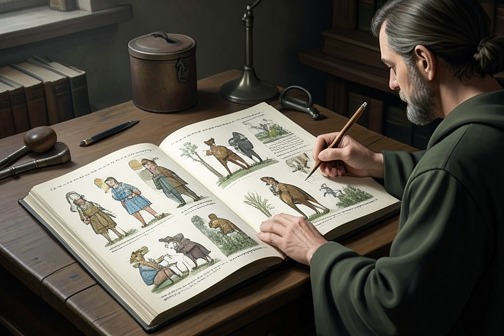
The [1610](entity:time-recall-time-1610-e05a2413205a) publication of Isaac Nicholas Nevelet’s Mythologia Aesopica was a major turning point in the early modern reception of Aesopian fables: its expansive gathering of texts made it, in the preface’s account, the most complete collection yet published and a foundation for the tradition’s renewed and lasting fame. Rather than representing a single author’s work, the volume presented fables transmitted, adapted, and collected across centuries.
## A Collection Built from Earlier Traditions
Nevelet’s book appeared as the third printed edition of the fables. It retained the collection associated with Maximus Planudes, which had been reprinted in earlier editions, but substantially enlarged that base. Its contents included 136 fables from [Vatican Library](entity:location-recall-location-7d9a6727d9ec) manuscripts that had never before been published, 40 fables attributed to Aphthonius, and 43 from Babrias. Latin versions by Phaedrus, Avienus, and other writers further set the material within a history of retelling across languages and forms.
The book’s scale and arrangement mattered because the fables had not passed down as a stable, single-authored text. The preface traces their early existence as stories narrated by [Aesop](entity:character-recall-character-aesop-65dee389c9d4) and preserved through oral tradition; it then describes later acts of versification, collection, translation, and scholarly compilation. Socrates is said to have turned some fables he remembered into verse, while Demetrius Phalereus was credited with an early collection. Phaedrus adapted many into Latin iambics, and Aphthonius rendered some into Latin prose. Nevelet’s volume brought together materials associated with these different stages without making their histories identical.
## From Scholarly Compilation to Literary Revival
The preface calls Mythologia Aesopica a complete Corpus Fabularum Aesopicarum and presents Nevelet’s work as the culmination of a long revival. Its importance lay not only in the number of stories it gathered but also in its synthesis of printed collections, manuscript discoveries, and earlier Latin versions. The book gave readers a broad corpus through which to encounter fables attributed to Aesop and to other transmitters of the tradition.
The preface credits the collection with restoring Aesop to universal favor as a moral teacher. It also reports that, in the three centuries following its publication, the fables achieved an exceptionally wide circulation, were translated into many European and Eastern languages, and became familiar in everyday conversation across countries and religious communities. These claims make the 1610 volume a key point in the account’s history of reception: it is presented not merely as another edition, but as a work that helped carry the fables from learned collections into widely shared literary culture.
## Babrias and the Question of Authorship
Nevelet’s preface also gave lasting importance to the question of Babrias. It reports that he proposed Babrias might prove to be the actual author of the existing form of the Aesopian fables, a suggestion that prompted later inquiry into the relationship between Aesop’s name and the texts transmitted under it. The identification remained a question of literary history, not a settled claim that Nevelet’s book itself could conclusively resolve.
The later account of Babrias’s manuscript underscores the layered nature of the tradition Nevelet assembled. In [1844](entity:time-recall-time-1844-0fe9e6217c5a), Menoides found a manuscript at the convent of St. Laura on Mount Athos, containing a choliambic version divided into two books of 125 and 95 fables. Its discovery was described as confirming earlier critical conjectures and bringing valuable material to light. The preface identifies the recovered Babrias text as an important witness to the antiquity and authenticity of much [Aesopian fable](entity:concept-recall-concept-aesopian-fable-6f64e3353c0c), while distinguishing this later manuscript discovery from Nevelet’s earlier printed collection.
## The Collection’s Place in the Book’s Transmission History
The translation’s source list identifies editions of Babrias prepared by George Cornewall Lewis, including a [1846](entity:time-recall-time-1846-f07be3a3ed36) publication and a [1857](entity:time-recall-time-1857-059d07fabf42) edition of the second part from manuscript. It also names a 1810 edition of fables as transmitted before Planudes and an 1822 edition of Phaedrus. These later works make clear that the book’s account of the tradition is not a simple line of descent from one author to one text: it depends on collections, manuscript witnesses, adaptations, and editorial decisions made at different times.
The publication of Mythologia Aesopica thus occupies two related roles in the preface. It is a substantial seventeenth-century compilation in its own right, bringing together materials from distinct sources, and it is the decisive landmark through which the book narrates the restoration of Aesopian fables to broad literary circulation. Its significance rests on that combination: preservation of a diverse textual inheritance and renewed public life for stories whose forms and authorship had long remained in motion.
Event 16
巴布里乌斯寓言抄本的发现(1844年)

The discovery of the Babrius manuscript in [1844](entity:time-recall-time-1844-0fe9e6217c5a) brought a long-suspected ancient collection into view and strengthened the historical basis for the Aesopian fables. Found by Menoides at the convent of St. Laura on Mount Athos during a commissioned search for ancient manuscripts, the codex comprised two books containing 125 and 95 fables. Its recovery confirmed a chain of scholarly conjecture and supplied an important source for the study of the fables’ antiquity and transmission.
## Background to the Discovery
The manuscript answered questions raised by the complicated history of the fable collection. The fables were first narrated by [Aesop](entity:character-recall-character-aesop-65dee389c9d4) and passed through oral tradition; Socrates was said to have versified some he remembered, and Demetrius Phalereus was credited with making an early collection. Later transmitters and adapters included Phaedrus, who recast many fables in Latin iambics, and Aphthonius, who rendered some in Latin prose. The surviving collection therefore represented a layered tradition rather than the unaltered work of one author.
Centuries later, Maximus Planudes assembled about 150 fables, and his collection became the foundation of early printed versions. Its authorship and sources were disputed: critics argued that references to monks and Christian scripture made the texts later than Aesop, while the possibility that Planudes had drawn on Babrius remained under investigation. Some scholars accused Planudes of turning Babrius’s verse into prose; others went so far as to deny that he had encountered Aesop’s fables. The preface presents the evidence as falling between these extremes, maintaining that Planudes knew genuine fable material, even if his versions were likely affected by later translations and scholarly exercises.
## The Manuscript’s Recovery
The discovery followed a sustained scholarly debate about Babrius. In the late seventeenth century, Dr. Bentley argued that many existing fable versions could be restored, with changes, to the choliambic meter associated with Babrius, and advanced the expansive claim that Babrius was their exclusive author. His position provoked opposition, including a learned exchange with Charles Boyle. In [1776](entity:time-recall-time-1776-4a1bbb92315a), Thomas Tyrwhitt renewed the case by publishing a dissertation on Babrius and fables in choliambic meter from a manuscript in the [Bodleian Library](entity:organization-recall-organization-bodleian-library-fab4417d242a); Francesco de Furia also supplied evidence by printing previously unpublished fables from a Vatican manuscript.
In 1844, Menoides, acting on a commission arranged at the suggestion of M. Villemain, Minister of Public Instruction to King Louis Philippe, found the sought-after manuscript at the convent of St. Laura on Mount Athos. The codex contained two books: one with 125 fables and the other with 95. Its choliambic version of Babrius turned a long-standing scholarly expectation into material evidence, though the preface describes the discovery as confirming the critics’ conjectures rather than proving that Babrius alone composed every fable in the broader tradition.
## Publication and Consequences
The recovered fables were soon published. Sir George Cornewall Lewis served as editor, and the Reverend James Davies as translator. The account identifies this publication as a significant contribution to restoring the collection after centuries of obscurity and calls Babrius the earliest and most reliable collector of genuine Aesopian fables. That assessment concerns Babrius’s importance as a collector and transmitter; it does not erase the diverse origins and later reshaping of the fable corpus.
The manuscript also belongs to a wider history of collecting and print. Isaac Nicholas Nevelet’s [1610](entity:time-recall-time-1610-e05a2413205a) *Mythologia Aesopica* had assembled Planudes’s fables alongside 136 previously unpublished pieces from Vatican manuscripts, 40 attributed to Aphthonius, 43 from Babrius, and Latin versions by Phaedrus, Avienus, and others. The 1844 discovery thus extended a printed collection that had already brought disparate witnesses together, while making a substantial Babrian text newly available for publication and study.
## Significance for Aesopian Transmission
The find sharpened the distinction between Aesop as the traditional name attached to the fables and the writers and collectors who shaped the surviving texts. The preface traces a passage from oral narration through verse adaptation, prose rendering, manuscript compilation, and print. Its account stresses that the collection contains material from before and after Aesop’s lifetime, even while Aesop’s influence and the shared form of the stories helped establish him as the founder of Greek fable.
The discovery therefore mattered not simply as the recovery of an old book, but as new evidence in a history of attribution. It gave scholars access to a substantial choliambic collection associated with Babrius and helped substantiate the antiquity and authenticity of much [Aesopian fable](entity:concept-recall-concept-aesopian-fable-6f64e3353c0c) material. At the same time, the longer transmission history cautions against treating the surviving corpus as a single, fixed authorial text: its familiar identity emerged through repeated acts of narration, adaptation, collection, and editorial recovery.