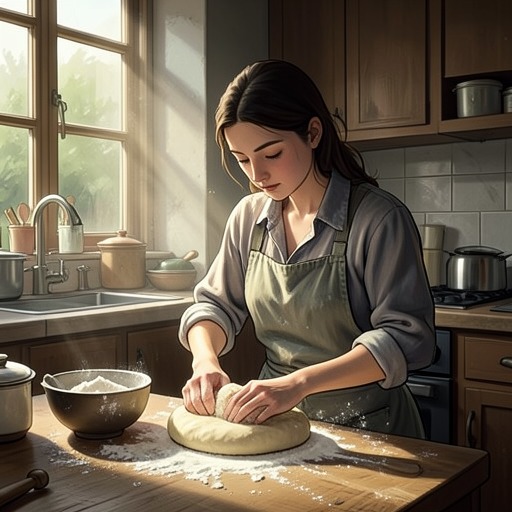
Lala Jane's Chocolate Cookies and Recipe
Always and Forever, Lara JeanLara Jean’s chocolate chip cookies and recipe are both a baking project and a small domestic archive: Lara Jean tries to engineer an ideal cookie, shares imperfect batches with the people around her, and gradually finds meaning in the acts of baking and eating that no perfected recipe can supply. The cookies link her precision to Peter’s and Kitty’s contrasting tastes, mark ordinary moments she expects to remember, and give her a concrete standard against which even New York’s famous bakeries can be judged.
The Search for a Perfect Recipe
For several weeks, Lara Jean works toward a cookie that reconciles Kitty’s preference for a flat, lacy texture with Peter’s liking for a chewy one. Her own ideal is a compromise: crunchy yet soft, light brown rather than pale, and slightly tall without becoming puffy. The recipe is not simply a matter of choosing chocolate or sugar; she wants several opposing qualities to coexist in one cookie.
Her experiments are systematic. She reads baking blogs and compares white sugar with brown-and-white mixtures, baking soda with baking powder, vanilla bean with extract, and chocolate chips with chunks or chopped bars. She tests different ways to shape and chill dough, freezing it in balls or a log, flattening cookies with a glass, and alternating between scooping before freezing and scooping afterward. Despite all that iteration, the cookies continue to rise more than she wants.
A batch made with substantially less baking soda is still vaguely puffy. Lara Jean is ready to reject it as imperfect, but refuses to waste the ingredients. Instead, she redirects the cookies to Kitty’s teacher as an apology for Kitty talking during silent reading. This practical solution also reflects a recurring problem: Lara Jean has already given cookies to the mailman, Kitty’s bus driver, and the nurses’ station at her father’s hospital, and is running out of people to receive them.
Kitty asks what Lara Jean will do when she finally works out the recipe, while Peter questions the value of making a chocolate chip cookie eight percent better. Lara Jean’s answer gives the project a longer horizon than immediate taste: she wants the satisfaction of possessing the perfect recipe and plans to pass it down to the next generation of Song girls. When Kitty points out that boys might inherit it too, Lara Jean agrees. The recipe’s imagined future is thus both familial and open-ended, less a private formula than something to be handed on.
Cookies as a Shared Ritual
The cookies move easily between kitchen, school, and family table. At school, Peter reaches for a brownie before Lara Jean reminds him that she has brought cookies; he is excited and takes one from her container. He would rather keep them to themselves, but their friends spot the pair. Gabe praises the cookies enthusiastically, while Lara Jean insists that they are good but not amazing or perfect, and breaks off part of Peter’s cookie to make the point that they taste better fresh from the oven.
That insistence contrasts with the pleasure the cookies already provide. Gabe asks Lara Jean to bake for him at home so he can taste them warm, and Peter playfully objects when Gabe keeps eating his girlfriend’s cookies. A year into their relationship, hearing Peter call her his girlfriend still gives Lara Jean a thrill. The cookie is part of the social scene, but Peter’s possessive joke makes it a small token of their intimacy, too.
Lara Jean imagines that, when she is as old as Stormy, she will remember an ordinary school moment: Peter bent over a chocolate chip cookie, sunlight coming through the cafeteria window and catching his brown hair, and his glance in her direction. The memory she anticipates is not of the recipe finally becoming flawless. It is of a cookie being eaten beside someone she loves, in a particular patch of light. That contrast makes the cookies a vehicle for preserving the everyday rather than just an object of technical ambition.
They also become part of family routine. Lara Jean brings them out with ice cream after dinner, and her father remarks on how much she has been baking, wondering whether the wait for college acceptance letters is stressing her. She denies that explanation and says she is only trying to perfect the recipe. Her father and Trina exchange a meaningful look, suggesting they read the baking differently, while Lara Jean holds to the practical account she has given them. The cookies sit at the intersection of ordinary dessert and a period of uncertainty she does not want to name as their cause.
Baking Through Waiting and Uncertainty
Baking recurs when Lara Jean cannot sleep. After reviewing her college application prospects—including her activities, SAT score, AP history result, and essay about her mother and sisters—she gets out of bed and measures ingredients for cookies. The scene places recipe work beside the uncertainty of waiting for an admissions decision: she can control measurements and mixtures even as the outcome she is thinking about remains outside her control.
The same pattern returns after a six-hour trip back to Virginia. Having slept for much of the ride, Lara Jean unpacks, finishes homework, talks to Peter on the phone, and goes to bed, but cannot settle. She slips downstairs and opens drawers, asking herself what can be baked without waiting for butter to soften. The question is specific to her household: Trina leaves butter out in a dish, but Lara Jean describes her family as keeping butter in the refrigerator. She also worries that overly soft butter changes the chemistry, especially in Virginia’s spring and summer warmth, when it melts quickly.
Instead of choosing cookies on that particular night, she considers cinnamon-roll brownies made from Katharine Hepburn’s brownie recipe, with cinnamon and a cream-cheese swirl, and begins melting chocolate in a double boiler. The episode matters to the cookie project because it shows that baking is broader than the one recipe she is trying to perfect. When sleep fails, she turns to measuring and making; the form of the activity gives her something tangible to do, whether she is pursuing the ideal chocolate chip cookie or beginning another dessert.
The New York Benchmark
On the school trip to New York, Lara Jean hopes to test her ideas against the city’s celebrated baked goods. As she falls asleep with her head on Peter’s shoulder, she mentions wanting to visit Levain Bakery and Jacques Torres’s chocolate shop, describing the latter’s chocolate chip cookie as definitive and legendary. Peter has been listening closely enough to turn that wish into an unexpected stop the next day.
In Central Park, Peter disappears from the group shortly before it is due to move on. He returns with a brown paper bag and a still-warm Levain chocolate chip cookie. Lara Jean is delighted by the gesture and hugs him, then makes sure Chris recognizes how thoughtful he has been. The cookie is a tasting opportunity, but it is also evidence of Peter’s attentiveness: he has remembered the details of her baking interests and gone to find the thing she wanted to try.
The Levain cookie is dense, doughy, and heavy, more like a scone than Lara Jean expected. When Peter asks for her verdict, she calls it unique and in a class of its own. The description neither dismisses it nor declares it the perfect cookie she has been seeking; its distinctiveness becomes its own category. The experience also gives her a chance to compare the famous bakery’s product with the qualities she has been pursuing at home.
Later, Lara Jean and Peter slip away to Jacques Torres’s shop while the rest of the group waits for ice cream. Lara Jean is so excited that she is shaking when she finally tastes the famous cookie. It is flat, chewy, and dense, with chocolate pooled on top and hardened and a flavor she reads as almost caramelized. The cookie offers a striking alternative to her own target: its flatness and chewiness recall some of the qualities she values, but its density and concentrated chocolate make it a singular benchmark rather than a recipe she can simply reproduce.
Peter says that Lara Jean’s cookies are better, but she recognizes that he is lying to make her feel good. She wonders whether the industrial ovens explain why hers do not taste like the bakery’s, then concludes that she may have to accept a not-quite-perfect homemade cookie and be content with good enough. This is a genuine adjustment in the terms of the project. The aspiration remains, but the tasting does not end with a claim that she has surpassed the famous version; it ends with acceptance of a limit.
Memory, Imperfection, and Inheritance
Across the book’s recurring scenes, the cookie’s meaning shifts without losing its material specificity. It is a precisely measured recipe, a batch that can still be given away when it falls short, a warm treat Peter seeks out for Lara Jean, and a taste associated with a sunlit cafeteria memory. The repeated distinction between good and perfect sustains a tension: Lara Jean’s exacting standards drive her experiments, yet her most cherished cookie moments arise from sharing, surprise, and recollection rather than from technical completion.
The recipe’s proposed inheritance makes that tension explicit. Lara Jean imagines passing it to future generations, first naming the Song girls and then accepting Kitty’s correction that boys may inherit it too. The formulation remains hers, but its value lies partly in its capacity to travel through a family and be adapted by others. The story does not show the recipe finally perfected; instead, Lara Jean’s New York comparison leads her toward a more livable conclusion, in which a cookie can be worthwhile without matching an ideal.
That balance is captured by the everyday detail she expects to carry into old age: Peter eating one of her cookies, the light on his hair, and the look he gives her. The recipe aims to preserve a taste; the scenes preserve time spent together. Its lasting significance therefore rests not only in the quest for a better cookie, but in how baking repeatedly brings people into the same room, gives affection a practical form, and turns imperfect results into memories worth keeping.